Delhi High Court rules visa overstay bail cannot mean detention centre stay
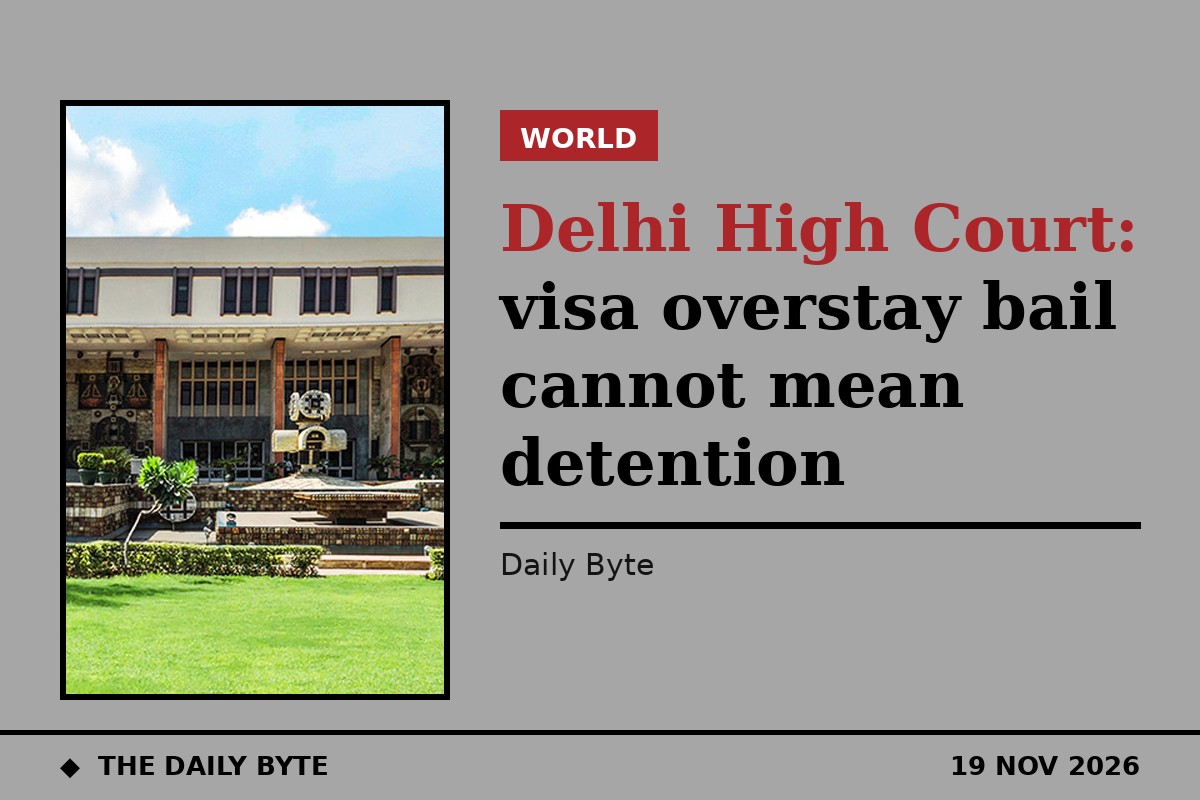
The Delhi High Court has ruled that foreign nationals accused of overstaying their visas in India cannot be ordered to remain in a detention centre as a condition of being granted bail. A division bench held on 18 November 2026 that such a condition would frustrate the very purpose of releasing an accused person on bail.
The bench, comprising Justice Navin Chawla and Justice Arun Bhardwaj, said that simply being a foreign national cannot be a reason to curtail a person's right to bail, and that visa overstay cases should not be treated differently from other criminal cases when bail is considered.
The case behind the ruling
The court was answering a criminal reference from a Metropolitan Magistrate at Saket Courts in Delhi. The reference arose from the bail application of a Nigerian national who had entered India in 2016 on a tourist visa valid for three months but continued to stay after it expired. He was prosecuted under Section 14 of the Foreigners Act, 1946.
The magistrate had asked the High Court three questions: whether granting unconditional bail to a foreign national accused of overstaying would effectively legalise his continued stay in India; whether such cases should be treated differently from other criminal cases; and whether detention in a detention centre could be imposed as a bail condition.
What the court decided
On the first question, the court said granting bail does not, by itself, legalise a foreign national's continued stay in India or operate as a substitute for a valid visa. A criminal court deciding bail looks at the alleged past offence, while regulating a foreign national's future presence in India is a separate matter for the central government.
On the second question, the court answered in the negative, holding that cases involving foreign nationals accused of visa overstay should not be treated differently from other criminal cases.
On the third question, the court held that a criminal court cannot require a foreign national to remain in a detention centre throughout the trial as a condition of bail. It said such a direction would frustrate the very order of bail and therefore cannot be imposed. The power to restrict or detain a foreign national under the immigration framework rests with the competent executive authorities and is independent of the court's power to grant bail.
Reasonable conditions can still apply
The ruling does not prevent courts from imposing conditions on bail. The bench said reasonable conditions may be set depending on the gravity of the offence and the likelihood of the accused evading trial, including requiring the person to live at a specified place, restricting movement to a specified area, and requiring periodic reporting to designated authorities.
The court noted that foreign nationals are entitled to protection under Article 21 of the Constitution of India, which guarantees the right to life and personal liberty. It referred to the Supreme Court's judgment in Union of India v. Chidiebere Kingsley Nawchara & Ors., which held that the state may regulate, restrict and expel foreign nationals, but that foreign citizenship alone cannot justify curtailing the right to bail.
The bench also took account of the changed legal framework: the Immigration and Foreigners Act, 2025 repealed the Foreigners Act, 1946, and a Ministry of Home Affairs standard operating procedure dated 10 December 2025 deals with visa applications of foreign nationals involved in criminal cases who have been granted bail and whose presence is required in India for court proceedings.
The ruling clarifies bail procedure in visa overstay cases. It does not change India's visa rules, and anyone affected should check the current official guidance rather than treating the judgment as immigration advice.
Sources: Live Law and Karnataka Legal.
Frequently asked questions
Can a foreign national accused of visa overstay be kept in a detention centre while on bail?
No. The Delhi High Court held that a criminal court cannot impose detention-centre residence as a bail condition, as that would defeat the purpose of bail.
Does being granted bail legalise an overstay?
No. The court said bail does not legalise continued stay in India and is not a substitute for a valid visa.
Can courts still impose conditions on bail?
Yes. Courts may require the accused to live at a specified place, restrict movement and require periodic reporting to authorities.


