Midterm Wins May Reshape Trump Latin America Policy
By The Daily Byte
·11 Nov 2026
·4 min read
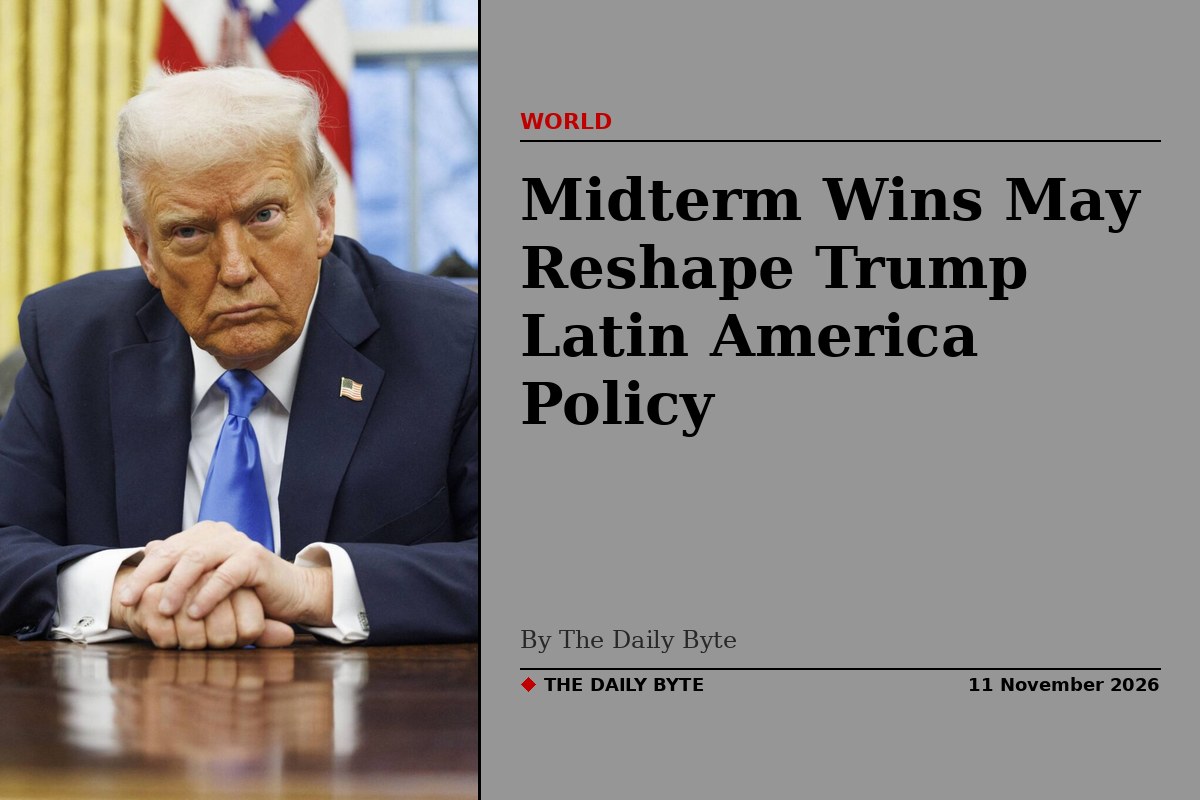
The Democrats’ sweeping wins in the US midterm elections could change how President Donald Trump’s administration deals with Latin America in its final two years, analysts say — even though the first signals from the White House have pointed in opposite directions.
Democrats won control of both chambers of Congress, ushering in divided government for the remainder of Trump’s term. That gives them control of the committees that can hold hearings, demand documents and shape spending. Analysts are now trying to read what that means for a region where Trump’s impact has already been enormous, from immigration and deportations to boat strikes and the capture of Venezuelan leader Nicolás Maduro, [the Associated Press reported](https://www.kcau9.com/news/politics/ap-analysts-weigh-how-democrats-midterm-wins-could-shift-trumps-latin-america-policy/).
## Migration: deportations continue, for now
Trump has sent mixed messages since the vote. In a “60 Minutes” interview that aired on 8 November, he said his immigration crackdown may have been “too tough” and suggested it was time to sit down with Democrats. Hours later, he named Stephen Miller, the main architect of his immigration agenda, as his new chief of staff.
The first postelection message from Homeland Security Secretary Markwayne Mullin was unequivocal: “Deportations will continue.” Immigration arrests have gone on unabated since the election, with officers reported operating from California to Michigan to Massachusetts.
But limits are appearing at local level. Houston and Austin have announced plans to restrict police cooperation with US Immigration and Customs Enforcement, a trend that could spread once Governor-elect Gina Hinojosa, a vocal critic of ICE, takes office in January 2027.
## Security: more pressure on cartels
Mexico could see the sharpest increase in pressure, analysts say, because it offers Washington the best chance of quick, visible results — more arrests and extraditions — while the Justice Department continues to investigate the cartels. Mexican analyst David Saucedo said joint US-Mexico operations against the cartels were expected to continue.
Further south, the US military is expected to keep working with Latin American partners under the “Shield of the Americas” initiative against criminal gangs, an approach that does not require large new funding from Congress.
The boat strikes in the Caribbean and the Pacific, which have killed at least 240 people, are likely to face much closer scrutiny. Democrats have already called for an investigation into whether the strikes were lawful, and a Democratic-controlled Congress will have the power to demand answers.
## Venezuela and Cuba in the spotlight
Venezuela stands out as a top Latin American priority for the Democrats, because it touches on a concern that matters to voters: corruption. There are already specific calls from Democratic lawmakers to investigate who has benefited from oil agreements signed between the Trump administration and Caracas.
Christopher Sabatini, of the London-based think tank Chatham House, expects Democrats in Congress to pursue hearings on the oil deals and to press for elections to be held in Venezuela. The Atlantic Council’s Jason Marczak made a similar point, writing that Venezuela’s oil deals and military operations would come under scrutiny, including who benefits, how revenues are managed and the legal authority for the arrangements, [the Atlantic Council said](https://www.atlanticcouncil.org/dispatches/experts-react-democrats-just-swept-the-us-midterms-heres-what-it-means-for-the-world/).
Pressure on Cuba is not expected to ease. Two days after the election, Secretary of State Marco Rubio announced further sanctions against the island. José Briceño, a professor at the Mexican Center for Research on Latin America and the Caribbean, considered a military operation against Cuba unlikely, given the complexity and risks involved — but, as the AP noted, no one wants to rule it out.
## Trade and the wider region
On the economy, analysts see limited room for change. Tariffs were deeply unpopular with voters, according to exit polls, but Mariana Aparicio, an expert in international political economy at the National Autonomous University of Mexico, predicted Trump would keep using them as a tool for political leverage. Mexican Economy Secretary Marcelo Ebrard said tariffs were unlikely to change significantly, although he suggested the new Congress could make adjustments to the North American trade agreement.
Brazil will stand as the main counterweight to Washington, analysts say, after Luiz Inácio Lula da Silva’s re-election checked the region’s shift to the right and denied Trump a powerful ally. Mexican President Claudia Sheinbaum, who also leans to the left, has been less outspoken and has walked a fine line with the Trump administration.
## What to watch
The new Congress takes control in January, and the first test will be whether Democrats use hearings and spending power to force changes, or whether Trump leans harder on executive authority to keep his Latin America policy on course. On immigration, the cartels, Venezuela and Cuba, the direction of travel is now contested — and the region will be watching which side of the White House’s mixed messages wins out.
Source
Associated Press via KCAU 9 — https://www.kcau9.com/news/politics/ap-analysts-weigh-how-democrats-midterm-wins-could-shift-trumps-latin-america-policy/ 

