Denmark Greenland Deal Ratified 109-0 in Parliament
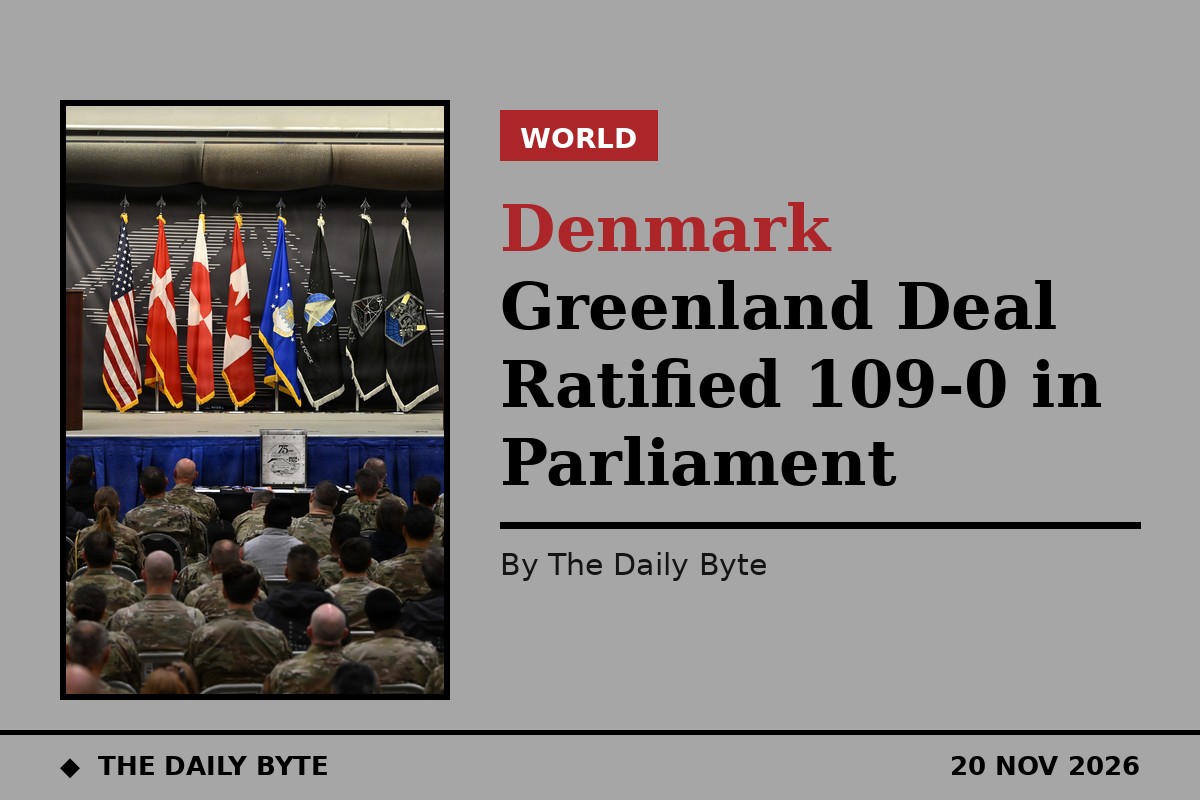
Denmark's parliament has voted unanimously to ratify a landmark security agreement between the United States, Denmark and Greenland, closing the final chapter of a year-long Arctic standoff and clearing the way for an expanded American military presence on the island.
The Folketing approved the deal by 109 votes to none on Thursday, with every deputy present backing the text after a second reading held without debate or opposition. The vote completes the parliamentary process: Greenland's own parliament, the Inatsisartut, approved the agreement earlier this month by 16 votes to none, with seven abstentions.
What the deal allows
Signed in New York on 22 September by US President Donald Trump, Danish Prime Minister Mette Frederiksen and Greenlandic Prime Minister Jens-Frederik Nielsen, the agreement updates a 1951 accord governing the American military presence in Greenland. It allows the United States to modernise and expand operations at Pituffik Space Base in the far north-west, and to establish two new defence areas at Narsarsuaq in the south and Mestersvig in the north-east. It also opens the door to deploying Washington's proposed Golden Dome missile defence system on the island.
The agreement carries no expiry date and would remain binding even if Greenland one day becomes independent. It also blocks countries outside the EU and Nato from strategic sectors in Greenland, a provision aimed at stopping China or Russia from gaining influence on the island, particularly through investment.
A deal born of tension
The agreement was negotiated after months of strain. Since returning to the presidency in January 2025, Mr Trump has repeatedly insisted that the United States needs to control Greenland for strategic reasons, alarming Copenhagen and Nuuk and rattling Nato allies. The September deal was designed to answer Washington's security concerns without changing the island's political status.
Ms Frederiksen hailed the ratification as a great day on social media, saying the agreement was good for Greenland, the Kingdom of Denmark and the United States, and for Nato and Europe. She stressed it was an agreement that respects the Kingdom's sovereignty, its territorial integrity and the Greenlanders' right to self-determination.
US Secretary of State Marco Rubio said the ratification will make us all safer, stronger, and more secure, adding that the agreement modernises the United States-Denmark-Greenland defence partnership and bolsters the national security of the United States and its allies in Nato. The US ambassador to Denmark, Kenneth Howery, welcomed the strong support in the Danish parliament.
What happens next
The agreement enters into force once Denmark formally notifies Washington, through a diplomatic note, that its parliamentary procedures are complete. But ratification is not the last word: the specific terms governing the two new defence areas at Narsarsuaq and Mestersvig have yet to be negotiated, and parliamentary approval alone does not authorise construction to begin.
For Greenland's 57,000 people, the deal settles the immediate question of the island's status while leaving its longer-term future open. The agreement's independence clause means the defence arrangements would survive any future vote for full independence, a point both Copenhagen and Nuuk were keen to lock in.
The unanimous vote also closes a diplomatic episode that had strained one of the transatlantic alliance's oldest relationships for most of 2026. Whether the expanded American presence brings the stability its supporters promise will now depend on the negotiations still to come over the new bases.


