Denmark Top Court Backs 'Ghetto Law' Evictions
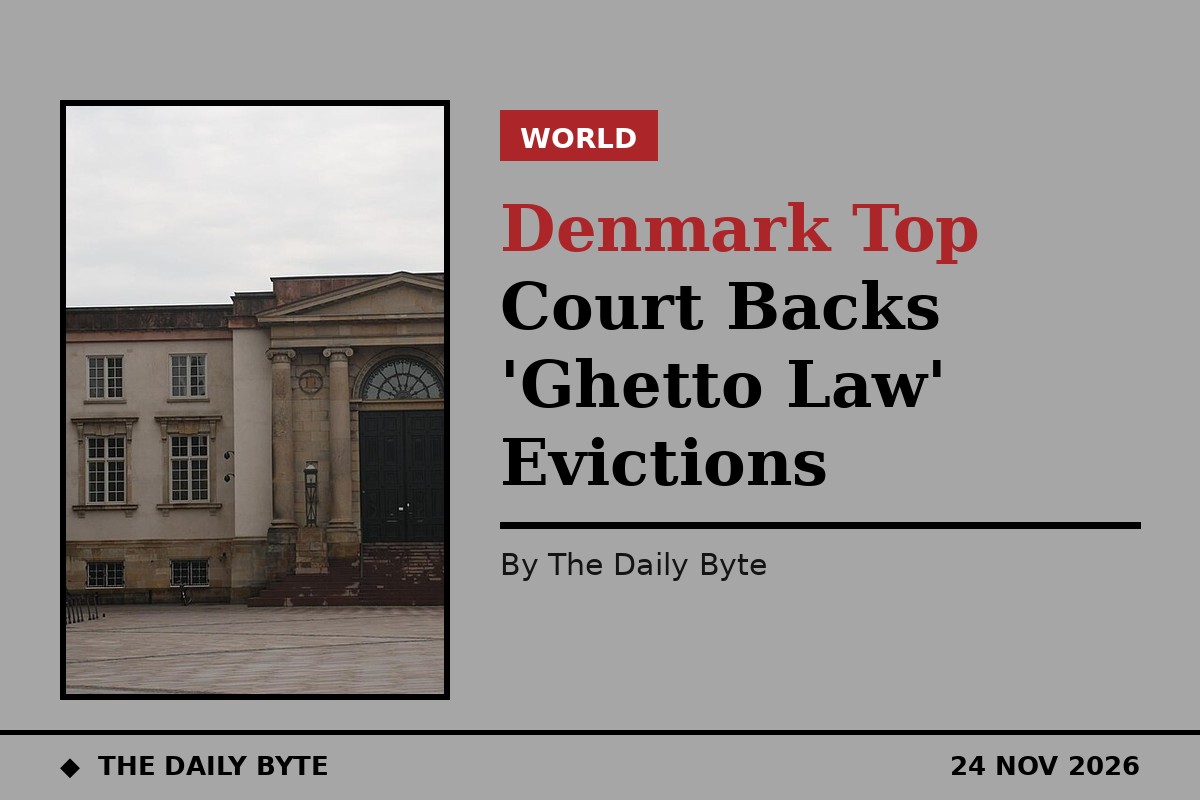
Denmark's Supreme Court ruled on Monday that a housing association did not discriminate on ethnic grounds when it ended 91 leases in a neighbourhood in Helsingor, in a decision that upholds one of the country's toughest immigration measures.
The case concerned the Nojsomhed housing estate in Helsingor, north of Copenhagen, where residents of 91 rented homes were told to move so the area would not be classed as a so-called hard ghetto. Seven of the evicted tenants challenged the terminations, arguing that they had been discriminated against because of their ethnic origin.
The Supreme Court upheld a 2022 lower-court ruling against the tenants. It found that the law's criterion of immigrants and descendants from non-Western countries is neutral and is not a measure of ethnic origin. The judges said that applying the criterion divides people into two groups, immigrants and descendants from non-Western countries and everyone else, and that both groups include people of a very large majority of different ethnic origins, with people of the same ethnic origin appearing in both groups.
The court also said there had been no information about the ethnic background of the residents who were evicted, and it found no evidence that particular ethnic groups had been put at a disadvantage. It said that even if the housing association had aimed to cut the share of non-Western immigrants and descendants in Nojsomhed to 50 percent or below, that would not be direct discrimination, because the criterion itself is lawful.
The 2018 law and the European court
Denmark's so-called ghetto law, adopted in 2018, allows residents to be moved out of minority-heavy areas in what the government has described as a bid to promote integration. An area can be listed if more than half of its residents have a non-Western background and it meets socio-economic criteria, and Denmark officially stopped referring to such areas as ghettos in 2021.
The European Union's top court ruled last year that the law could amount to ethnic discrimination if ethnic origin was a decisive consideration when it was adopted. It also said residents of listed areas faced a higher risk of early lease termination than residents of areas with similar social problems but fewer non-Western residents, and it left the final decision to the national courts. Professor Frederik Waage of the University of Southern Denmark told Reuters that the European ruling gave the Danish courts a certain leeway, and that it was being fully taken advantage of.
Denmark was one of the first of a wave of European Union states to introduce a tough approach to immigration and integration in recent years, and its policies have become increasingly influential among other European governments. Last week, Denmark and four other European Union countries announced plans to send rejected asylum seekers to a deportation hub in Rwanda.
Reaction to the ruling
Housing Minister Jacob Mark said in a statement that he was satisfied with the Supreme Court decision, saying the law strengthens security, social cohesion and integration. Eddie Khawaja, the lawyer for the evicted residents, said the Supreme Court had looked more into the wording of the law instead of how it was implemented on the ground. One of the plaintiffs, Riad, told the AFP news agency: "We are obviously disappointed."
The housing association, Boliggaarden, said in a written statement that it was aware its decision to evict residents had affected people and their homes, but that it had been important for the association to rehouse the residents. The ruling settles the seven Nojsomhed cases, and the criterion the court upheld remains the basis on which Danish housing areas are assessed.


