Deutsche Bank Italy Hid €800m Losses, Report Says
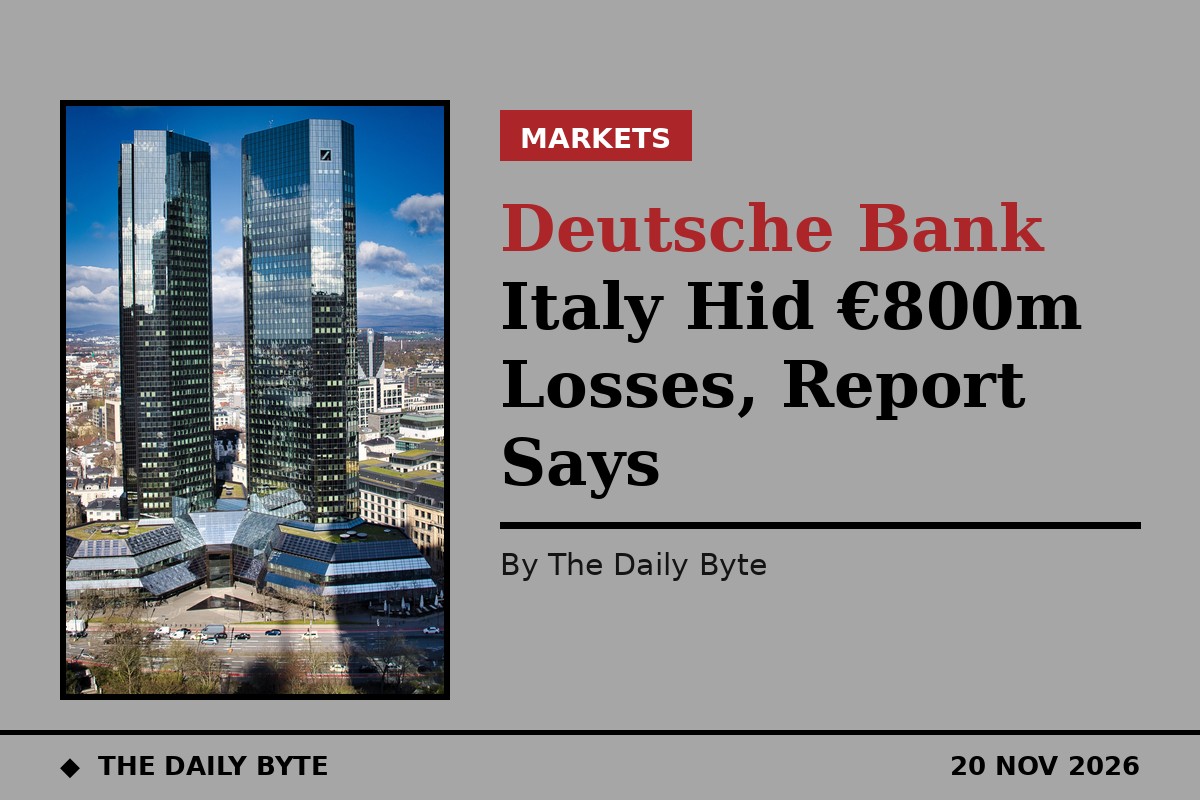
Deutsche Bank's Italian business concealed losses of up to €800 million on mortgage lending for more than a decade, using derivatives deals and shadow accounting to keep the shortfall out of sight, according to a Financial Times report published on Thursday.
The report, based on leaked internal documents, is the latest damaging disclosure from a trove of more than 15 million files examined by an international consortium of journalists. It lands in a week in which Deutsche Bank shares have fallen about 12 percent, and it has revived questions in Berlin about whether the lender's controls have genuinely improved.
According to the report, managers in Milan built a secret reserve account nicknamed "tesoretto", or "little treasure", and drew on it in 2011, 2014 and 2016 to plug gaps and meet profit targets. An internal investigation codenamed Project Aetos later found that the Italian unit had taken on €900 million of derivative positions with no sound economic justification, and had manipulated loan-loss provisions to build the hidden reserve.
How the losses were hidden
The roots of the problem go back to a change in Italian law in 2007, which allowed households to repay fixed-rate mortgages early without paying extra fees. The Italian unit never properly adjusted its pricing or its risk models for that change, and over the following decade the mismatch quietly turned into losses.
Milan also stopped sharing some lending data with group headquarters in Frankfurt. As a result, €2.8 billion of loans and €1.4 billion of early repayments sat outside the central risk systems, leaving head office with an incomplete picture of what its Italian business was carrying.
The arrangement only came to light in 2018, when an internal whistleblower raised concerns. Deutsche Bank told the European Central Bank in 2020 that it had suffered a financial hit of €522 million, with potential total losses of €779 million once unrealised losses were counted. Between 2018 and 2023, headquarters injected €1 billion of fresh capital into the Italian unit.
No dismissals, and no restatement
Despite the scale of the findings, nobody was dismissed over the affair, according to the report. Flavio Valeri, who ran the Italian business for 12 years, local finance chief Carmine Di Martino and private banking head Mario Cincotto each received collective written warnings. The bank also gave up trying to claw back €5.25 million of deferred pay.
KPMG, which audited the Italian arm during the period, failed to spot the practice and later advised that no restatement of the accounts was needed, a conclusion the bank has repeated in its response to the latest report.
Bank rejects the claims as shares slide
Deutsche Bank has pushed back against the report, insisting that its consolidated accounts were accurate and that there is no need to restate its financial results. It has described the matters as legacy issues that were examined at the time.
Investors have not been reassured. The shares were trading at about €29 on Friday morning, down more than 10 percent since the start of the week, after falling about 6 percent on Tuesday, their biggest one-day drop in more than a year, when the wider leak investigation was published. They slipped a further 2.2 percent on Friday afternoon.
The pressure is not only financial. Germany's finance minister, Lars Klingbeil, has called on the bank to show full transparency about how it dealt with past failures, and the data protection commissioner in Hesse opened an investigation into the lender on Wednesday.
For now the bank is holding its course. Management reaffirmed its 2026 targets at an investor conference this week, aiming for revenue of more than €33 billion and costs of €21.3 billion. But with regulators, politicians and shareholders all asking the same question, whether the controls have really changed, the Italian revelations have given Deutsche Bank's critics fresh material, and its chief executive, Christian Sewing, a harder week than he will have wanted.