Diplomatic immunity explained: Michael Morris UK departure
Lieutenant Colonel Michael Morris left the United Kingdom in August 2026 before British police had a chance to question him about suspected offences involving indecent images of children. He was flown out on a civilian flight and is now assigned to the Air Force District of Washington while the United States Air Force decides whether his case should go to a court-martial. His departure has raised one persistent question: how was a man under investigation able to leave before the police spoke to him? The short answer turns on diplomatic immunity, but the full answer has not been made public.
What happened to Lt Col Michael Morris
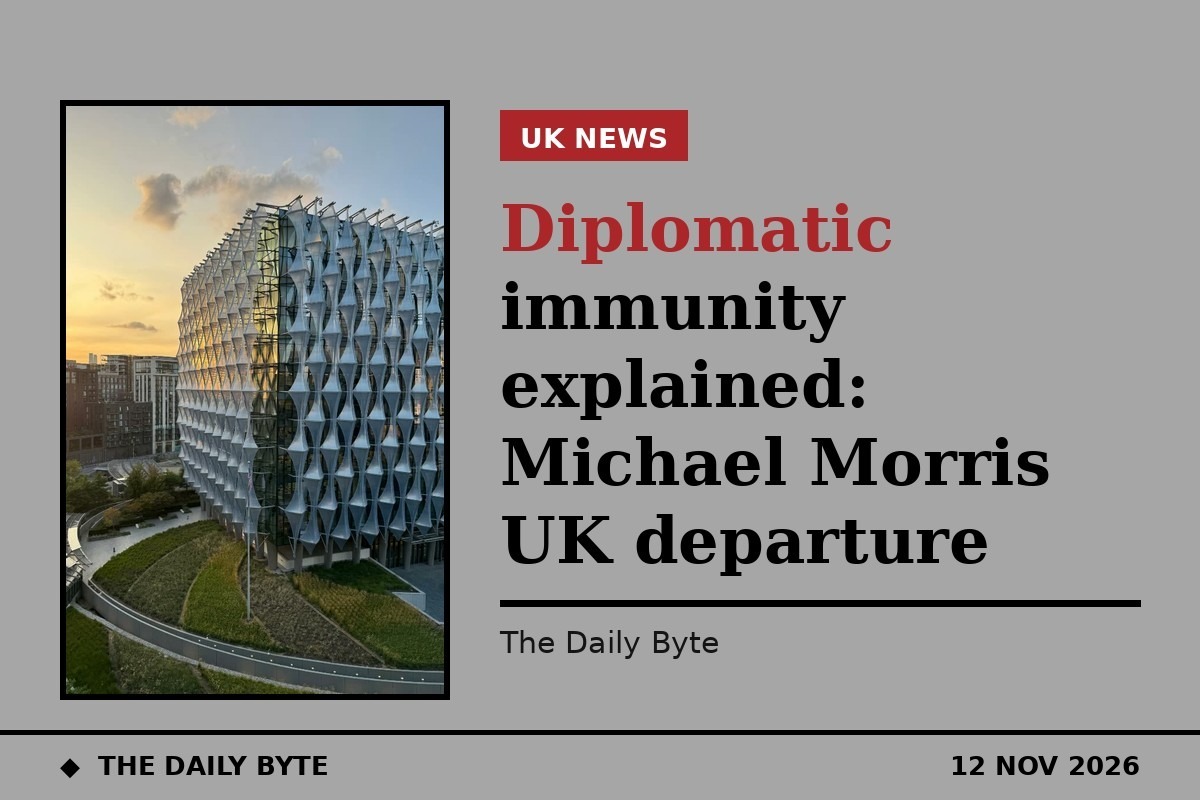
Morris served as an assistant military attaché at the US Embassy in London, at Nine Elms in south-west London. The BBC reported that he was flown out of the UK in August, before British police questioned him. The Metropolitan Police said US authorities told them on Tuesday 25 August that they were investigating suspected offences relating to indecent images of children, and that the force has been liaising with the US authorities regularly since.
The US Air Force has since confirmed that charges have been preferred against him. Reported charges include possession and distribution of child sexual abuse material, obstructing justice and conduct unbecoming an officer and a gentleman. The Air Force said: “Charges have been preferred against Lt Col Michael Morris, currently assigned to the Air Force District of Washington. The charges and evidence will be reviewed to determine whether the case should be tried by court-martial.” It added that charges are merely allegations and that Morris is presumed innocent unless and until proven guilty.
A military hearing is scheduled for November at Joint Base Andrews in Maryland. Morris will only enter a plea if the case is referred to a court-martial. No date within November has been confirmed publicly. The investigation is linked to Morris’s brother, Benjamin Morris, 33, who faces trial in Illinois over alleged possession and distribution of child sexual abuse material, which he denies; prosecutors allege he shared material with his brother.
What diplomatic immunity actually covers
Diplomatic immunity is set out in the 1961 Vienna Convention on Diplomatic Relations, which has the force of law in the United Kingdom through the Diplomatic Privileges Act 1964. Under Article 29, the person of a diplomatic agent is inviolable and cannot be arrested or detained. Under Article 31, a diplomatic agent enjoys immunity from the criminal jurisdiction of the receiving state. Article 41 requires members of a mission to respect the laws of the host country.
How much protection a person has depends on rank and role. According to Crown Prosecution Service guidance, criminal immunity and inviolability in the UK apply to diplomatic agents and to administrative and technical staff of foreign missions. Service staff, by contrast, have immunity only for acts performed in the course of their duties, and are not inviolable.
That distinction matters here. The BBC reported that Morris held a non-diplomatic position, while also reporting that he was flown out while remaining under the umbrella of diplomatic protection. Neither the US authorities nor the UK government has publicly explained which category applied to him, or whether immunity was formally claimed. That is the central unanswered question.
Can immunity be waived?
Yes. Under Article 32 of the Vienna Convention, immunity can be waived by the sending state, in this case the United States. The host state can also ask for a waiver, or declare a diplomat persona non grata and require them to leave. Waiver is the route by which a person who would otherwise be immune can still face trial in the host country.
In Morris’s case there is no public record of a waiver being sought or given, and no public statement that one was refused. The UK government said at the time: “We expect all foreign diplomats in the UK to abide by our laws, in the same way we expect all UK diplomats to do so when posted overseas.”
What happens next
The November hearing at Joint Base Andrews is the next formal step. A preliminary hearing officer will review the charges and the evidence and recommend whether the case should be referred to a court-martial, dealt with another way, or dropped. If it is referred, Morris will enter a plea and the matter will go to a full military trial. Until then, the position is unchanged from late October: a senior US Air Force officer who worked at the London embassy faces military charges, a hearing is due this month in the United States, and the allegations against him have not been proven. Why he was able to leave before British police questioned him remains open.
Sources: The Times and Crown Prosecution Service.