Domestic abuse orders roll out across England and Wales
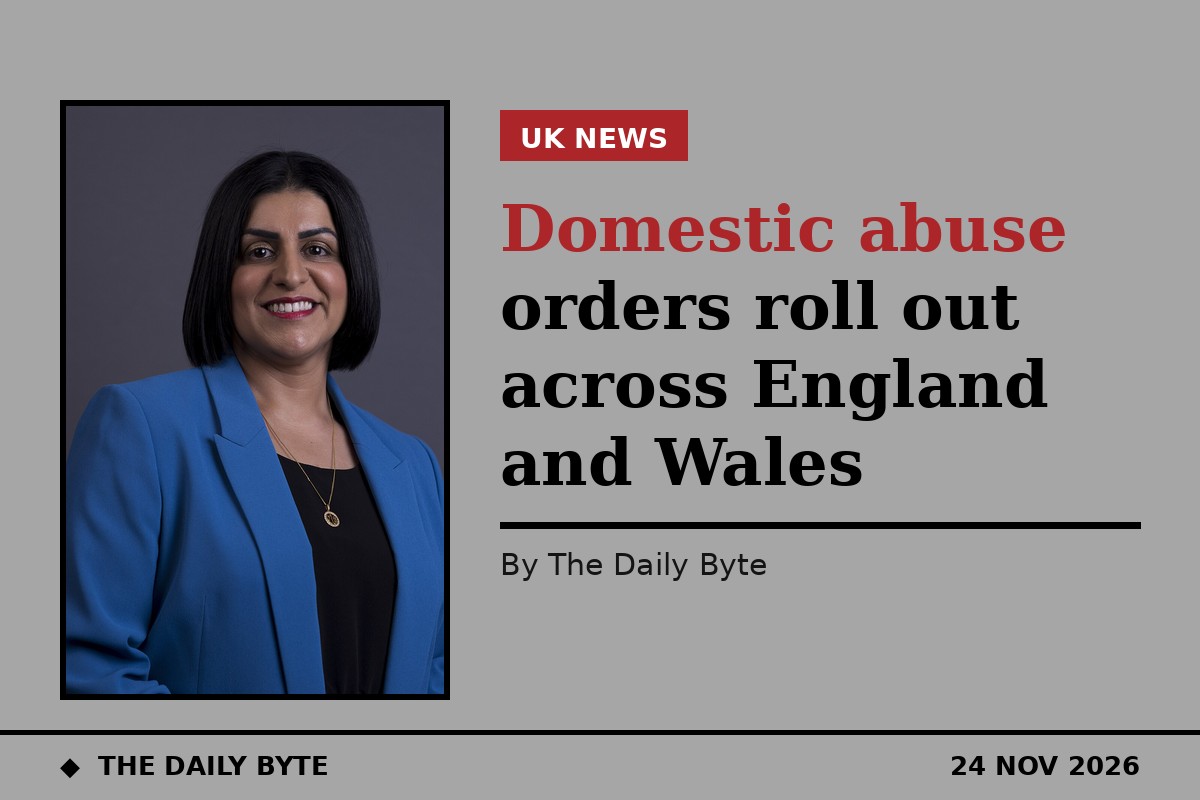
Domestic abuse protection orders will be available across England and Wales from 25 November, after a two-year pilot in five areas. The nationwide rollout was announced by Home Secretary Shabana Mahmood, who said the orders would put the restrictions on abusers rather than on victims.
Under a domestic abuse protection order, known as a DAPO, a court can impose almost any restriction it considers necessary to protect a survivor. An abuser can be forced to leave a home shared with their victim, and ordered to hand over house keys, phones, laptops and social media passwords used for harassment or stalking. Orders can also bar an abuser from a victim's workplace, prohibit contact, impose curfews and restrict access to particular places.
Unlike the orders they replace, DAPOs have no minimum or maximum time limit. They can, where necessary, remain in force for the rest of a perpetrator's life if that person is judged to pose a long-term risk to a former partner.
How victims can seek an order
Police will be able to apply for an order, and can also issue an immediate domestic abuse protection notice giving emergency protection while a court considers a longer-term order. Victims will also be able to apply directly to the family courts, rather than having to go through the police, and local authorities and a victim's family can seek the court's permission to apply on their behalf.
The orders cover all forms of domestic abuse, including controlling or coercive behaviour, stalking and economic abuse. Criminal courts will also be able to require an abuser to undergo drug or alcohol treatment or mental health support as part of an order.
What happens if an order is breached
Breaching a DAPO is a criminal offence. An abuser who breaks the terms of an order can face up to five years in prison.
More than 3,000 orders were imposed during the pilot, which began in November 2024 in Greater Manchester, parts of south London, Cleveland and North Wales, and with the British Transport Police. Police involved in the pilot have described the orders as an important step in keeping victims safe. The orders were created under the Domestic Abuse Act 2021 and are being brought into force through commencement regulations under the Crime and Policing Act 2026, with the relevant provision taking effect on 25 November.
The scale of the problem the orders are designed to address is large. Last year, 4.7 million people suffered domestic abuse in England and Wales, according to figures cited by the Home Secretary.
Funding and enforcement
The government has provided £13 million to set up protective order teams to strengthen enforcement of the orders, alongside funding for accommodation for victims. Mahmood said the government was investing nearly half a billion pounds over the next three years to help victims find safety and support, including safe accommodation.
Domestic abuse specialists are also being placed in 999 control rooms, so that callers get a specialist response from the start, and every police force is to have specialist rape and sexual offence teams.
Mahmood said the government would “always stand with victims and survivors”, describing the orders as “the strongest protections ever available to victims of domestic abuse”. Lord Chancellor Alex Norris said the government was determined that victims should “get the justice they deserve”.
London's victims' commissioner, Andrea Simon, said protective orders only worked if they were applied consistently and properly monitored and enforced, and that courts recording domestic abuse at sentencing gave “a real opportunity to ensure DAPOs are actively considered and used by courts to protect victims and hold perpetrators to account”.
The rollout is being introduced in phases, with further elements of the scheme to follow. The government has committed to halving violence against women and girls. Details of the rollout were reported by The Times, and the commencement dates are set out in the Crime and Policing Act 2026 (Commencement No. 5) Regulations 2026.