Dominican Republic Launches First Battery Storage
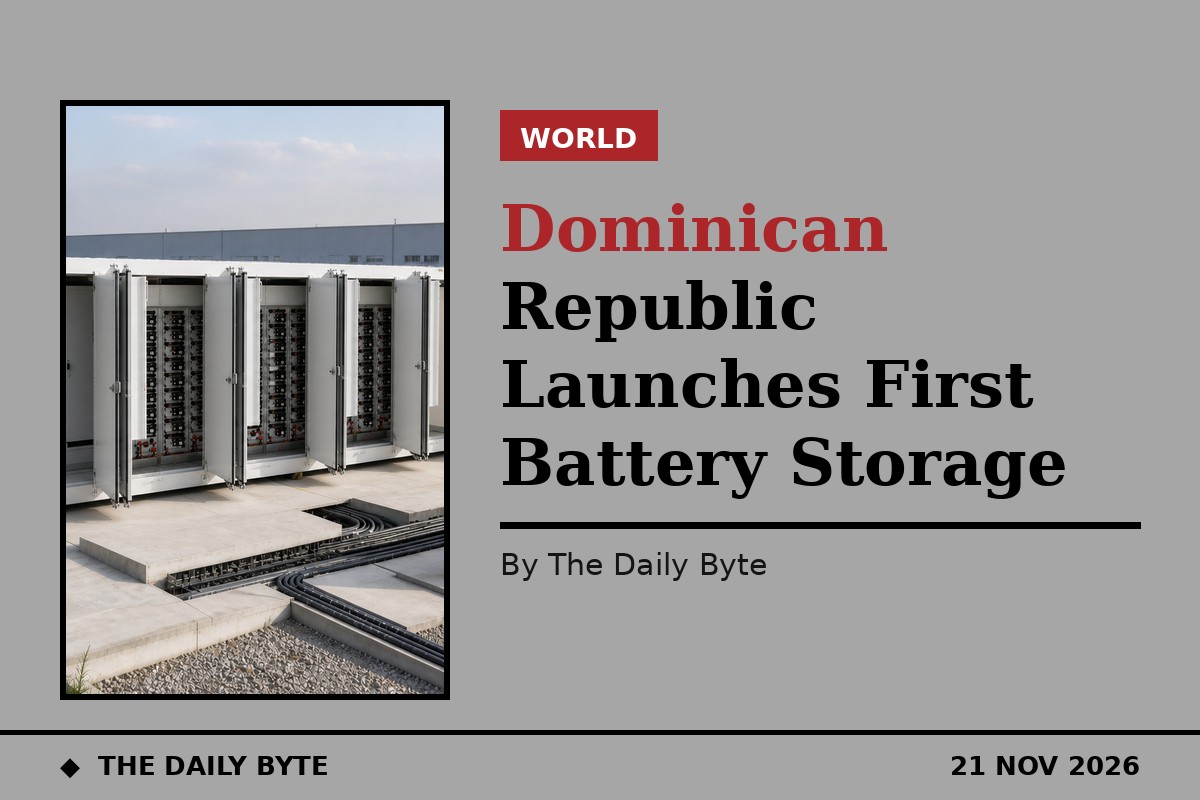
The Dominican Republic will switch on its first battery energy storage system in late November, adding 47 megawatts to the national grid in a step the government says will steady supply during the evening peak.
Energy and Mines Minister Joel Santos announced the project this week. The system, known as BESS, stores electricity so it can be released when demand is highest, between 7pm and 11pm. “This will give the system much more stability,” Santos said.
More storage to follow
Two more storage projects will be added before the end of 2026, with further additions continuing through 2027. The government's goal is to reach at least 800 megawatts of battery storage before 2028.
Santos said storage is becoming essential as the country generates more of its electricity from renewable sources. Renewables, including solar, wind, biomass and hydroelectric power, already account for about 27 per cent of generation, alongside a series of natural gas projects. Batteries help to balance a grid in which solar and wind output rises and falls with the weather, storing power when it is plentiful and releasing it after dark.
750 million dollars for distribution
The minister said battery storage was one of four parts of the electricity system that had to work together, alongside generation, transmission and distribution, and that harmonising them was fundamental to a more efficient system. The government has programmed investments of around US$750 million for 2027 and 2028 to strengthen and optimise the national electricity distribution networks.
Santos also stressed that the investments needed to continue beyond the current administration, describing a stable electricity system as fundamental to the country's development. The Dominican Republic's economy has been growing rapidly, and demand for power has risen with it, putting pressure on a grid that has long struggled with losses and outages.
Storage matters most in the evening, when solar output falls away just as households switch on lights, cooking and air conditioning. Without batteries, the grid must lean on thermal plants to cover that gap, and any shortfall shows up as outages. By charging during the day and discharging after dark, the new system should let the grid use more of the solar power the country already generates instead of wasting it.
The project also fits a wider shift in the Dominican energy mix. The government has promoted solar and wind alongside natural gas, and Santos said the country had diversified its generation in recent years. Battery storage is the missing piece in that plan: it turns variable renewable output into power that can be called on at a set hour, which is what a grid operator needs to keep the lights on.
If the first 47-megawatt system performs as expected, it will become the template for the much larger storage build-out the government has planned for the next two years.


