Dresden Court Rules German Border Checks Unlawful
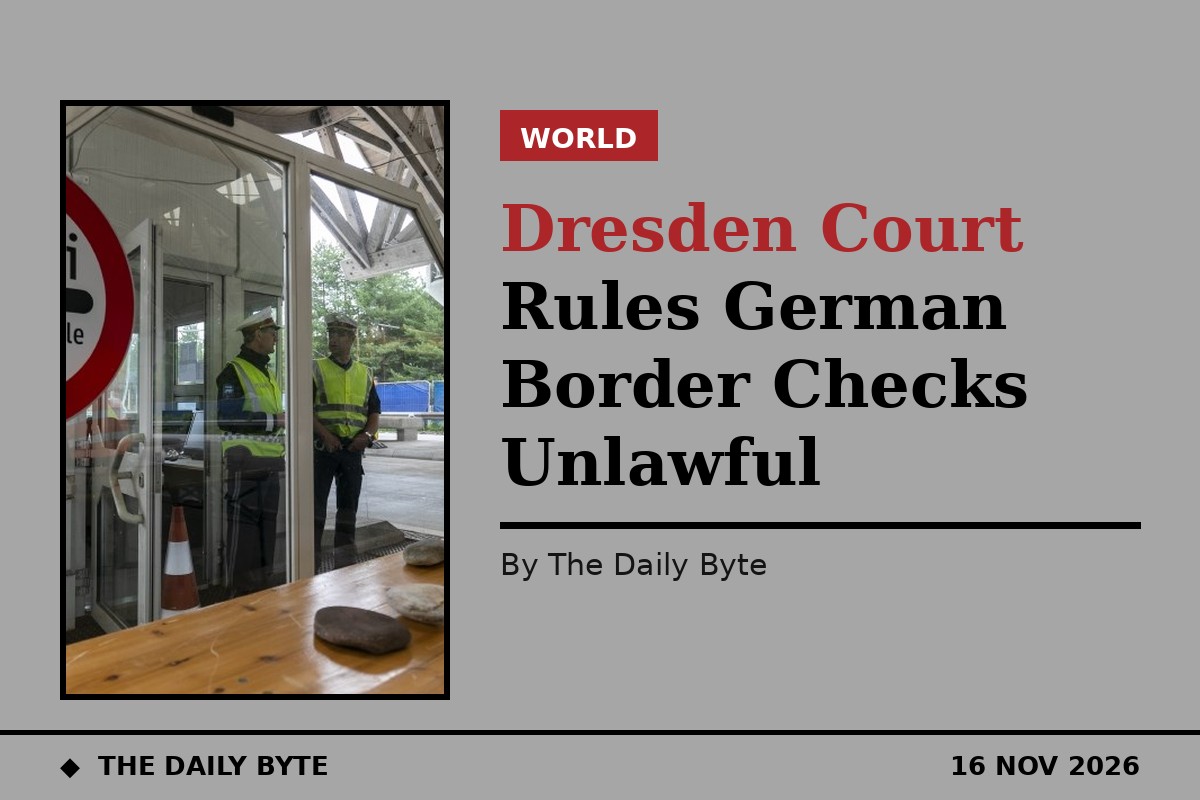
A court in Dresden has ruled that two German border checks — one on the Polish border and one on the Czech border — were unlawful, in a decision that raises fresh questions about Germany's border controls while leaving the controls themselves in place.
The Dresden Administrative Court announced the two judgments on 12 November, after a hearing the previous day. In the first case, a Polish citizen had his identity checked and his vehicle searched after crossing from Zgorzelec into Görlitz on 25 September 2024. In the second, a German citizen travelling from Prague on a replacement coach service was checked by police near Breitenau on 18 May 2026.
Why the court ruled the checks unlawful
The court found that the Interior Ministry's blanket order reintroducing border controls did not justify the specific checks examined, because the police had not shown an immediate threat that met the proportionality test in the Schengen Borders Code. Appeals were permitted because of the wider legal importance of the decisions, and the written judgments had not yet been published when the court announced its findings.
The rulings concern only the individual checks challenged by the two travellers. They do not automatically cancel the border controls Germany is currently operating, and they do not establish that every current German border inspection is unlawful.
The controls stay in place
Germany's notified controls cover nine neighbouring land borders, including Poland and Czechia, and run until 15 March 2027 under the European Commission's current Schengen notifications. Poland is also maintaining checks, at its borders with Germany and Lithuania, until 30 March 2027.
Interior Minister Alexander Dobrindt has already extended the German controls, citing smuggling networks and migration pressures, and the government is expected to appeal the Dresden rulings. The decisions are the latest in a series of lower-court defeats for Germany's internal border regime, which began with controls on the Austrian frontier in 2015 and was extended to Czechia, Poland and Switzerland, and then to all neighbouring countries in 2024.
For travellers, the practical effect is limited for now: checks continue, and anyone crossing Germany's land borders should still carry a passport or identity card. But the court's reasoning — that a general order is not enough, and each check must be justified — will be watched closely by lawyers and by the governments on both sides of the two borders.
Sources: Travel and Tour World, VisaHQ News


