Dublin Hoax Bomb Threats Before EU Summit
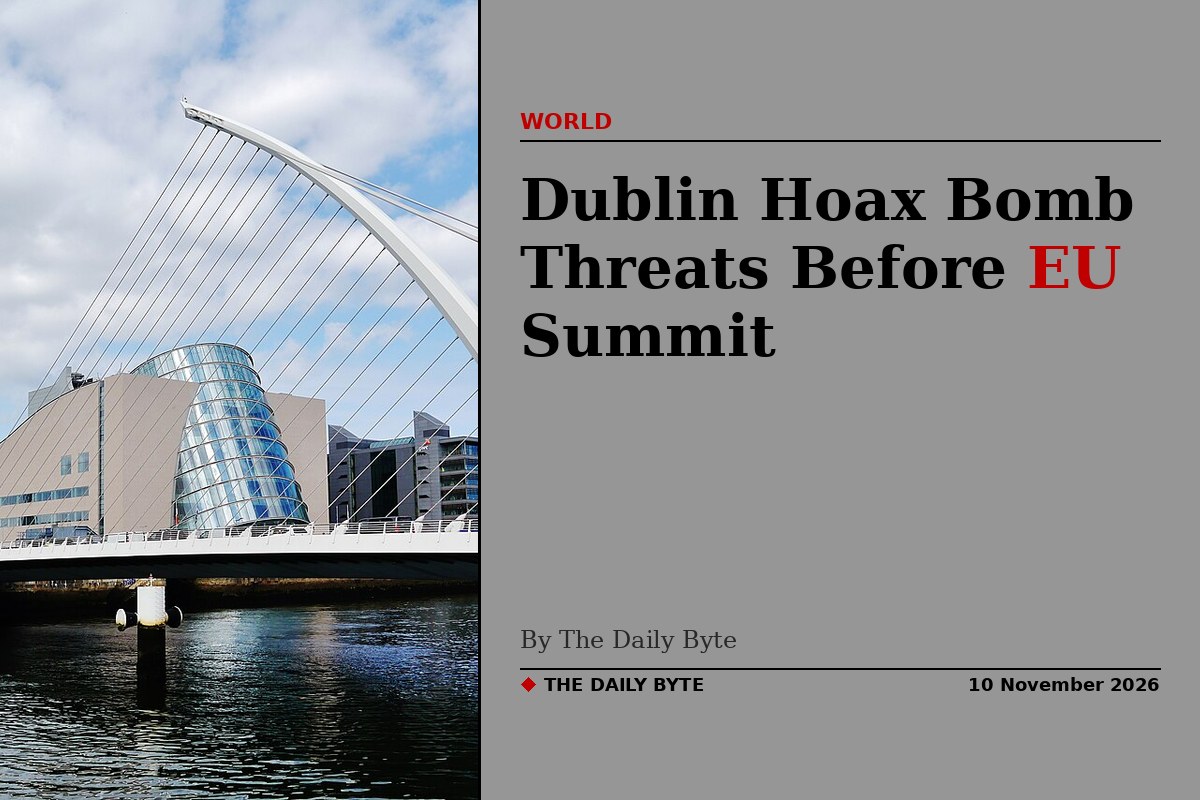
More hoax bomb threats were made in Ireland on Monday and again on Tuesday morning, Ireland's police chief has said, as authorities mount their largest-ever security operation ahead of major European Union events in Dublin.
Garda Commissioner Justin Kelly told a security briefing in Dublin on Tuesday, 10 November 2026, that there was “no credibility” behind the recent bomb threats, but that the people responsible wanted to “sow discord” and “destabilise democracies”.
Mr Kelly said he believed the threats were coming from outside Ireland, and that the police force was working with Europol and international security partners to try to establish who was behind the hoaxes.
Threats on Monday and Tuesday
Mr Kelly said more hoax bomb threats had arrived on Tuesday morning. “We saw some yesterday as well. It’s something that we certainly do anticipate in the coming days,” he said, according to the Press Association report carried by The Oldham Times.
He declined to give further details about some of the recent threats because they were still live. “Some of that is at quite early stages so I’m reluctant to talk too much about them because they’re actually quite live actions,” he said.
The Irish Independent understands that one of Tuesday's threats was an emailed warning aimed at a Ryanair flight from Dublin to Sofia in Bulgaria, and that the aircraft carried on to its destination without incident. A second threat, which targeted a school in the south of the country on Monday and involved a vulnerable teenager, was not judged credible.
A week of hoax alerts
Several Irish media outlets received hoax bomb threats last week, days after airlines, supermarkets and schools were also targeted with hoax bomb alerts. No explosives were found in the incidents reported last week, and the threats were assessed as having no credibility.
There has been increased attention on so-called hybrid threats, including bomb scares, in the run-up to the summits, as part of Ireland's presidency of the Council of the European Union. Mr Kelly said the police force had spent a lot of time assessing risks, adding that there was a “whole myriad of threats”, from hybrid threats to public order and general interference.
Largest-ever security operation
Irish authorities have begun their largest-ever security operation as more than 50 world leaders visit Dublin for the European Political Community summit on Thursday, 12 November, followed by an informal meeting of the EU Council on Friday, 13 November.
The operation will see thousands of gardaí deployed throughout the Irish capital. There will be 100 specially trained motorcycle escort officers who will perform a minimum of 200 movements of VIPs, including heads of state. About 500 public order trained Garda members will be deployed, along with 500 officers of various disciplines, some of whom will carry firearms in tactical roles including emergency response and close protection.
Equipment including water cannons, public order dogs and horses will also be available. Police officers from the Police Service of Northern Ireland, as well as officers from Lithuania and Portugal, will support gardaí in specialised work including counter-drone operations and explosive search dogs.
Protests and disruption
Mr Kelly said there would be a zero-tolerance approach to protests that were not peaceful, and no tolerance for any blockage of motorways, critical infrastructure or the summit locations. Assistant Commissioner Jonathan Roberts said gardaí would facilitate lawful, peaceful protest and had engaged with groups planning to demonstrate on Thursday and Friday.
“We have nothing to suggest that any protest that is planned will be anything other than peaceful,” Mr Roberts said. Road closures and transport disruption are expected across central Dublin from Tuesday to Friday, with the heaviest disruption on Thursday, when the European Political Community summit takes place at the Convention Centre Dublin.


