Dutch Government Fights US MATCH Act on ASML
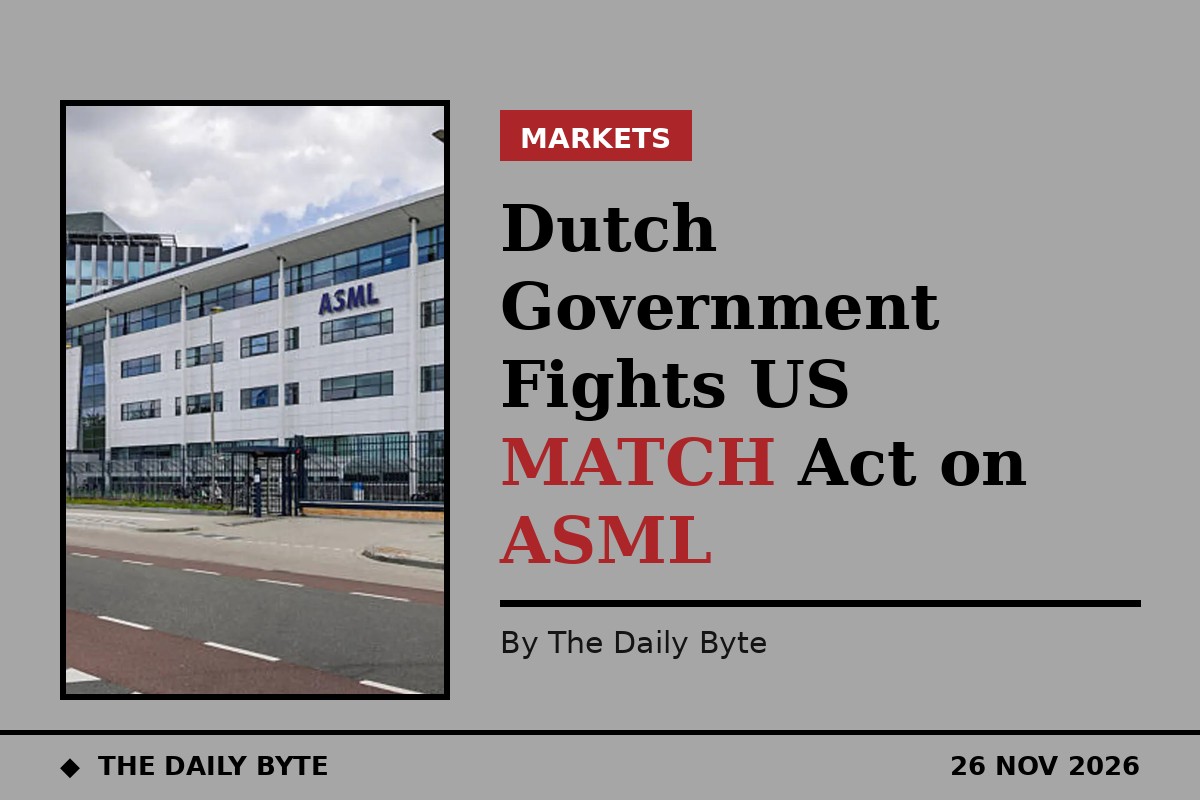
The Dutch government will resist US plans to force tougher chip export controls on China, trade minister Sjoerd Sjoerdsma told the Dutch parliament on Thursday, 26 November 2026, warning that the proposed MATCH Act goes “way too far” and could put Europe at an unacceptable disadvantage.
The Netherlands is lobbying hard against the bipartisan Multilateral Alignment of Technology Controls on Hardware (MATCH) Act, which the US Congress is negotiating to attach to the annual defence policy bill. The bill would force American allies, including the Netherlands and Japan, to adopt tougher export controls on China or face Washington unilaterally imposing restrictions on their semiconductor equipment.
What the MATCH Act would mean for ASML
The dispute centres on ASML of Veldhoven, Europe’s most valuable listed company, which makes the tools needed to manufacture computer chips. ASML expects China to account for about 20% of its sales this year, according to Reuters, so any extension of US controls would hit a large share of its business. The bill would also reach ASML’s immersion deep ultraviolet (DUV) lithography tools, the workhorse machines used to pattern chips.
The Dutch objection is aimed at the bill’s reach beyond American exporters. Bloomberg reported that the Dutch government is opposed to the extraterritorial scope of the bill, which would effectively let Washington set export rules for Dutch-made equipment. Sjoerdsma put it bluntly in parliament: “The US is not the boss of Veldhoven,” Bloomberg reported.
“We will not simply be told what to do”
Sjoerdsma told lawmakers that the damage would not stop at the Dutch border. “The consequences will be felt throughout the European Union, also as it will create a strong precedent,” he said, adding: “Europe can’t afford to fall behind,” in a reference to the importance of the semiconductor industry and rapid developments in artificial intelligence.
He also set out what the Netherlands would do if lobbying fails. “We will not simply be told what to do. If the act is adopted, our message to the US administration will be to not enforce it,” Sjoerdsma said. “We will explore what options we will have for this, both bilateral and in the European context, and if we will need other instruments for this.”
Working with Brussels, Berlin and Paris
Sjoerdsma said he was working with the European Commission, Germany and France in an effort to prevent the MATCH Act from being attached to the defence bill. If that lobbying fails, the Netherlands and the European Union will weigh their options to limit the consequences.
The minister’s statement follows Dutch MPs urging the government on Tuesday evening to push back against the bill, and a visit to Beijing on Wednesday by Dutch foreign minister Tom Berendsen. China has previously condemned the MATCH Act and warned of countermeasures.
Why the Dutch are pushing back now
The Netherlands has previously aligned with US-led export controls aimed at slowing China’s ability to make its own chips, measures that already affect ASML’s export business. The country has agreed, under US pressure, to stop shipping ASML’s most advanced machines to China. The MATCH Act would go further, and the Dutch government argues it would put European industry at a disadvantage while inviting retaliation.
ASML’s own chief executive, Christophe Fouquet, told Semafor in an interview published on Thursday that a total ban on chip tools to China would backfire by pushing Beijing to accelerate its own domestic alternatives. That warning underlines why The Hague sees the bill as a threat to its most valuable company.
What happens next
Congress is negotiating whether to attach the MATCH Act to the annual defence spending bill. The Dutch government will keep lobbying in the meantime. If the act is adopted, the Netherlands plans to ask the US administration not to enforce it against Dutch equipment, and to weigh European countermeasures with its partners.
Questions answered
Q: What is the MATCH Act?
A: The Multilateral Alignment of Technology Controls on Hardware (MATCH) Act is a bipartisan US bill that would force American allies, including the Netherlands and Japan, to adopt tougher export controls on China or face Washington unilaterally imposing restrictions on their semiconductor equipment.
Q: Why does it matter for ASML?
A: ASML of Veldhoven, Europe’s most valuable listed company, makes the tools needed to manufacture computer chips, and China accounts for about 20% of its sales this year. The bill would reach its DUV lithography machines as well as its most advanced equipment.
Q: What will the Netherlands do if the act passes?
A: Trade minister Sjoerd Sjoerdsma said the Netherlands would ask the US administration not to enforce it, and would explore bilateral and European options with the European Commission, Germany and France.


