Dutch neo-Nazi gets suspended term for Hitler praise
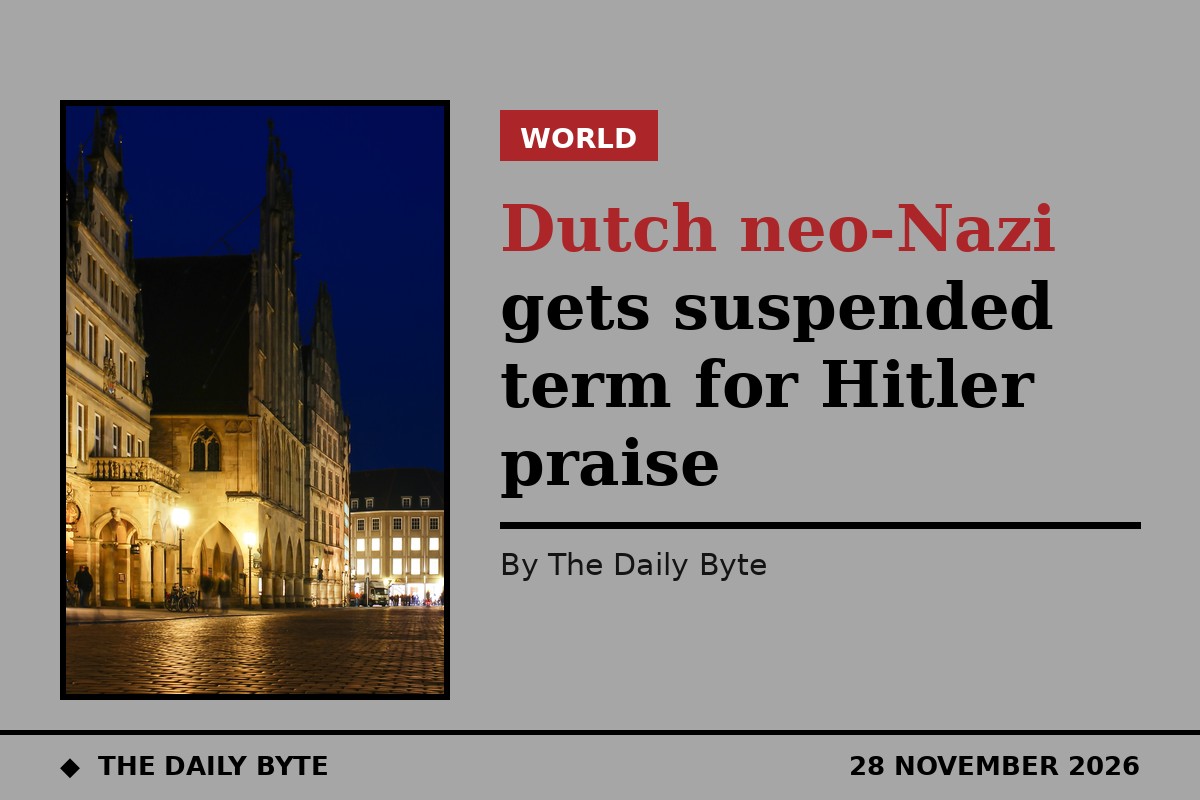
A German court has given Dutch neo-Nazi Stefan Wijkamp an eight-month suspended prison sentence for publicly praising Adolf Hitler, ruling that his remarks went beyond the limits of free speech.
The District Court in Munster convicted the 59-year-old from Oosterbeek in the Netherlands on Friday of incitement to hatred, known in German law as Volksverhetzung. The eight-month term is suspended for three years, and Wijkamp must pay 1,000 euros to the treasury of the state of North Rhine-Westphalia, plus court costs. Dutch public broadcaster NOS reported that he intends to appeal, and the judgment is not yet final.
The case centred on remarks Wijkamp made during a far-right demonstration in Munster on 19 July 2025. In a video interview beside the city's main railway station, he praised Hitler, calling him "a genius" and "a wonder of the world without equal." He added: "I admire him. My love for Germany is called Adolf Hitler."
Wijkamp appeared at Friday's hearing again dressed as a Hitler lookalike, wearing a long leather coat and a tie with an edelweiss badge once used by Waffen-SS mountain troops. When the interview was played in court, he nodded along, according to German public broadcaster WDR. In his closing remarks before the verdict, he said: "I admire Adolf Hitler, I love the Fuhrer." He argued that his views were protected by freedom of speech and that if people in Germany may only speak badly of Hitler, that is not free speech but opinion control. His defence sought an acquittal. The court rejected that argument.
The judge's reasoning
Judge Antonia Buddenbaumer said Wijkamp's public comments had seriously disparaged the victims of the Nazi regime and disturbed the public peace. "There are limits to the freedom of expression, and those have been clearly exceeded," she said, according to NOS.
The case reached a full trial only after Wijkamp challenged an earlier penalty order. He failed to appear at the first court hearing on 24 July 2026, and the court then issued a written penal order imposing an eight-month suspended term with a payment of 3,000 euros. Wijkamp objected to that order, which led to Friday's trial. The length of the suspended sentence stayed the same, while the financial payment was cut to 1,000 euros.
Wijkamp has long been known in the German media as "Holland Hitler" for modelling his hairstyle and moustache on those of the Nazi dictator. WDR reported that he describes himself as a "Dutch Nazi." In 2017 he joined the federal executive board of the far-right party Die Rechte, serving as its representative for international affairs, according to the domestic intelligence agency of Lower Saxony, which described the party as drawing on the ideology of historical National Socialism. By January 2019 he was no longer on the party's federal board, but he has continued to attend German far-right demonstrations, including events linked to Die Heimat, formerly known as the National Democratic Party of Germany.
Friday's verdict was not his first conviction outside the Netherlands. In 2008, a criminal court in the Belgian city of Hasselt fined Wijkamp and Dutch far-right politician Joop Glimmerveen 1,100 euros each over a neo-Nazi gathering at a German military cemetery in Lommel on 10 March 2007, at which both men performed Nazi salutes and praised Nazism.
The law on glorifying Nazism
German law treats the public glorification of Nazi rule as incitement to hatred when it violates the dignity of the victims and disturbs the public peace. Section 130(4) of the Criminal Code provides for up to three years in prison or a fine for glorifying the Nazi dictatorship in that way, and Germany's Federal Constitutional Court upheld the provision in 2009, citing the country's particular historical responsibility arising from Nazi rule.
The July 2025 demonstration at the centre of the case drew about 90 participants, according to Munster police, while around 750 people attended four counter-demonstrations. The far-right marches that summer arose from a legal dispute over the burial site of German neo-Nazi Siegfried Borchardt, whose grave location the authorities in Dortmund sought to keep undisclosed to prevent it becoming a pilgrimage site for right-wing extremists.


