EASA Extends Gulf Airspace Warnings to Jan 2027
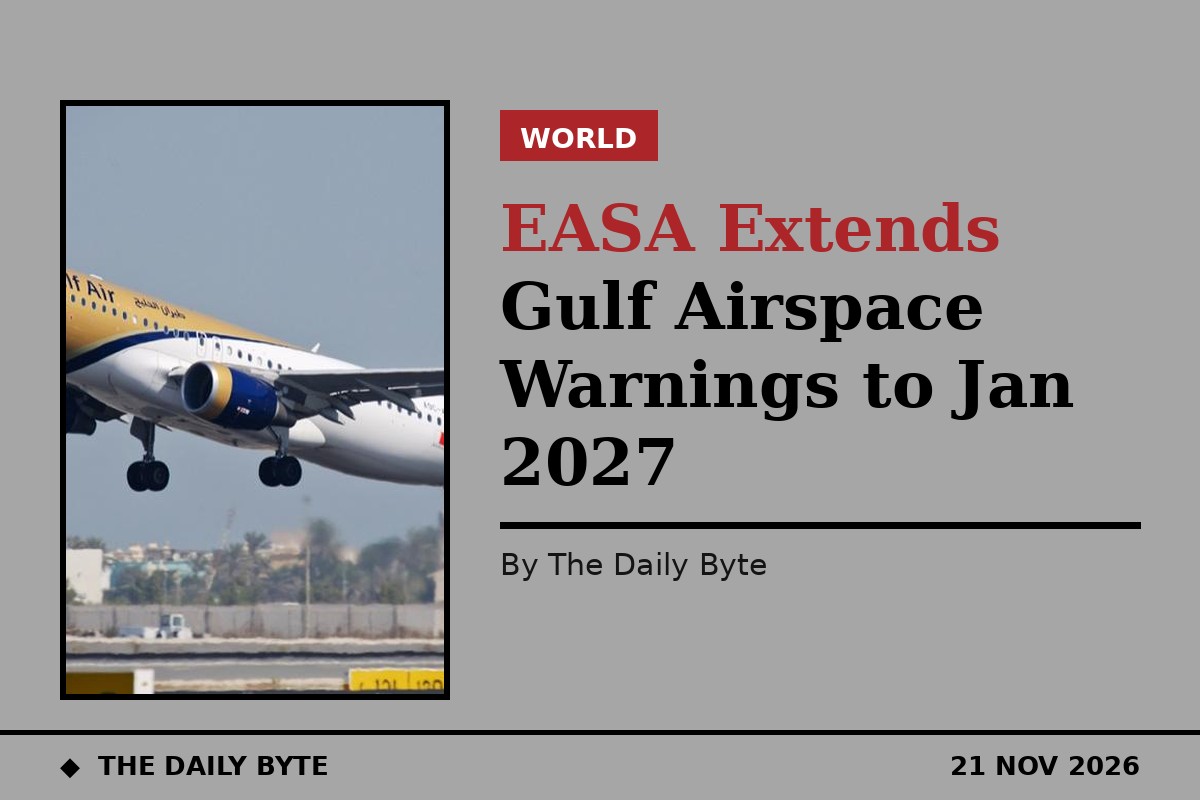
Europe's aviation safety regulator has extended its warnings for civil aircraft flying over the Middle East and the Persian Gulf until 31 January 2027, keeping in place advice that has steered airlines away from some of the region's busiest air corridors since the war with Iran began.
The European Union Aviation Safety Agency, known as EASA, issued the extension on 16 November, prolonging six Conflict Zone Information Bulletins covering Iran, Iraq, Lebanon, Jordan, Saudi Arabia and the waters of the Persian Gulf and Gulf of Oman. The move was reported on 18 November.
The bulletins are non-binding safety recommendations, not flight bans, but airlines treat them as the baseline for their own risk assessments. They apply to European operators and to third-country operators authorised by EASA when flying to, from and within the European Union. The agency said the extension changes nothing in the underlying advice: the content and recommendations of all six bulletins remain as they were.
What the six bulletins say
For Iran, airlines are advised not to operate in the Tehran flight information region at any altitude or flight level. EASA notes that Iran keeps its air force and air defence units on high alert, which increases the risk of a civil aircraft being misidentified.
The same advice applies to the Baghdad flight information region in Iraq, where EASA cites Iranian drone and ballistic missile attacks, air defence activity and operations by Iranian-backed militant groups.
Airlines are told to avoid Lebanese airspace, with one exception: flights to and from Beirut International Airport that approach from the sea or depart over the sea, backed by an up-to-date risk assessment and continuous risk monitoring.
Over the Persian Gulf and the Gulf of Oman, airlines should not fly over Gulf waters in the Bahrain, Kuwait, Doha and Emirates flight information regions, except for arrivals at and departures from airports in those regions. They should also avoid Gulf of Oman waters west of 58 degrees east in the Muscat flight information region, and exercise caution over land in these regions.
In Saudi Arabia, airlines are advised not to operate in two defined areas of the Jeddah flight information region, and to use caution in the rest of it. EASA says the southern and south-western parts of Saudi airspace are the most exposed because they are close to Houthi-controlled areas in Yemen, and notes that attacks have also reached Riyadh, Tabuk, Medina and Yanbu.
For Jordan, the advice is lighter: airlines should take the potential risks into account and keep contingency plans ready. EASA has recorded no military activity affecting Jordanian airspace since 9 September, but warns that the situation can worsen quickly with little or no warning.
Why the warnings stay in place
The conflict began on 28 February 2026, when the United States and Israel struck targets in Iran, prompting Iranian retaliatory attacks. A temporary ceasefire between the United States and Iran was first announced on 8 April, followed by an agreement on 17 June to extend it for a further 60 days. EASA describes its implementation as fragile.
The agency also points to Iranian efforts to control the Strait of Hormuz, recurring attacks on commercial vessels and related American military action. With air defence systems on high alert, the risk of misidentification and unintended engagement of civil aircraft increases, and military activity can occur with little or no warning, leaving airlines and air navigation service providers limited time to reroute flights or put other safety measures in place.
EASA, the European Commission and EU member states will continue monitoring developments to assess whether the risks to EU aircraft operators increase or decrease. The bulletins may be reviewed earlier if conditions change.
Airlines still rerouting
Major European and international airlines, including Lufthansa, Air France and British Airways, continue to maintain extended route suspensions or reroutings around the affected corridors, according to travel industry reporting. European carriers operating routes to Gulf destinations have adjusted flight paths to avoid the designated maritime zones while maintaining connections to regional hubs.
For passengers, the practical effect is unchanged for now: longer routings around the Gulf and Iraq, fewer direct services to Saudi cities, and schedules that can change at short notice if the security picture shifts again before the new 31 January deadline.


