Europe keeps Middle East air warnings until 16 November
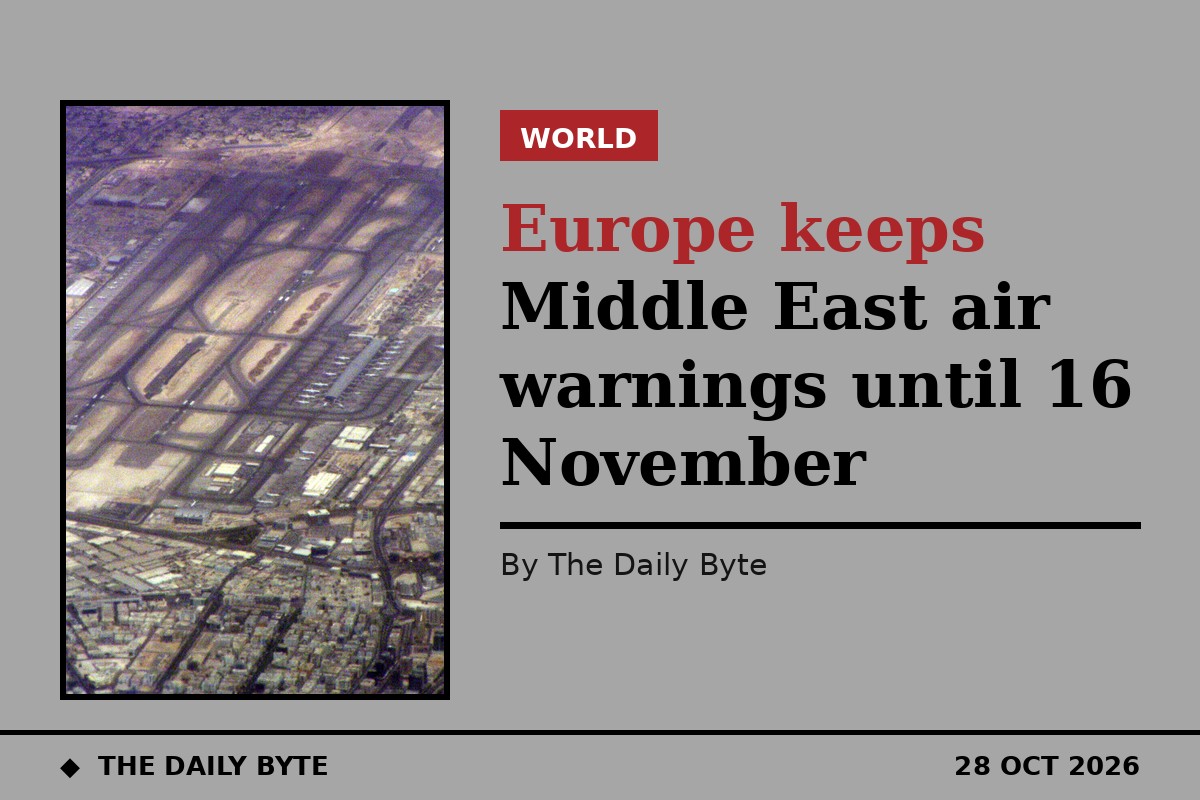
Europe's aviation safety agency has extended its conflict-zone warnings for the Middle East and Gulf region until 16 November 2026, prolonging the cautious routing that has shaped Gulf flying since the regional escalation. The European Union Aviation Safety Agency, known as EASA, renewed its bulletin after updated risk assessments covering geopolitical tensions, missile and drone threats, and the risk of aircraft being misidentified by air defences. The extension does not close the region's major hubs, but it keeps formal caution in place for another cycle.
What airlines must avoid — and what stays open
Under the extended guidance, European operators are advised to avoid the airspace of Iran, Iraq, Lebanon and Jordan entirely, at all flight levels. A separate over-water warning covering the Persian Gulf and the western Gulf of Oman also remains in force. Flights may still arrive at and depart from hubs such as Dubai and Doha, but they are directed through inland corridors over Saudi Arabia or northerly tracks rather than across the water. EASA also expects carriers to carry out individual risk assessments, monitor official notices to airmen, and hold pre-approved alternative routes.
The next decision point
For passengers, the practical effect is longer journeys rather than closed airports. TravelExtra puts the added time at 30 to 90 minutes on affected routes, with knock-on delays for long-haul services between Europe and Asia. Avi-Go notes the same pattern in planning terms: extra contingency fuel, adjusted schedules and heightened attention to war-risk insurance have become routine costs of Gulf operations, rather than one-off emergency measures.
The agency said the extension was intended to preserve high safety margins through continuous risk assessment without unnecessarily disrupting essential air links, while the United Arab Emirates civil aviation authority said safety remained its absolute priority. The bulletin will come up for review again on 16 November, when it could be extended, adjusted or allowed to lapse. Until then, travellers are advised to check flight status directly with their carrier before heading to the airport, as individual airline suspensions — which vary by route and date — continue to change independently of the EASA bulletin itself.
Sources: TravelExtra and Avi-Go / AviNews.