58% of East Africans Say Borders Are Hard to Cross
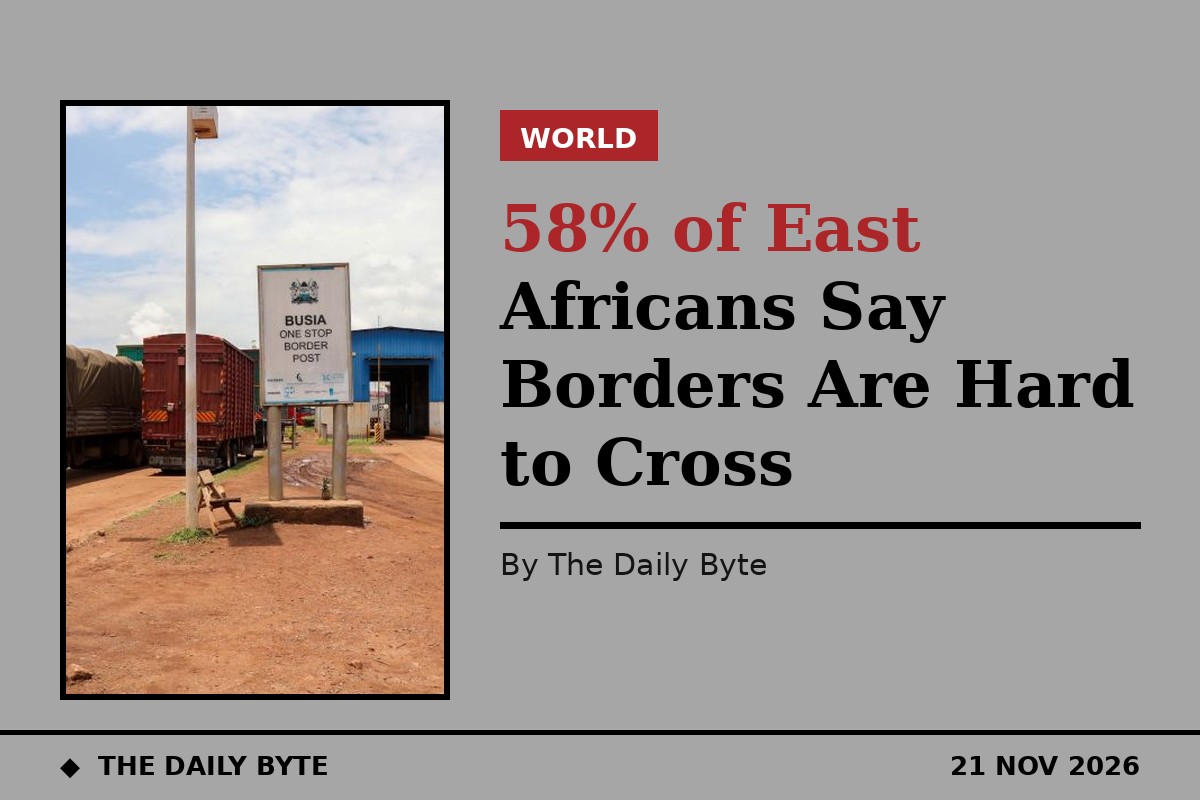
Nearly six in 10 people in East Africa say it is difficult to cross international borders to work or trade, according to a new Afrobarometer survey, a sharp rise from fewer than half of respondents in 2017.
The survey found that 58% of people in Kenya, Uganda and Tanzania describe crossing borders as difficult or very difficult, up from 45% in 2017. The findings were published on 20 November in Afrobarometer Dispatch No. 1252, written by Ssenkumba Muhammad of Hatchile Consult, the network's partner in Uganda.
The increase has been driven mainly by Kenya and Uganda. In Kenya, the share saying borders are difficult to cross rose by 25 points, from 38% in 2017 to 63% in 2024. In Uganda it rose from 51% to 65%. In Tanzania the figure held steady at 47%, while the share who said crossing was easy doubled, from 12% to 26%.
The results point to a gap between the East African Community's free-movement rules and what citizens actually experience at borders. The East African Common Market Protocol, which took effect in 2010, established freedom of mobility among member countries for people, labour, capital, goods and services. In 2024 the community approved a common labour-migration regime intended to protect migrant workers and maximise the benefits of labour mobility, and member states have advanced frameworks on mutual skills recognition. Even so, a majority of citizens in the region say the journey itself remains hard.
Support for free movement, with limits
On average, a majority of citizens in the three countries support free movement across borders for residents of the region. Yet strong majorities in all three countries also want their governments to reduce the number of foreign job seekers entering their country, even though more than half see the economic impact of immigrants as positive.
That tension runs through the findings. People back the principle of an open region, but they are wary of competition for jobs at home, and they report that the practical business of crossing a border to work or trade is getting harder rather than easier. The dispatch notes that the pattern is consistent with earlier Afrobarometer work: in Uganda, for example, 79% of citizens said East Africans should be able to move freely to trade or work, while about two-thirds said crossing borders was difficult in practice.
The survey also examined who wants to leave. About 28% of respondents across the three countries said they had considered emigrating at least a little, a figure unchanged from 2017. The average hides wide differences. In Uganda the share rose by seven points to 42%. In Kenya it held at 34%. In Tanzania it fell by six points to 9%.
Who wants to move, and where
Interest in emigrating is particularly high among men, people with post-secondary education, young people and unemployed respondents. It is also higher than average among citizens who are critical of their government's economic performance and pessimistic about the country's direction. Economic considerations are the most important reasons given for considering a move abroad, ahead of other motives.
Destinations differ sharply by country. Tanzanians who have considered leaving are split between Europe and another East African country, at 23% each. Ugandans are far more likely to look to the Middle East, at 18%, than Kenyans at 1% or Tanzanians at 6%.
The findings sit against a backdrop of large-scale movement in the region. The International Organization for Migration estimates that the number of African citizens living in another country on the continent rose from 15 million in 2010 to 21 million in 2020, and that the number of migrant workers living in East African Community countries doubled during the 2010s, from nearly 1.5 million to almost 3 million. United Nations figures put the number of citizens living abroad as of 2024 at 578,034 Ugandans, 540,466 Kenyans and 225,017 Tanzanians.
How the survey was done
The dispatch draws on country surveys conducted in 2024 in the three East African Community countries that form part of Afrobarometer's data set: Kenya, Tanzania and Uganda. Afrobarometer's national partners interviewed 2,400 adults face to face in each country, with fieldwork in Uganda in January 2024, in Kenya in April and May 2024, and in Tanzania in June and July 2024. The margin of error is plus or minus two percentage points.
Afrobarometer is a pan-African, non-partisan research network that conducts public attitude surveys across more than 30 African countries. The dispatch is the latest in its series tracking how ordinary citizens experience regional integration, and its message is a pointed one for governments that have spent years promising freer movement: the rules may be opening, but for most East Africans the border itself still feels like a barrier.


