Ebola Cases Found on DR Congo Routes as Funds Run Short
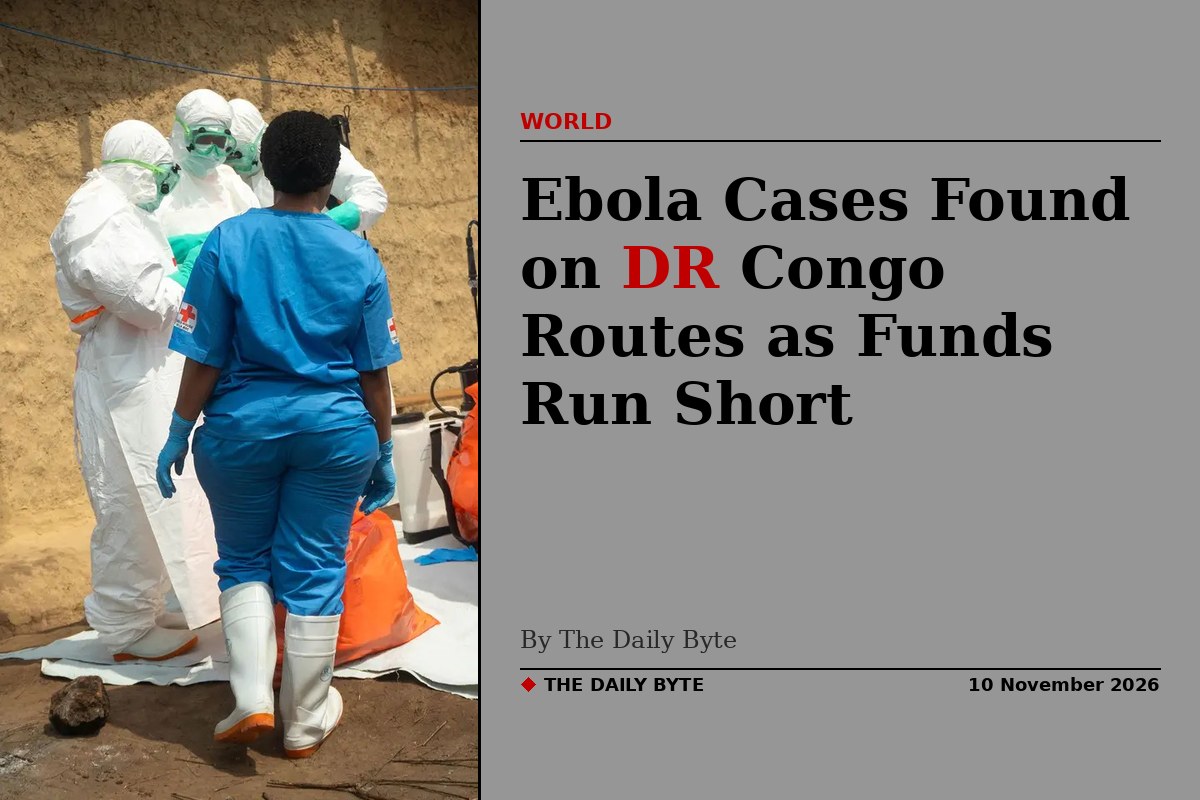
Seventy-one confirmed Ebola cases have been detected at transit surveillance points in the Democratic Republic of the Congo since the outbreak began, the International Organization for Migration (IOM) said on Tuesday, 10 November, warning that a funding shortfall of $59.8 million risks leaving the outbreak out of control.
The cases were picked up at points of entry and control supported by IOM, and almost all of them were found away from official border posts. According to the agency, 95 per cent of the 71 cases were detected on informal routes that bypass formal checkpoints, where travellers, traders and displaced families cross without screening.
Informal routes carry the greatest risk
Dr Andrew Mbala, IOM’s Regional Ebola Coordinator, told journalists in Geneva that screening could not stop at hospitals and official crossings. “We need to think about the mobility of the population,” he said, adding that responders must cover informal routes as well as formal ones.
The agency said most people transporting the bodies of Ebola victims also use informal routes, and 258 bodies have been intercepted so far. Surveillance at displacement sites identified three further confirmed cases between 26 October and 1 November, underlining the need to extend monitoring beyond border posts.
IOM maps the places where people gather, such as markets, bus stations and places of worship, and the corridors along which they travel, so that staff and resources can be sent where they are most needed. Since the outbreak began, teams have carried out 55 million screenings in the DRC and 11 neighbouring countries.
More than 10,400 cases and 5,100 deaths
According to the World Health Organization, more than 10,400 confirmed cases and 5,103 deaths had been reported in the DRC as of 31 October, across 67 health zones in eight provinces. The outbreak, caused by the Bundibugyo strain of the Ebola virus, was declared on 15 May 2026. Imported cases have also been reported in Kenya and Nigeria, raising concern about transmission along cross-border routes.
Insecurity and continued displacement are complicating efforts to reach affected communities. IOM supports surveillance at 67 displacement sites in the DRC, including 50 in health zones affected by the outbreak, and works with national authorities to strengthen early detection, health screening and referral systems.
Assessments in Tshopo Province identified 19 strategic river locations where additional surveillance points may be needed. In Uganda’s Kasese District, population mobility mapping identified 17 priority points of entry, including 13 informal crossings. In Kenya, where nine confirmed cases had been reported as of 26 October, IOM is supporting preparedness at 22 points of entry.
Funding gap threatens surveillance
Of the $110 million requested under IOM’s multi-country Ebola preparedness and response plan, $50.2 million had been received, leaving a regional funding gap of $59.8 million. Nearly half of that gap is concentrated in the DRC, raising concerns about the ability to sustain oversight and preparedness across the region.
“Ebola screening cannot stop at hospitals or official border crossings,” said Frantz Celestin, IOM Regional Director for East, Horn and Southern Africa. “People need timely access to health information and services wherever they live and travel, including displacement sites and remote border communities.”
The current response plan covers June 2026 to March 2027, but IOM says critical preparedness and response needs will extend beyond that period, and additional flexible funding is required to maintain disease surveillance, support frontline workers and strengthen early detection and referral systems. Read the full IOM update on ReliefWeb and the UN News report.


