ECB health check finds banks strong, cyber gaps
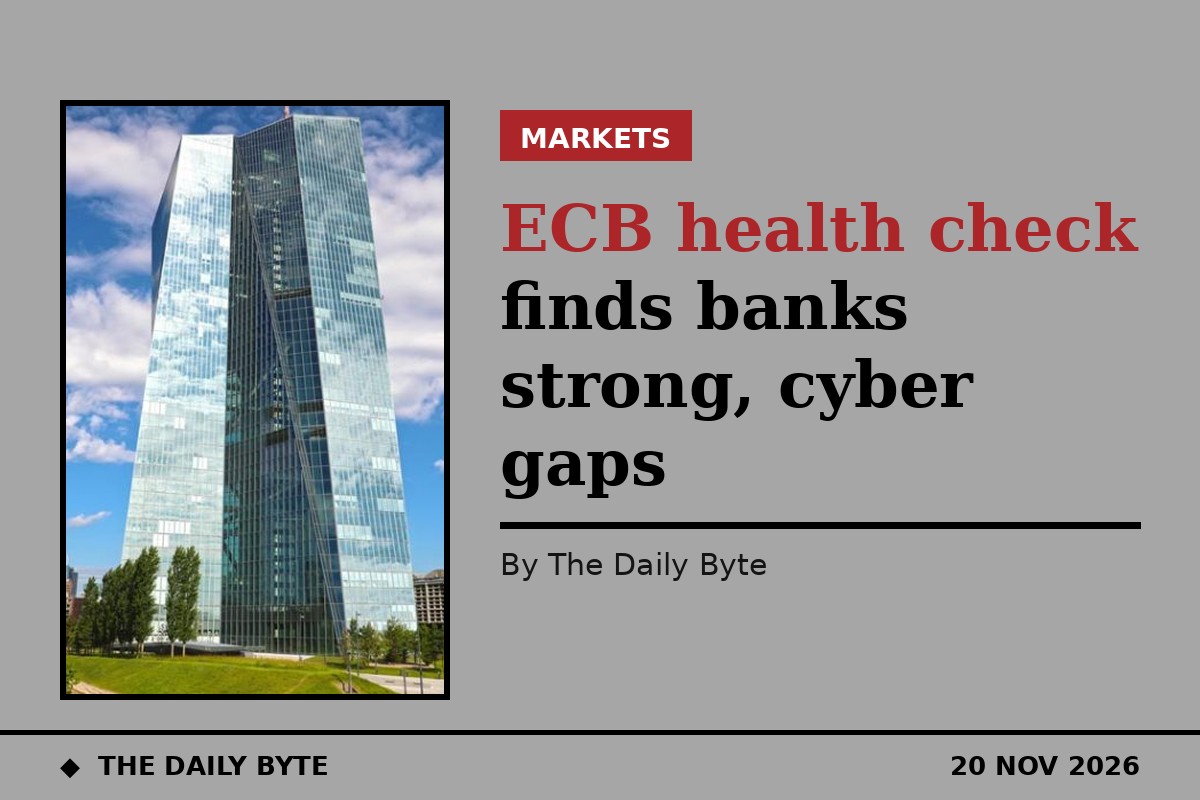
The European Central Bank's annual health check of the eurozone's banks has given the sector a broadly clean bill of health on capital, liquidity and profits, while flagging serious weaknesses in how banks manage cyber and technology risks.
The ECB published the results of its 2026 Supervisory Review and Evaluation Process, known as the SREP, on 19 November. The review covered 108 banks directly supervised by the ECB and assessed their capital, liquidity, business models, governance and risk management.
On the financial side, the numbers are strong. The weighted average total capital ratio stood at 20.1% in the second quarter of 2026, and the fully phased-in leverage ratio was 5.8%. Liquidity buffers remained well above the 100% minimum, with the aggregate liquidity coverage ratio at 155% and the average net stable funding ratio at 125%.
Profitability also improved. The annualised return on equity rose from 9.5% in 2025 to almost 11% in the second quarter of 2026, helped by fee income, higher loan volumes and improving interest margins. Strong revenues helped cut the aggregate cost-to-income ratio from 55% to 53%. Asset quality remained broadly stable, with the aggregate non-performing loan ratio at 1.9%.
Cyber gaps found at nearly all banks
The weak point is operational and technology risk. The ECB said 96% of significant institutions showed deficiencies in cybersecurity, third-party risk management and information and communication technology controls. The figure was corrected by the ECB on 20 November, when it amended its press release to raise the share from 92% to 96%.
Banks also need to strengthen how they gather and report risk data, the ECB said, with weaknesses in data quality, IT architecture and an overreliance on manual processes continuing to hamper effective risk management.
Claudia Buch, chair of the ECB's Supervisory Board, said the results showed the euro area banking sector "remains substantially resilient", but added: "Resilience does not mean immunity."
Capital requirements broadly unchanged
Overall Common Equity Tier 1 capital requirements and guidance for 2027 remained broadly stable at 11.3% of risk-weighted assets, against 11.2% for 2026. The Pillar 2 requirement to be met with CET1 capital was also broadly stable at 1.2%, up from 1.1%, while total capital requirements and guidance were 15.7%, against 15.6%.
The average overall SREP score was unchanged at 2.5, with 86% of banks receiving the same score as in 2025. Scores improved for about 8% of banks and worsened for about 7%, with the changes driven mainly by non-financial risks.
The ECB issued new qualitative measures to 78 banks in 2026, around half as many as the year before, after completing a reform of the SREP designed to focus on the most material risks. The measures mainly concerned credit risk, at 33%, internal governance, at 24%, and operational risk, at 12%.
Supervision priorities for 2027-29
The ECB's supervisory priorities for the next three years focus on two areas: strengthening banks' financial resilience to geopolitical risks and macro-financial shocks, and reinforcing their operational resilience and technology capabilities.
Supervisors will look at credit underwriting standards, the implementation of the final Basel III rules, exposures to non-bank financial institutions and climate-related risks. On technology, they will carry out on-site inspections of cybersecurity and third-party risk management, threat-led penetration testing under the Digital Operational Resilience Act, and targeted reviews of banks' reliance on cloud providers.
The ECB will also assess banks' responses to AI-enabled cyber threats and their preparations for migration to post-quantum cryptography, and will expect banks to fix material weaknesses in risk data aggregation and reporting within agreed deadlines, with enforcement action if necessary.
The ECB said the impact of recent geopolitical shocks may take time to become fully visible on banks' balance sheets, and that banks need to take a prudent approach to risk-taking, with sound governance and forward-looking capital and liquidity planning.