Hernández de Cos Nears ECB Top Job as Knot Offered Fallback
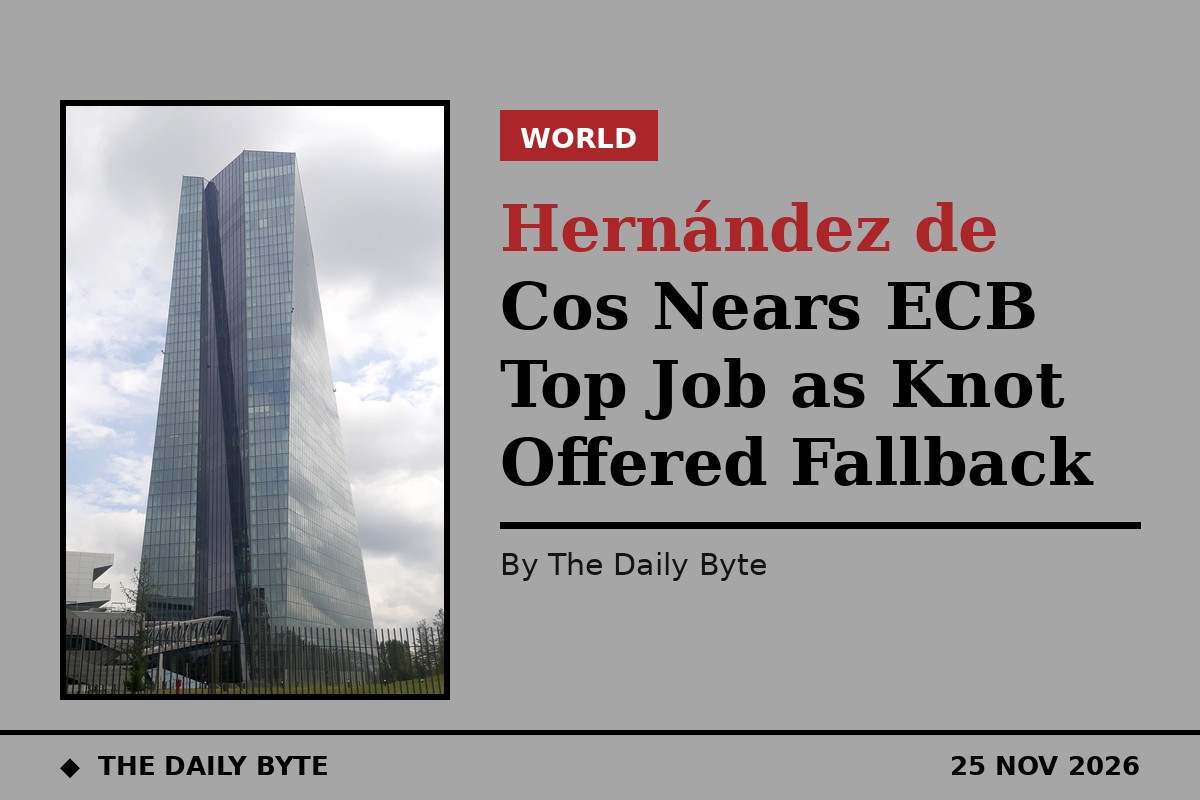
Pablo Hernández de Cos is poised to become the next president of the European Central Bank, with eurozone capitals working on a fallback role for his rival Klaas Knot to avoid a divisive vote at this week's EU summit.
Eurozone ambassadors are expected to adopt a recommendation on Wednesday 25 November and pass it to EU leaders, who meet in Brussels on Thursday and Friday. Under a Franco-German-backed package, the Spaniard would succeed Christine Lagarde, who steps down on 7 February 2027, months before her term was due to end.
The deal would give Germany the chief economist post, with Princeton professor Markus Brunnermeier nominated to replace Philip Lane when he leaves in May 2027, and France the executive board seat overseeing market operations, with former minister Laurence Boone succeeding Isabel Schnabel, who leaves in early January to join the International Monetary Fund.
Three jobs, one package
The succession has been negotiated as a single package covering three of the six seats on the ECB's executive board. Germany formally proposed Brunnermeier on Tuesday, a move that signalled Berlin's backing for Hernández de Cos, since the two posts were linked in the talks. People familiar with the discussions told Reuters that Germany would back the Spanish candidate for the presidency.
Hernández de Cos, 55, was governor of the Bank of Spain from 2018 to 2024 and now runs the Bank for International Settlements, often called the central bank of central banks. He also chaired the Basel Committee on Banking Supervision. If confirmed, he would be the first Spaniard to lead the ECB. Colleagues describe him as a consensus-builder, and economists at Mizuho have said his appointment would broadly preserve the gradual approach adopted under Lagarde, with a slightly more accommodative bias.
Knot, who led the Dutch central bank for 14 years until 2025 and chaired the Financial Stability Board, is the only other declared candidate. Historically regarded as a monetary policy hawk, he has more recently signalled openness to European joint borrowing. His candidacy had the backing of the Netherlands, but the emerging Franco-German understanding has weakened his chances, and officials say that if the nomination reaches a vote, Knot is likely to lose.
A fallback at the bailout fund
To smooth the outcome, negotiators are considering offering Knot the managing director role at the European Stability Mechanism, the Luxembourg-based bailout fund created during the eurozone debt crisis. The post is currently held by Luxembourg's Pierre Gramegna, whose five-year term expires in November 2027, although he is eligible for an extension. Knot became a part-time adviser to the ESM after retiring from the Dutch central bank in 2025.
The idea faces practical limits. Candidates for the fund's top job need backing from eurozone countries representing 80 per cent of its paid-in capital, and officials note that France, Italy and Spain all face elections in the coming months, making any current pledges of support uncertain by the time a formal vote is held. The Dutch government, unhappy at losing Berlin's support for Knot, has so far refused to step aside, raising the possibility that the matter moves to leaders for discussion at Thursday's summit.
The formal process is not yet complete. Eurozone finance ministers must agree a recommendation to the European Council, and the European Parliament and the ECB's governing council must be consulted before EU leaders make the final appointment. The decision requires a reinforced qualified majority: at least 16 of the 21 eurozone countries, representing at least 65 per cent of the bloc's population. Each executive board member serves a non-renewable eight-year term.
Leaders could settle the appointments at this week's summit, or at their next meeting on 17 and 18 December. Whoever takes over will face renewed inflationary pressures and the question of how the bank responds if stress in French government bond markets threatens to raise borrowing costs elsewhere in the currency area.


