ECB Warns AI Boom Risks Abrupt Market Repricing
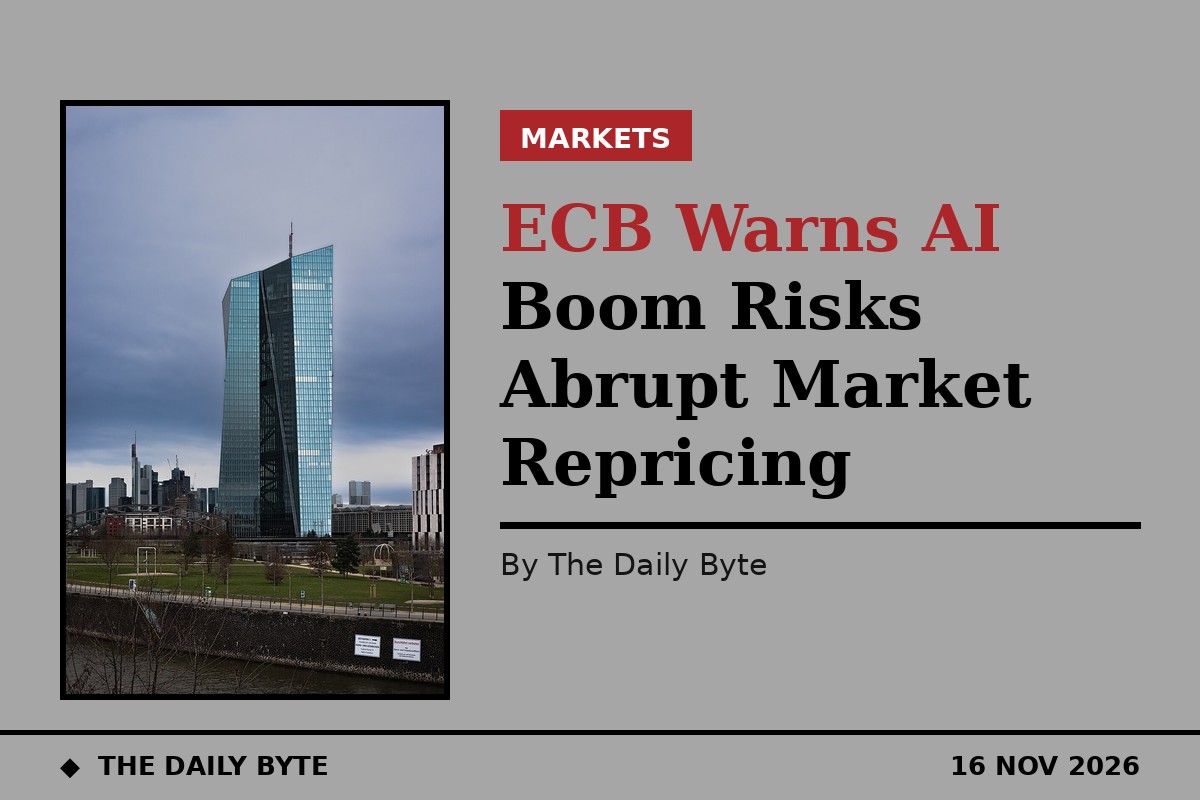
The European Central Bank has warned that a sudden loss of confidence in artificial intelligence could trigger an abrupt repricing in financial markets, with heavy losses for investors, as the AI boom and rising government debt emerge as the two biggest threats to eurozone financial stability.
ECB vice-president Boris Vujcic told an audience in Frankfurt on Monday, 16 November 2026, that AI and sovereign debt worries now stand out “very prominently” among the risks facing the 20-country euro area and require the attention of policymakers. His remarks came two days before the ECB publishes its twice-yearly Financial Stability Review.
From valuation worry to systemic risk
Vujcic said the nature of the AI risk has changed over the past year. Where the central bank once treated it mainly as a question of whether technology shares were overpriced, it now sees a systemic worry reaching into debt and equity markets, cybersecurity and the safety of day-to-day operations.
“A reassessment of the AI narrative may trigger an abrupt repricing in markets and significant valuation losses,” Vujcic said in a keynote speech at Euro Finance Week in Frankfurt. He added that such a reassessment could also trigger a surge in investment fund redemptions, forcing asset sales that would deepen the fall.
The warning matters for Europe because investment funds in the eurozone have become much more exposed to the AI sector, Vujcic said. A sharp fall in AI valuations would therefore hit the region directly, even though most of the companies at the centre of the boom are based in the United States.
Record borrowing behind the boom
Vujcic pointed to the scale of money now flowing into AI. Borrowing by large cloud and AI infrastructure providers has reached record highs this year, and cumulative capital spending by major US technology firms is projected to reach $5.5 trillion by 2030.
Equity issuance is also surging. The volume of new stock market listings, measured against the size of the US economy, is on track to exceed the peak reached during the dot-com boom of the late 1990s, Vujcic noted. Such surges have often coincided with market peaks in the past.
The warning comes in a week of high-profile tests for the AI trade. Nvidia, the chipmaker at the heart of the boom, reports quarterly results on Tuesday, while Anthropic, the maker of the Claude chatbot, is expected to start trading on Nasdaq on Thursday in what could be the second-largest stock market listing in history, raising about $61 billion and valuing the company at about $1.2 trillion.
Midterm falls a reminder to stay cautious
Vujcic said the market falls that followed the US midterm elections earlier this month, in which Democrats won both chambers of Congress, were a reminder to remain cautious about AI valuations. The falls were contained, he said, but they showed how quickly sentiment can turn when regulatory concerns rise.
The ECB has long highlighted debt sustainability among the eurozone’s weaker nations and stretched AI stock valuations as key vulnerabilities. What has changed, Vujcic said, is that both worries have become more acute over the past year, and the risk of a market repricing has increased rather than eased.
The US Federal Reserve’s own financial stability report last week found that AI was the top concern among market contacts, underlining that the unease is shared across the Atlantic.
ECB calls for tougher safeguards
Vujcic called for new safeguards to protect the financial system. He urged leverage limits on hedge funds, larger and more usable liquidity buffers at money market funds, and redemption terms at investment funds that are better matched to the liquidity of the assets they hold.
Europe’s ambition to increase non-bank financing for business must be accompanied by measures to preserve stability, he said, as the financing of AI expands from equity markets into debt markets and exposures become more concentrated.
The ECB’s Financial Stability Review, due on Wednesday, is expected to highlight the same two threats. Investors will be watching closely for any further detail on how the central bank judges the scale of the risk, and for any signal about how it expects policymakers to respond.
Source: Reuters