Ecuador Fishermen Sue Trump Over Drone Boat Attack
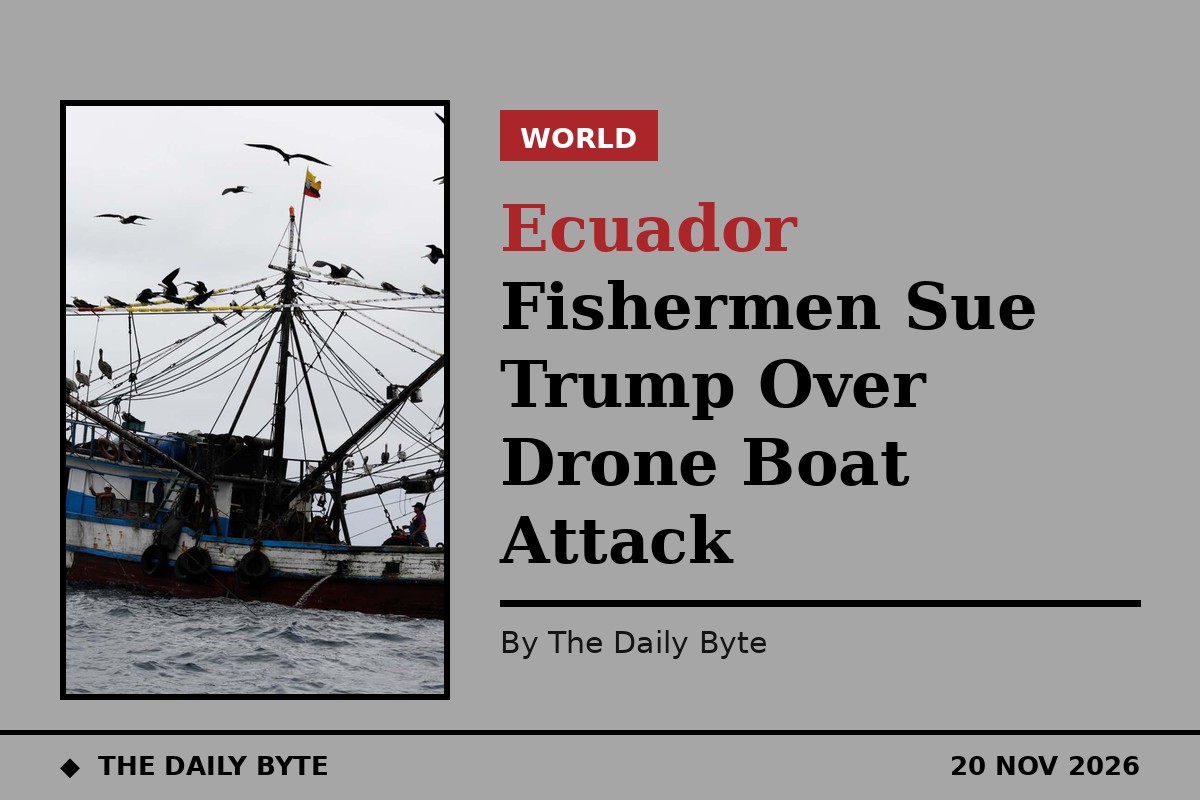
A group of Ecuadorean fishermen has sued the administration of President Donald Trump in a United States federal court, seeking damages for a drone attack in the Pacific Ocean that sank their vessel in March and injured members of the crew. The lawsuit, filed on Monday 16 November, is a direct legal challenge to the campaign of lethal strikes against boats that Washington says are carrying drugs.
The case was filed by the crew of the Negra Francisca Duarte II at a federal court in Pittsburgh, Pennsylvania. It seeks financial compensation and an order requiring the United States to end lethal boat strikes in the Caribbean and Pacific, as well as any other relief the court considers just.
According to the court filing, two separate armed drones launched from a vessel operated by the United States attacked the fishing boat on 17 March and set it ablaze. Two of the 16 crew members aboard suffered serious burns. All of the crew ended up jumping off the ship and into the sea, the filing says, before finding their way onto small emergency boats.
The crew say they then headed towards what they believed was a nearby tuna fishing boat, but were met by armed men speaking English and wearing military-style uniforms. They were subsequently transferred to a Salvadoran ship, which sailed them for seven days to a port in El Salvador.
The boat was all we had
The ship's captain, Hernan Flores, told Reuters by telephone that the crew had decided to sue because the boat was their livelihood. Nobody in Ecuador is helping us, he said, adding that the crew had enough evidence to show the lasting effects of the attack on the 16 crew members. The lawsuit describes the attack as part of an unprecedented and manifestly unlawful United States military campaign.
The crew's lawyer, Jorge Chiriboga, put the case in broader terms, saying that no country can go around the world trying to kill people and let impunity reign. Representatives of the White House and the United States Department of Justice did not immediately respond to requests for comment.
The United States government has claimed responsibility for airstrikes against what it calls narco-terrorists in the Pacific as part of Operation Southern Spear. But it has said it has no information about the attack on the Negra Francisca Duarte II and two other Ecuadorean vessels that were sunk earlier this year. The Washington Post reported in August that the ships were targeted as part of a CIA programme.
A wider campaign under scrutiny
The lawsuit says the United States has carried out 71 such strikes on boats across Pacific and Caribbean waters, killing at least 235 people since September 2025 and injuring many others. Those figures come from the fishermen's complaint, and they underline how far the campaign has spread beyond the single boat at the centre of this case.
The filing lands against a background of heavy United States activity against Ecuadorean vessels. From late August to mid-September, United States Southern Command said it intercepted and sank at least eight Ecuadorean vessels in the Pacific, saying they were being used as resupply points for drug traffickers working with the Ecuadorean criminal gang Los Choneros. The vessels collectively had about 160 crew members on board. Of these, 56 were released without charge by court order and 40 were acquitted for lack of evidence, while 50 are awaiting trial and 14 were not formally charged, according to Human Rights Watch.
The fishermen's case turns on a question that has followed the boat-strike campaign from the start: whether the United States is entitled to use lethal military force against civilian vessels at sea. The fishermen argue that, in the plain terms of international humanitarian law, there is no actual armed conflict that could justify the use of military force against the boats. The Trump administration has presented the strikes as a campaign against drug trafficking organisations it describes as narco-terrorists.
For the crew of the Negra Francisca Duarte II, the case is also personal. Their boat is gone, two of their number were seriously burned, and they spent a week at sea aboard a foreign ship before reaching land. Whatever the court decides about the legality of the campaign, their lawsuit puts the human cost of one strike on the record in a United States courtroom, with the crew's own account of what happened to them at the centre of it.


