Ecuador Prison Gangs Run Cocaine Trade From Jail
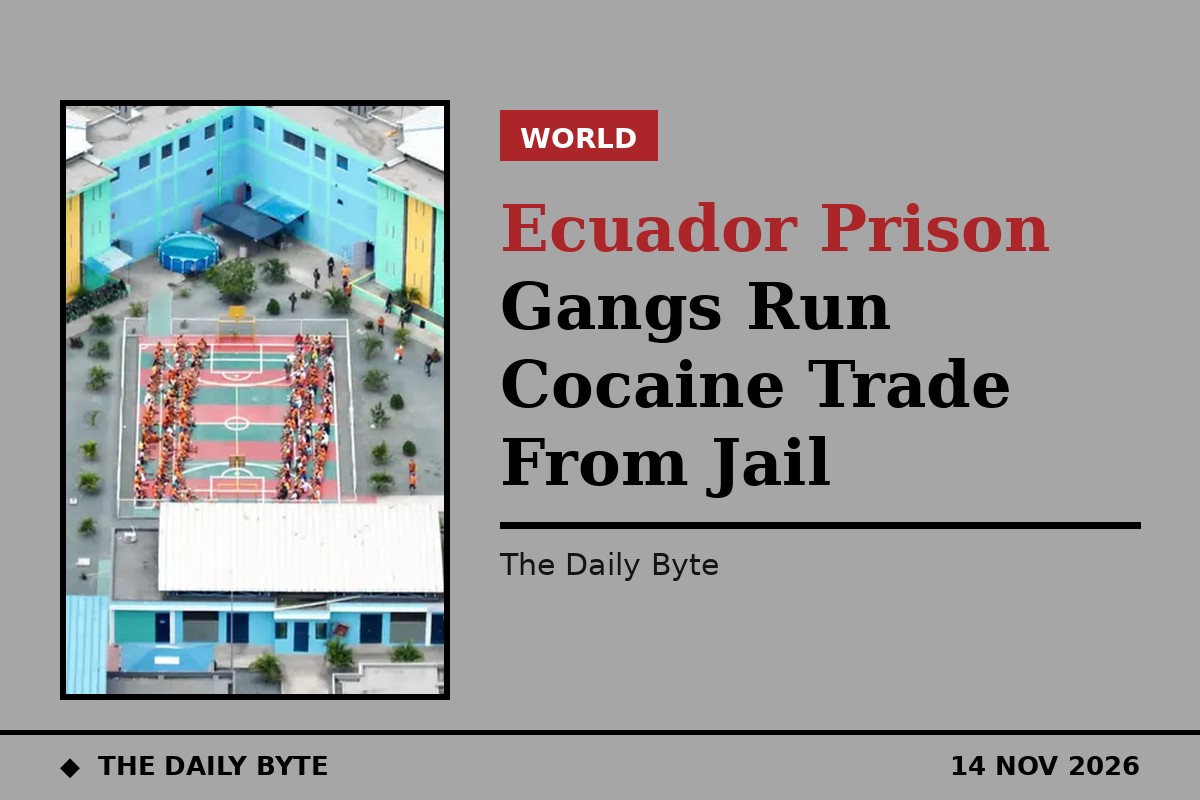
In Guayaquil, Ecuador's largest city and main port, gang members walk the streets carrying assault rifles and machetes. They move cocaine that ends up on streets from the American Midwest to the south of France. Few who defy them survive, not police officers, prosecutors or politicians. And much of this power is directed from an unlikely headquarters: the country's prison system.
Criminal organisations use Ecuador's prisons as command centres for operations far beyond their concrete walls, the authorities say. From inside their cells, gang leaders direct drug shipments, run extortion rings, corrupt officials and order killings. Once one of Latin America's most peaceful nations, Ecuador is now among its most dangerous, with homicides surging 800% since 2018 amid turf wars, score-settling and battles with law enforcement.
Gangs, not guards, in control
Inside the facilities, gangs rather than guards exert control. They decide who gets food, a bed or a mobile phone, and they charge for all of it. The extortion fees generate an estimated $200 million a year, according to the research group InSight Crime. Some gangs have stockpiled long guns and grenade launchers, and inside the prison walls they have built nightclubs and swimming pools and created luxurious cells with big-screen televisions and marble decorations.
Renato Rivera, an analyst at the Global Initiative Against Transnational Organized Crime, said: Whoever controls the prisons controls the streets.
The pipeline began with Jorge Luis Zambrano, leader of Los Choneros. Arrested on murder charges in 2011, Zambrano turned Los Choneros into Ecuador's dominant criminal outfit from behind bars, persuading smaller prison gangs to join an alliance that expanded the group's national footprint. His assassination at a shopping mall in December 2020, months after his release from prison, shattered that alliance and sent the country's drug war into overdrive. A record 331 prisoners were killed in 2021 in massacres between rival factions.
Noboa's crackdown has not broken their grip
President Daniel Noboa has made retaking the prison system central to his security strategy. In January 2024 he declared Ecuador in an internal armed conflict, designated 22 criminal groups as terrorist organisations and deployed troops to take over internal security in the prisons. He also opened a maximum-security prison designed for 800 inmates named El Encuentro, or The Encounter, intended to force crime bosses to face state authority in total isolation.
Yet the tactics have failed to curb the violence or the flow of drugs north. Last year was Ecuador's most violent on record, yielding a homicide rate double Colombia's and nearly triple Mexico's. At least 206 inmates were killed last year, and InSight Crime reports that there were more confirmed violent deaths in penitentiaries in 2025 than in the previous two years combined.
Researchers say military intervention and transfers to El Encuentro created power vacuums that sparked fresh waves of internal violence. John Henry Murdy, a University of Chicago researcher studying Ecuador's penal system, said the government was able to take control for a maximum of a few months. But we can now say they failed, he said.
Life inside the Litoral
At Guayaquil's sprawling Litoral Penitentiary, conditions remain dire despite the heavy military deployment. Troops have hit prisoners on the back with sticks and cables and fired tear gas at them, one inmate told the Wall Street Journal. A lack of food and squalor fuelled a tuberculosis outbreak amid widespread hunger that killed at least 800 inmates last year, according to Billy Navarrete, head of the Permanent Committee for the Defense of Human Rights in Guayaquil.
Families say gangs withhold meals from prisoners whose relatives cannot afford the extortion payments. Paul Zamora, 35, died in the penitentiary in February after being jailed for drug possession. His family could not afford the payments, so the ruling gang withheld his meals, and he developed severe malnutrition, tuberculosis and scabies before suffering a fatal cardiac arrest. Santiago Hidalgo died in July 2025, eight months after entering the Litoral, after also being denied food for not paying shakedown fees. His mother said he drank water from the toilet tank and was, in her words, pure bones.
Noboa's government now plans to hand oversight of the prisons back to the country's penitentiary agency, with new mobile phone signal jammers, more intelligence work and the separation of violent inmates from minor offenders. It is hiring retired police and military personnel to address guard shortages, and it says it will build another prison for 15,000 inmates, where prisoners will be required to work to cover the state's incarceration costs.
Former officials say the biggest challenge will be stemming the corruption that lets the gangs thrive: with drug traffickers holding so much money, it is easy to co-opt staff on modest salaries to smuggle in a phone for thousands of dollars. Source: The Wall Street Journal | Source: InSight Crime


