Edinburgh Senate Demands Answers Over 90 Course Closures
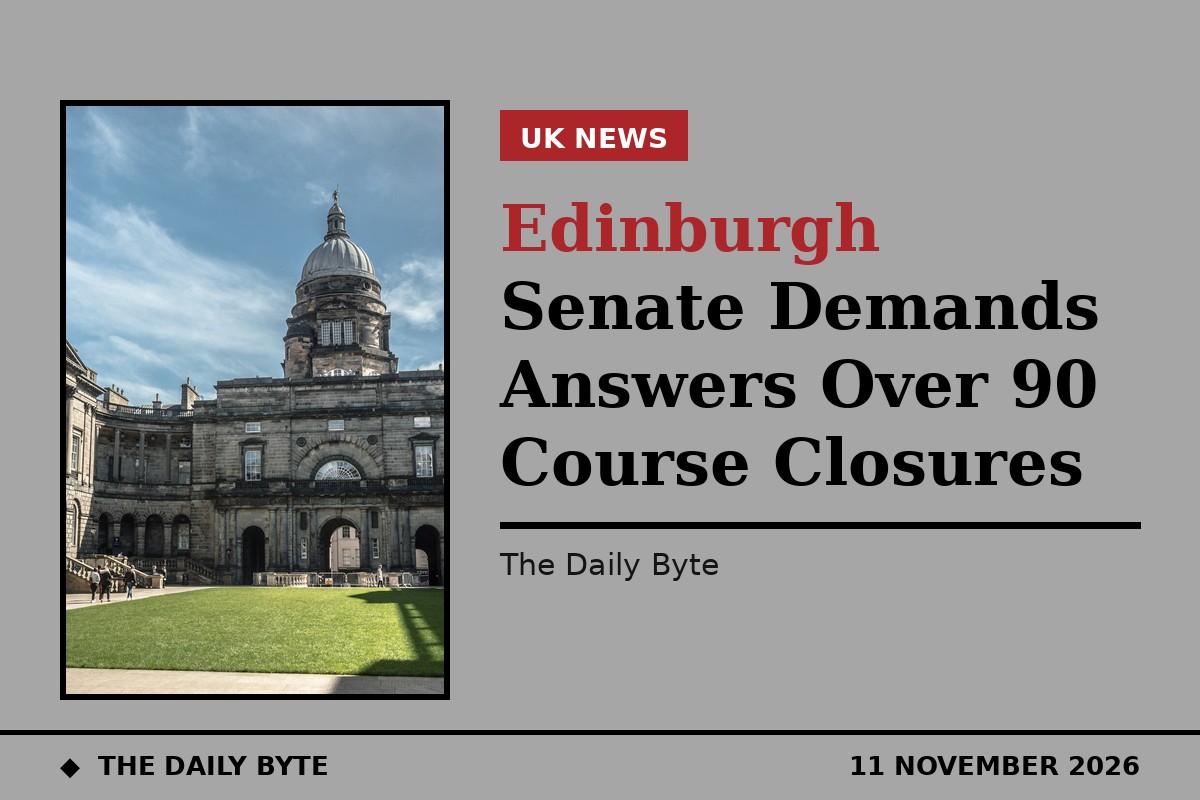
The University of Edinburgh's senate meets on Wednesday 11 November 2026 to demand transparency over spending cuts that have seen around 90 degree programmes closed to new students, after senators accused senior managers of pushing the changes through without proper academic oversight.
Senators will put forward a motion asking Principal Peter Mathieson to provide a full report listing every programme closure approved since 1 August 2025. For each closure, the report would have to record when it was considered, which committee approved it, what student involvement took place, and, for joint and interdisciplinary programmes, what engagement there was with partner boards and external partners.
The motion argues that approving and closing degree programmes is a matter of regulating and superintending the teaching of the university, and therefore falls within the senate's statutory remit. Senators say that role has been sidelined.
The 'shadow-Senate' allegation
The meeting follows a 24-page report compiled by 25 senators and published earlier this month, which accuses university management of circumventing the senate — the university's senior academic body, with 300 members — to close more than 90 degree programmes and make £140 million of cuts to the annual budget.
The report says senior leadership has created opaque "parallel" bodies inside Corporate Services to push the cuts through without proper oversight, and describes the University Initiatives Portfolio Board, chaired by Provost Kim Graham, as "now running the entire programme of the superintendence and regulation of teaching and discipline [...] that by law belongs to Senate".
"Effectively, the Senior Leadership of the university has produced a shadow-Senate designed to circumvent normal statutory governance," the report says.
The senators say they have tried repeatedly to scrutinise the changes, citing a motion of no confidence in the executive's financial leadership in May 2025 and a vote asking that restructuring proposals be approved before taking effect. They say the motion "has been ignored", and that requests for meeting papers and minutes were refused in an unsigned letter from the university's Strategic Change Service.
The scale of the cuts
The programme closures, first reported in September, mean no new students will enter the affected programmes from the 2027-28 academic year, although current students will be able to finish their degrees. The biggest impact falls on the School of Literatures, Languages and Cultures, which is losing 48 programmes, including courses in Celtic, Scottish literature and Scottish ethnology, as well as many joint honours language degrees. Other closures span divinity, the Edinburgh College of Art, economics, history, classics and archaeology, and the law school.
The closures form part of a plan to cut £140 million from the university's annual budget, including £90 million from staff salaries. At least 950 members of staff have been made redundant since the savings drive began, according to earlier reporting, and trade unions have warned that as many as 1,800 jobs could ultimately be at risk. Five weeks of strikes have taken place during the 2026-27 academic year.
The senators' report also raises the role of private consultants. Freedom of information disclosures show PA Consulting, Nous Group and Bramble Hub have been paid more than £450,000 over the last two academic years for work on the university's strategic change programme, including business transformation workshops across human resources, finance and planning. As private firms, they are not subject to freedom of information law and are not required to report to the senate.
The university's response
The university has disputed the senators' report, saying it "includes a number of inaccuracies" about its governance processes. A spokesperson said the university was committed to adhering fully to its governance frameworks and rejected any suggestion to the contrary.
Sir Peter Mathieson, the principal, has previously defended the cuts as necessary to put the university on a firm financial footing, while insisting there is no deficit. He has said the university made £73 million of savings in the 2025-26 financial year, largely through voluntary severance, and ended the year with a £16 million surplus. He has also rejected claims circulating on social media, including suggestions that Celtic and Scottish studies provision would be cut altogether.
What happens next
If the motion passes, the principal will be expected to bring the requested report to the next available meeting, setting out how each closure since August 2025 was decided.
The dispute comes at a sensitive moment. Sir Peter announced recently that he will leave the post in early 2028, after a decade in charge, and the cuts programme — and the argument over who should control it — will remain unresolved when he goes. For students and staff, the immediate question is simpler: whether the senate, the body legally charged with overseeing teaching, will finally be given the full picture of what has been closed, and why.


