Édouard Philippe Pledges Retirement Age of 65 and End of 35-Hour Week to Save France from Debt Crisis
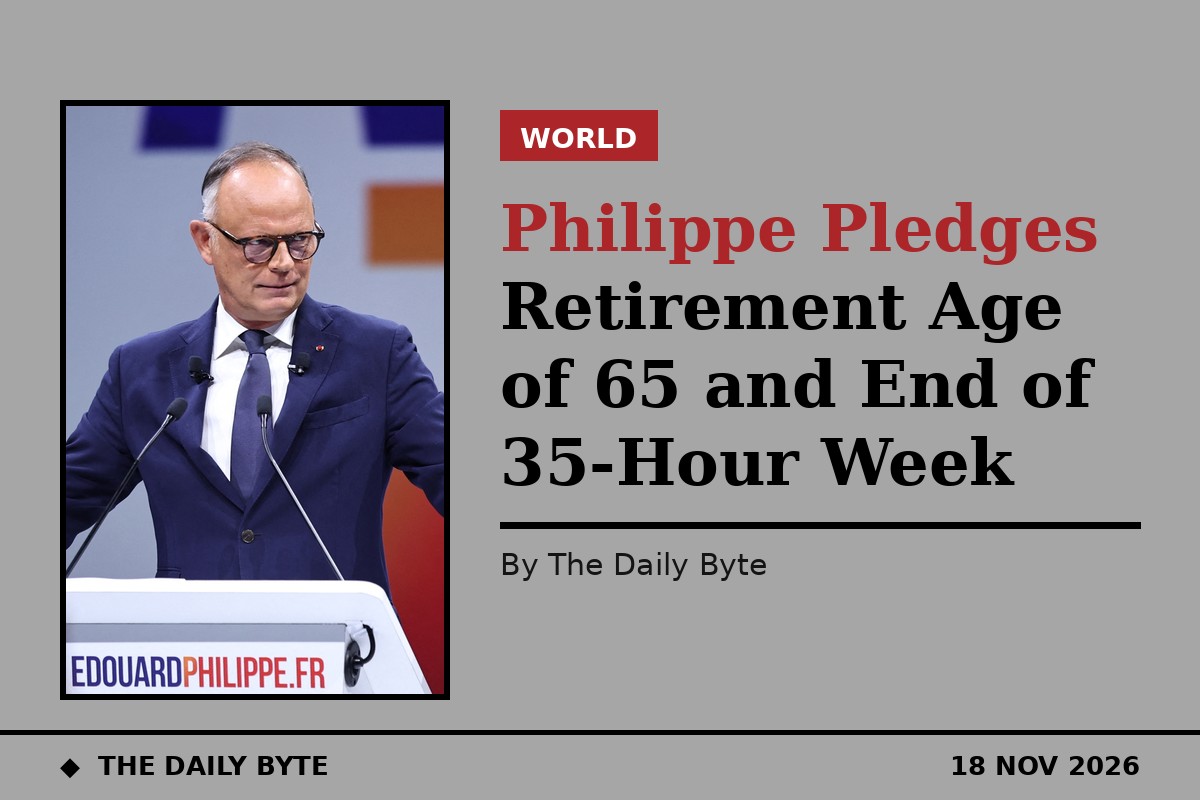
French presidential candidate Édouard Philippe has promised radical economic reforms, including raising the retirement age to 65 and scrapping France's statutory 35-hour working week, warning that the country is on the verge of a spiralling financial crisis.
Philippe, a former prime minister under President Emmanuel Macron, set out the measures at a press conference in Paris on Wednesday, 18 November. He said France could no longer avoid tough decisions to bring down a budget deficit that has pushed the country's borrowing costs sharply higher.
"Our destiny could escape us"
"We're at risk of seeing our destiny escape us," Philippe told the press conference, adding that France could end up being humiliated by its creditors.
"Many of our fellow citizens think I'm exaggerating. I wish I was wrong. But we're close to the situation Italy, Greece and Portugal have known," he said, referring to the eurozone debt crisis of 2010 to 2012, when several southern European countries were forced to adopt tough austerity measures under pressure from financial markets.
France has so far avoided comparable spending cuts, with pension reforms in particular repeatedly watered down or delayed. Philippe said his programme would aim to cut the budget deficit to below the European Union's mandated 3% limit by the end of the next five-year presidential term.
The scale of France's debt problem
French public debt stood at 119% of gross domestic product at mid-year, the third-highest in the eurozone after Greece and Italy, according to figures cited by Reuters. The budget deficit is expected to reach 5.5% of GDP this year, the highest among the 21 eurozone members, according to the European Commission.
France has one of the lowest retirement ages among developed economies. A 2023 reform to raise it gradually to 64 from 62 was suspended last year, leaving the minimum age for a full pension at 62.9. Philippe proposes raising that to 65 and ending the 35-hour week, a landmark of French labour law.
A crowded race to the run-off
Philippe is struggling in opinion polls, which suggest he will fail to reach the second-round run-off in next spring's election. Far-right candidate Marine Le Pen and hard-left leader Jean-Luc Mélenchon have topped the polls for the April-May election for the past few months, putting Philippe under pressure to revive a lacklustre campaign.
His pension proposals stand in sharp contrast with those of his rivals. Le Pen said on Tuesday that, if she won the election in May, she would allow workers who started young to retire between 60 and 62 after contributing for 40 to 42 years, depending on the age they entered the workforce. Mélenchon would bring the retirement age down to 60.
The retirement-age proposal is not new: Philippe first set out the case for retiring at 65 in September, as reported by Business Day. Wednesday's press conference packaged it with the 35-hour-week pledge and a stark warning about France's public finances. The first round of the presidential election is due on 18 April, with a second-round run-off likely on 2 May, Reuters reported.
Frequently asked questions
What is Édouard Philippe proposing? He proposes raising France's retirement age to 65 from the current 62.9 years and scrapping the statutory 35-hour working week, aiming to cut the budget deficit below the EU's 3% limit.
When is the French presidential election? The first round is due on 18 April 2027, with a second-round run-off likely on 2 May 2027.
How do his rivals differ on pensions? Marine Le Pen would let early starters retire at 60 to 62, while Jean-Luc Mélenchon would bring the retirement age down to 60.


