Egypt Adds 35 Groups, 36 People to Terror Lists
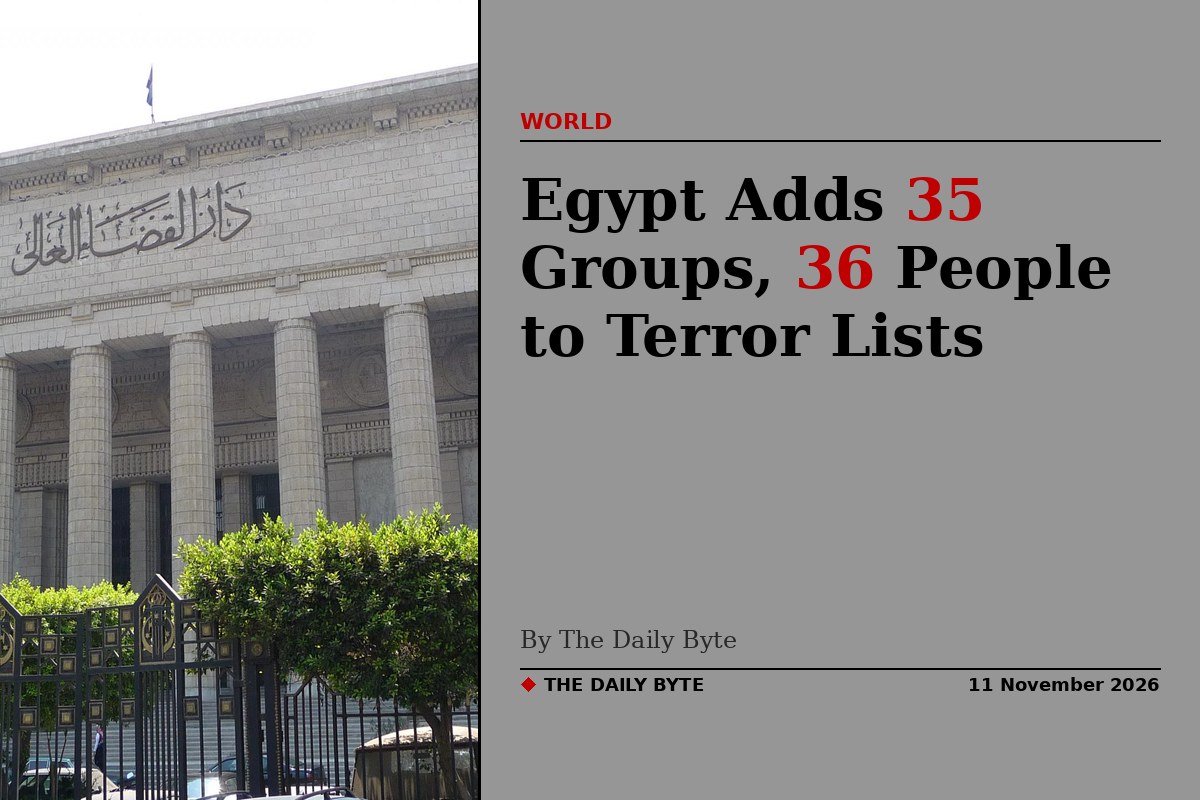
An Egyptian court has placed 35 organisations and 36 individuals on the country's lists of terrorist entities and terrorists for five years, in a ruling that reaches well beyond Egypt's borders to associations and institutions operating across Europe. The Cairo Criminal Court decision was published on 10 November in a supplement to Egypt's official gazette, and was reported on 11 November.
The ruling was issued in case number 11108 of 2026, registered with the Supreme State Security Prosecution. Among the organisations named is the Council of European Muslims, a Brussels-based umbrella body, along with a series of affiliated institutions concerned with religious guidance, education and community affairs. The 36 individuals appear on a separate list from the organisations.
Which organisations are named
According to reporting of the gazette publication, the decision covers Islamic institutions and associations active in several European countries, including France, Britain, Switzerland, Germany, Sweden and Italy. Named bodies include the European Council for Fatwa and Research, the European Council of Imams, the European Islamic Forum for Students and the European Institute for the Humanities, alongside branches of the Council of European Muslims itself.
The individuals listed are described as holding leadership and administrative roles in these institutions. The decision subjects them to legal and precautionary measures under Egypt's anti-terrorism legislation, which can include travel restrictions and asset freezes.
What a listing means under Egyptian law
A listing on Egypt's terrorist entities list is not itself a criminal conviction, and the specific conduct attributed to each organisation or individual has not been independently established. Under Egyptian law, designation can bring a prohibition on activities, the closure of premises, limits on meetings and financing, and the freezing of covered funds and assets.
The practical effect on any particular organisation or person depends on the applicable legal provisions and their circumstances. The ruling does not by itself establish what assets, if any, a named organisation holds in Egypt, or whether a specific asset has been frozen.
Egyptian law also provides a route to challenge a listing before the Court of Cassation within 60 days of its publication. It has not been established whether any of the people or organisations covered by this decision intend to challenge it.
No automatic effect in Europe or the UK
Some of the organisations covered by the Egyptian ruling operate in European countries. That does not mean the Egyptian designation automatically places them on a European Union or UK terrorist list. Each jurisdiction has its own legal framework and decision-making process, and an Egyptian court order is not itself a UK proscription decision.
The Council of European Muslims describes itself as an independent, non-governmental and non-profit body serving Muslim communities and encouraging participation in European society. It has previously rejected portrayals of its work as part of an extremist political project, including in relation to a French government report published in 2025. That earlier response was not a response to the new Egyptian decision.
Wider legal background
Egypt introduced its law on terrorist entity and individual lists in 2015, and the legislation has since been amended. Legal analysis has noted that changes made in 2020 broadened the scope of assets that could be frozen following a listing, compared with the original law's focus on assets used in terrorist activity.
Legal analysts have also criticised the breadth of the law's definitions and questioned the procedural protections available to those affected. Those criticisms concern the legal framework generally and do not establish what occurred in each case covered by the latest ruling. For the organisations and individuals named, the five-year listing now sets the terms of a legal process that will play out in Cairo, and potentially in European capitals, in the months ahead.


