Egypt Train Crash Inquiry: Safety System Disabled
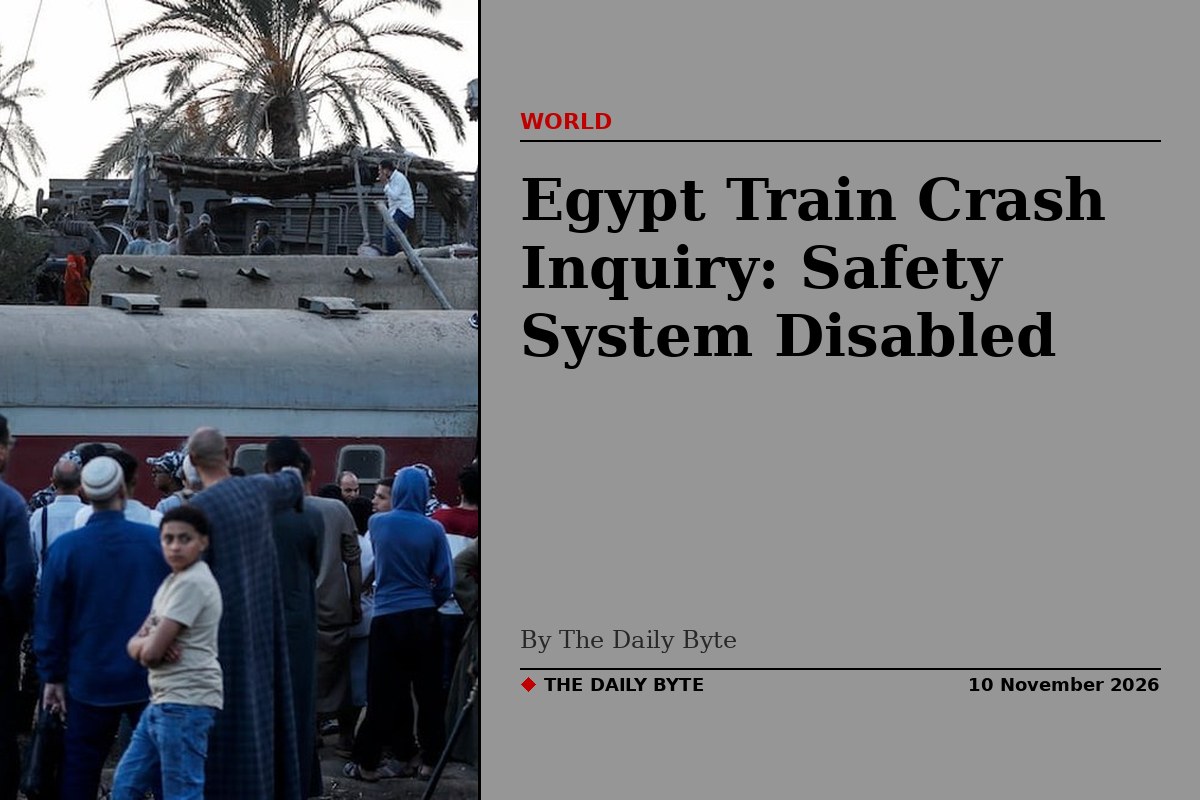
Egypt's Public Prosecution has said the driver of a passenger train disabled its automatic safety system before the train struck a stationary service at al-Ayyat, south of Cairo, killing seven people and injuring more than 100.
The collision happened on the afternoon of Sunday, 8 November 2026, in the al-Ayyat district of Giza governorate, about 52 kilometres south of Cairo. Train No. 134, the Giza-to-Fayoum Tahya Misr service, struck the rear of Train No. 2010, the Cairo-to-Aswan service, which was stationary on the same track. Both trains were travelling in the same direction.
Four passenger carriages derailed in the collision, and several fell down an embankment. The driver of Train No. 134 was among the seven people killed.
What the prosecution found
In a detailed statement issued on Monday, 9 November, after a technical examination by a committee of professors from Cairo University's Faculty of Engineering, the Public Prosecution said examinations of the train's automatic control system and station equipment showed the driver of Train No. 134 had disabled it.
The automatic train control system monitors train speeds, checks compliance with track speed restrictions and applies the brakes automatically if a driver fails to respond to a signal or exceeds the permitted speed.
Investigators also found failures at Al-Raqqa station. The head of the Central Administration for Signals and Telecommunications confirmed that the station controller and the station master had failed to monitor the control panel, which displays the status of signal tower T-10. Both acknowledged the failure during questioning, according to the prosecution.
Investigators further found that the station controller had tampered with the signal logbook in an attempt to conceal his failure to monitor the panel.
Three detained as inquiry widens
Detention was ordered on Monday pending investigation for two Al-Raqqa station employees, the controller and the station master, and for the assistant driver of Train No. 134 until he could be questioned. The driver himself could not be questioned because he died in the crash.
The Public Prosecution also questioned the chairman of Egyptian National Railways and several of his deputies, along with officials responsible for infrastructure, maintenance, operations, safety, quality, signalling and telecommunications.
Its teams visited hospitals in Giza and Beni Suef to interview injured passengers, examined the bodies of the dead and heard statements from relatives. The engineering committee was directed to evaluate operational and monitoring systems, equipment, human resources, signalling systems and the effectiveness of development projects.
President Abdel Fattah al-Sisi ordered an urgent investigation on Sunday and said anyone found to have been negligent would be held accountable. The investigation continues, and the findings so far are at the investigation stage, not convictions.
Minister faces parliament today
The House of Representatives' Transport and Communications Committee is holding an emergency session on Tuesday morning, 10 November, on the collision. The committee summoned Transport Minister Kamel El-Wazir, who visited the site of the collision on Sunday.
The committee says the meeting is intended to establish the real causes of the crash and to find practical solutions. Some lawmakers from the government's own coalition have gone further, with MPs calling on the minister to take political responsibility and resign. The minister has not resigned.
The Health Ministry's injury figures moved during Sunday as casualties were counted, with the Associated Press reporting at least 125 injured. The ministry said 71 injured passengers had been discharged after treatment, while others remained in hospitals in Giza and Beni Suef. More than 70 ambulances were deployed, and traffic on the line was running normally again by Monday morning, the railway authority said.
A district with a troubled rail record
Al-Ayyat has seen rail accidents before. On 10 September 2026, two freight trains collided at Al-Balyada station in the same district, injuring a driver and his assistant. In September 2016, a derailment at El-Ayyat killed five people and injured 27.
The Public Prosecutor has directed the engineering committee to review records of previous railway accidents to identify common factors and recurring causes, and to identify anyone whose failure to perform their duty contributed to the accident, regardless of their position.


