Egypt First Outside Europe in EU Digital Signature Trust
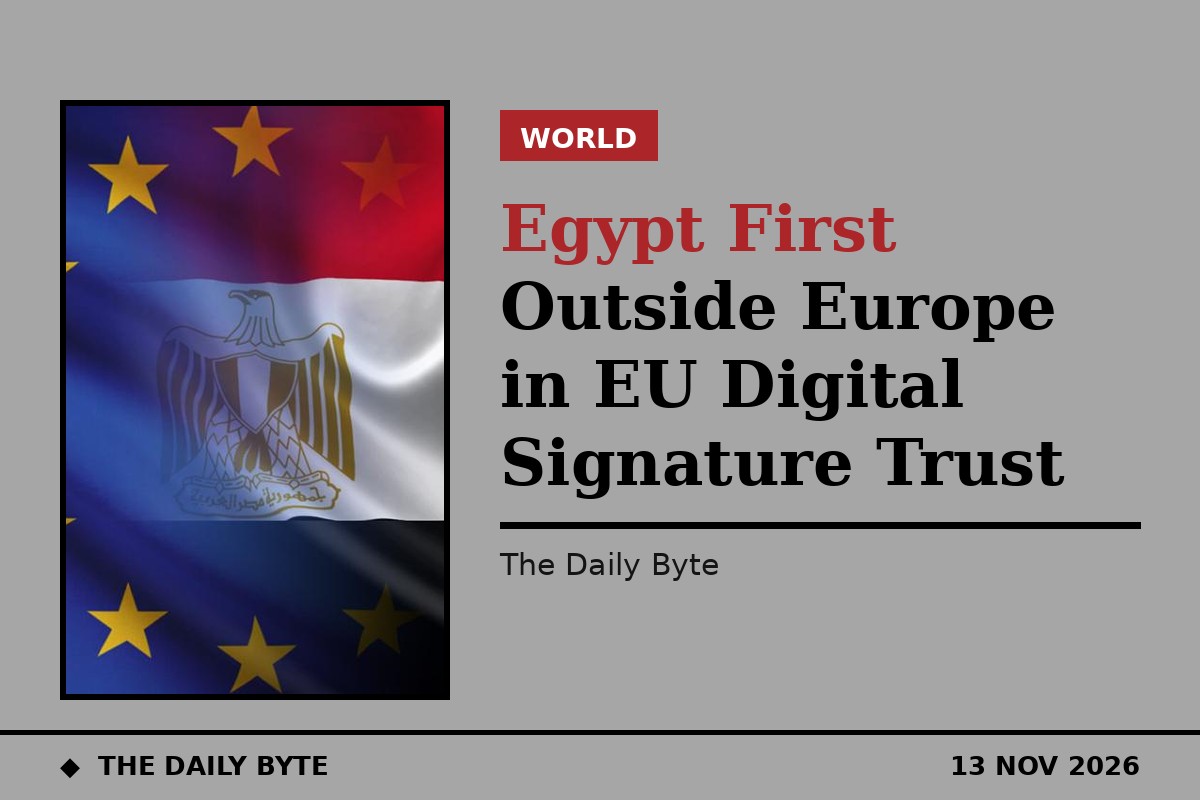
Egypt has become the first country outside Europe whose electronic signatures framework is technically aligned with the European Union’s, in a milestone for digital trade between the two sides. The European Commission said the achievement follows the successful technical assessment of Egypt’s Trusted List for Electronic Signatures and Seal Schemes under the EU’s eIDAS Regulation.
Egypt will now be incorporated into the EU Third Countries Trusted List, confirming that EU and Egyptian electronic signature and seal schemes are technically compatible and can be validated by EU member states, the Commission said in a statement published on 12 November and updated on 13 November.
What the deal means in practice
The alignment allows electronic documents, contracts and official seals to be verified across borders with an advanced level of trust, simplifying exchanges for governments and businesses. An administrative arrangement has been signed between Egypt’s Information Technology Industry Development Agency (ITIDA) and the European Commission to put the cooperation into effect, EuropeSays reported.
The technical assessment was carried out by European Commission services together with Egypt’s Ministry of Communications and Information Technology and ITIDA.
A summit pledge delivered
The milestone is a deliverable of the EU-Egypt Summit of 22 October 2025 and forms part of the EU-Egypt Strategic and Comprehensive Partnership, which set out a shared interest in deeper digital cooperation. The partnership itself dates from March 2024.
For Egypt, the first-of-its-kind recognition positions Cairo as a digital bridge between Europe, the Middle East and Africa, and removes a layer of paperwork that has slowed cross-border business. The Commission said the step will facilitate exchanges based on electronic documents, according to its statement.


