Egypt IMF Deal Unlocks $2.3bn in Final Loan Review
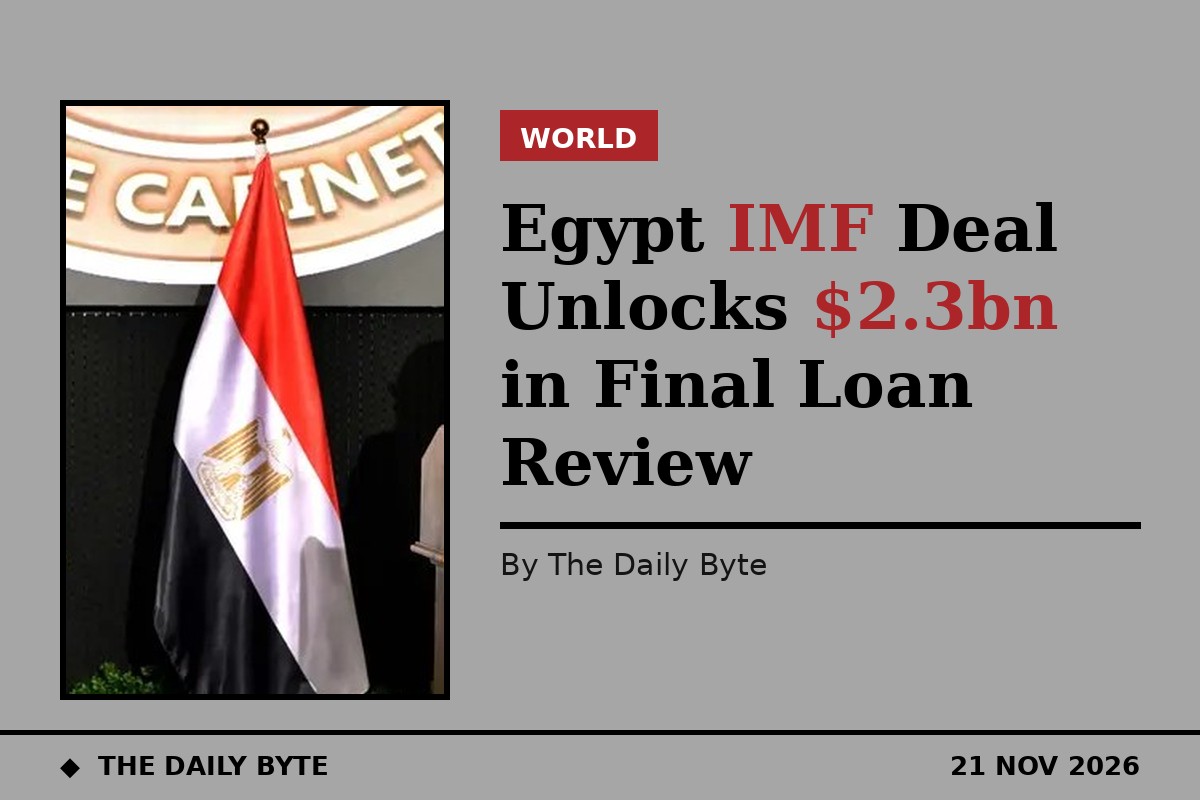
Egypt has reached a staff-level agreement with the International Monetary Fund on the final review of its $8 billion loan programme, a step that would release about $2.3 billion if the Fund’s Executive Board approves it.
The agreement was announced by the IMF on Tuesday, 18 November. It covers the eighth and final review of Egypt’s 48-month Extended Fund Facility and the third review of its Resilience and Sustainability Facility, which finances climate-related reforms.
An IMF mission led by Amine Mati held talks with the Egyptian authorities in Cairo from 25 October to 5 November, with virtual discussions continuing from 7 to 15 November.
About $1.5bn plus up to $800m
Subject to approval by the IMF Executive Board, Egypt will receive a disbursement of SDR 1,113.02 million, about $1.5 billion, under the Extended Fund Facility, and up to SDR 600 million, about $800 million, under the Resilience and Sustainability Facility. Together that would be up to about $2.3 billion.
Total disbursements under the two arrangements would then reach SDR 7,111.69 million, about $9.6 billion, which is everything approved under them. The programme began in December 2022 as a $3 billion loan and was enlarged to $8 billion in March 2024. It runs until 15 December 2026, and the IMF said in October that it aimed for board approval before the arrangement expires. No date for the board’s decision has been given.
The staff-level agreement is the deal Fund staff must strike before the Executive Board can vote. Staff will now prepare a report that, subject to approval by IMF management, goes to the board for discussion and decision.
Growth of 5.1 per cent
The IMF said the authorities’ implementation of their economic reform programme and their response to the implications of the Middle East war had helped preserve macroeconomic stability and supported Egypt’s resilience in the face of a series of external shocks.
Real GDP growth reached 5.1 per cent in the 2025/26 financial year, which ended on 30 June, supported by the recovery in Suez Canal and petroleum-related activity and continued strength in manufacturing, tourism and communications. Inflation outcomes, while still elevated, have been more favourable than expected.
The Fund welcomed the 100-basis-point rise in policy rates by the Central Bank of Egypt in October, saying it underscored the bank’s commitment to price stability. It said maintaining an appropriately tight, forward-looking and data-dependent monetary policy stance remains essential to contain inflation and bring it towards the central bank’s target of 7 per cent, plus or minus 2 percentage points, in the final quarter of 2027.
Higher imports have widened the current account deficit, but the IMF said the authorities had responded with appropriate policies, including by allowing the exchange rate to adjust, which helped preserve gross reserves comfortably above the Fund’s reserve adequacy metric.
Debt, divestment and the risks ahead
On the public finances, the IMF said fiscal performance remained strong, with the end-September primary surplus and tax-revenue targets exceeded. The authorities remain committed to achieving a primary surplus of 5 per cent of GDP in 2026/27 and to reducing gross financing needs by 5 per cent of GDP in that year through maturity extensions, voluntary liability-management operations and divestment proceeds.
Staff welcomed the successful completion of the Banque du Caire initial public offering and the authorities’ plans to accelerate the divestment of state-owned assets. The newly unveiled National Economic Transformation Program provides a roadmap to accelerate reforms, while the executive plan for implementing the State Ownership Policy should help strengthen competitive neutrality, oversight and transparency.
Downside risks remain significant, the IMF said. Escalation of regional conflicts could disrupt trade and investment and, alongside tighter global financial conditions, trigger capital outflows and raise borrowing costs, while high debt and financing needs remain key vulnerabilities. Conversely, easing tensions, stronger Suez Canal activity and faster reform implementation could further lift growth.
President Abdel Fattah al-Sisi has indicated Egypt does not plan to seek another IMF arrangement after the current programme ends. The government’s task now is to manage the monetary trade-offs while cutting reliance on official financing, and to convert IMF-backed stability into durable private investment.