Egypt, Sudan Agree Reconstruction and Red Sea Pact
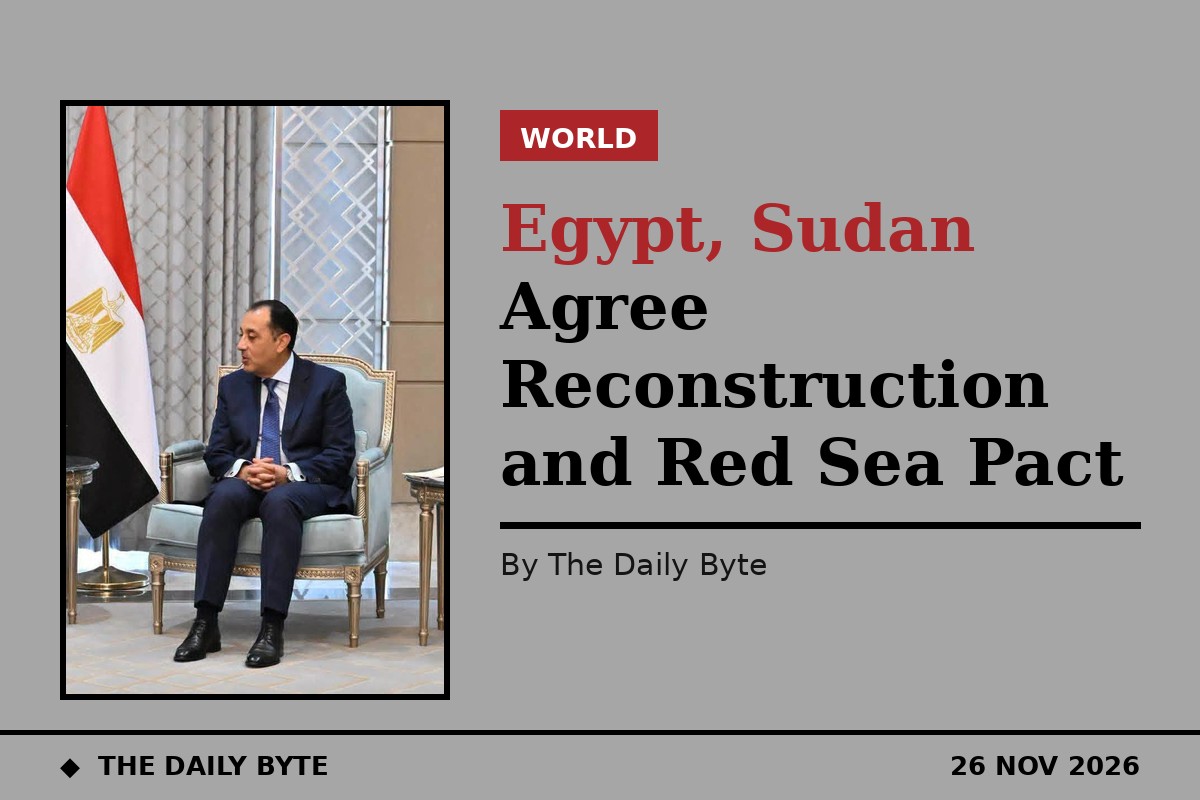
Egypt and Sudan have agreed to prioritise Sudan's postwar reconstruction and to reject any attempt to militarise the Red Sea, in a joint statement issued after talks in Cairo.
Egyptian President Abdel Fattah al-Sisi and Sudanese Prime Minister Kamal Idris met at the Ittihadiya Palace on Monday 24 November. Al-Sisi reaffirmed Egypt's support for Sudan and its national institutions, and stressed the need to translate political solidarity into practical economic and development projects aimed at restoring stability and rebuilding state institutions.
The two sides agreed to strengthen bilateral economic cooperation, with Egypt pledging full support for Sudan's national reconstruction efforts and readiness to help rehabilitate infrastructure and the industrial and agricultural sectors. Egyptian companies will be welcomed to take part in reconstruction projects, and the two governments agreed to expand trade, investment and cooperation in health and education.
Red Sea for its coastal states only
On the Red Sea, the joint statement asserted that governance of the waterway belongs exclusively to its littoral states under international law. Cairo and Khartoum rejected any maritime access granted to non-coastal countries at the expense of the sovereignty, territorial integrity or ports of coastal states, as well as attempts to exploit regional conditions to militarise the waterway.
The two sides also underscored the importance of respecting freedom of navigation in the Red Sea. The statement follows a series of recent engagements in which Egypt and Sudan have coordinated with Eritrea and Somalia on Red Sea security, including a summit at New Alamein on 4 October and trilateral foreign ministers' talks involving Egypt, Sudan and Eritrea in November.
The alignment has sharpened amid Ethiopia's renewed push for sovereign maritime access, which Cairo and its allies view with concern. The two governments also condemned attacks by drones launched from a neighbouring country against civilians and infrastructure in Sudan, particularly electricity stations and water facilities.
Al-Sisi directed Egyptian authorities to prioritise arrangements for the voluntary return of Sudanese nationals and their movement between the two countries, and called for a plan to repatriate Sudanese prisoners held in Egyptian prisons so they could serve the remainder of their sentences in Sudan. The two sides agreed to expedite the resolution of issues concerning detainees in both countries.
On water security, the two sides affirmed the interdependence of Egyptian and Sudanese water security, their adherence to their water rights under the 1959 agreement, and their rejection of unilateral measures concerning the Grand Ethiopian Renaissance Dam.
Idris, in turn, said his visit aimed to launch Sudan's reconstruction process and expand economic cooperation with Egypt. He sought Egypt's support in restoring Sudan's standing and participation in the African Union and other continental institutions, and outlined his government's intention to initiate an inclusive intra-Sudanese dialogue aimed at building national consensus, addressing humanitarian concerns and laying the groundwork for reconciliation.
The joint statement also rejected the establishment or recognition of any parallel entities in Sudan, and reaffirmed the close interconnection between the national security of the two countries. Idris invited his Egyptian counterpart, Mostafa Madbouly, to visit Sudan to follow up on the outcomes of the talks.


