Egypt to Restore 100 Shut-In Oil Wells with Weatherford
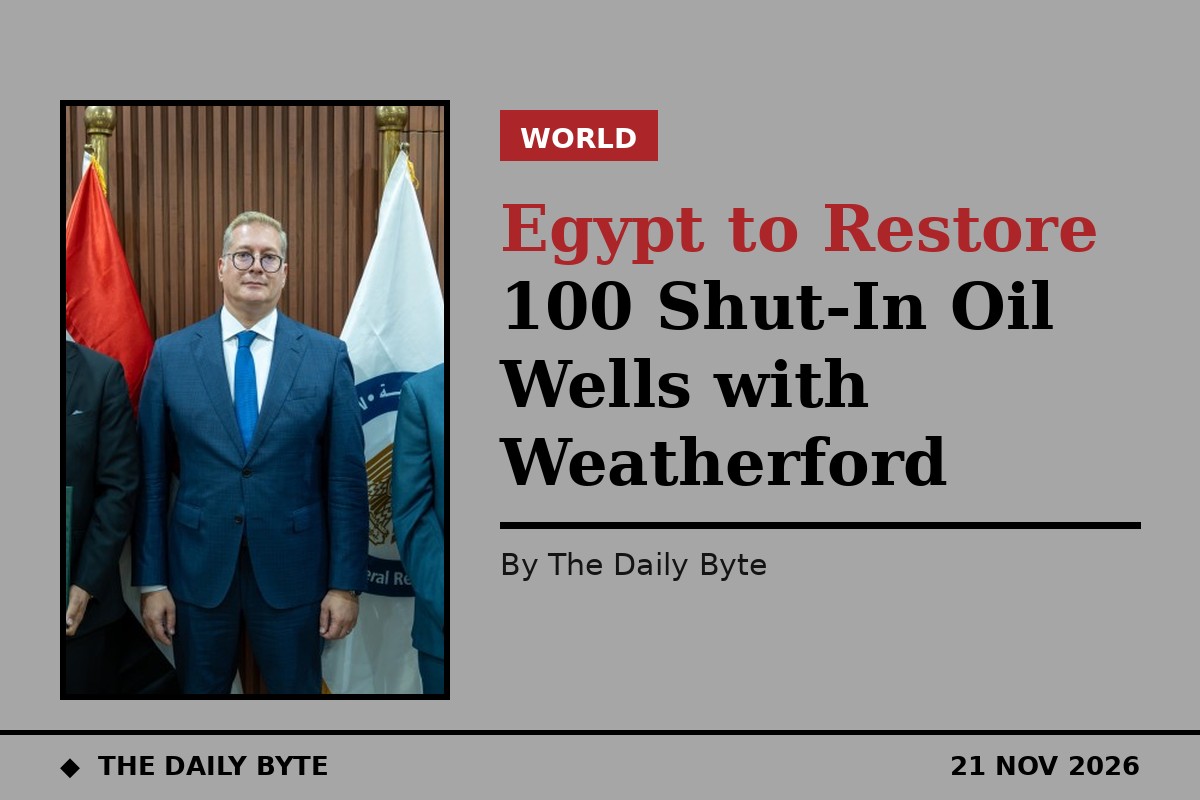
Egypt has signed a framework agreement with US oilfield services company Weatherford International to bring about 100 shut-in oil wells back into production within 18 months. The state-owned Egyptian General Petroleum Corporation signed the deal with Weatherford, witnessed by Minister of Petroleum and Mineral Resources Karim Badawi, according to a ministry statement reported on Friday 20 November.
The programme will cover onshore and offshore production areas across Egypt and is aimed at boosting domestic output. Shut-in wells are wells that have stopped producing, often because of technical problems or ageing infrastructure, but which may still hold recoverable oil and gas. Rather than drilling new wells, the project will work through the existing ones, assessing each for its production recovery potential.
Artificial intelligence will be used to analyse data from the shut-in wells and select the most suitable technical intervention for each well. The work will use rigless intervention technologies, meaning maintenance and repair operations can be carried out without the need for drilling rigs, saving time and costs and speeding the return of wells to production.
From discussion to signing in two weeks
The agreement was signed by Salah Abdel Karim, chief executive of the Egyptian General Petroleum Corporation, and Osama El-Shanoufi, Weatherford's GeoZone manager for Northeast Africa. Girish K. Saligram, Weatherford's chairman and chief executive, joined by video conference, and the signing was attended by Amr Ashraf, head of the central administration for the minister's office.
Saligram said only two weeks had passed between the first discussion of the project with the petroleum minister on the sidelines of the Abu Dhabi International Petroleum Exhibition and Conference, known as ADIPEC, and the signing of the agreement. Badawi said he looked forward to welcoming the Weatherford chief executive in Cairo during the Egypt Energy Show, EGYPES 2027, next March.
Part of a wider push on existing fields
Badawi said deploying modern technologies and artificial intelligence would open up new opportunities to increase production from existing resources. The programme forms part of the ministry's five-year plan to boost oil and gas production through the end of the fiscal year 2029/2030, alongside exploration, appraisal and field development.
The minister said technical challenges or ageing wells were no longer an obstacle to using them, but promising opportunities when subjected to accurate assessment and modern technologies. He said the ministry did not overlook any production addition, regardless of its size, in order to maximise returns from existing assets and ease the burden on the import bill.
The Weatherford agreement is separate from a cooperation agreement signed on 12 November between the Egyptian General Petroleum Corporation and Halliburton, which covers technical studies for a proposed programme of 50 wells using horizontal drilling and multi-stage hydraulic fracturing. That programme remains at the study stage, while the Weatherford project is an executive programme to return wells to production.
Why shut-in wells matter
Egypt has been working to slow the natural decline of its older oil and gas fields and to reduce its reliance on imports. Reviving wells that are already drilled can deliver production faster and at lower cost than exploring for new reserves, which carries higher risk and longer lead times. No production forecast or contract value was announced for the Weatherford programme, and the ministry statement did not say how much extra output the 100 wells are expected to deliver. The test of the agreement will be how many of the wells return to production inside the 18-month timetable, and at what cost.


