Egypt, World Bank Sign Health Pact for 18.5 Million
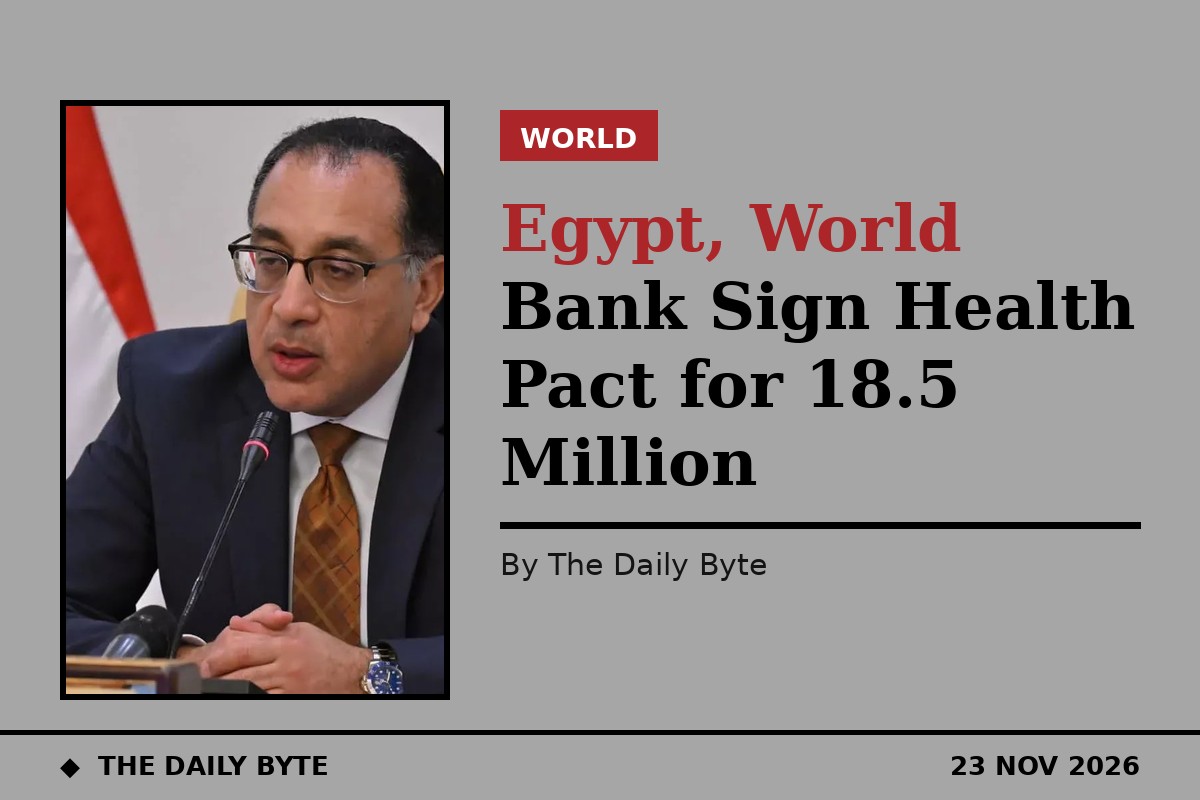
Egypt has signed a National Health Compact with the World Bank Group to speed up the rollout of its Universal Health Insurance System, aiming to bring an additional 18.5 million people under cover in six governorates by 2030.
The compact was signed in Cairo on Monday in a ceremony attended by Prime Minister Mostafa Madbouly and witnessed by Planning Minister Ahmed Rostom, World Bank Managing Director of Operations Anna Bjerde and several development partners, Business Tech News reported.
What the compact promises
The agreement was signed by Health Minister Khaled Abdel Ghaffar, Finance Minister Ahmed Kouchouk and Deputy Foreign Minister for International Cooperation Samar El-Ahdal. It sets a roadmap for the second phase of the insurance rollout, covering Damietta, Kafr El-Sheikh, Minya, Matrouh, North Sinai and Alexandria.
Taken together, the first and second phases are intended to reach about 23.5 million beneficiaries by 2030. The expansion is expected to need about 178 billion Egyptian pounds in financing by that date, comprising about 163 billion pounds from public-sector sources and 15 billion pounds from the private sector, according to Stallion Times, citing Amwal Al Ghad.
The money will fund the construction, upgrading and operation of health facilities. Egypt plans to upgrade 935 facilities under the compact, including 827 primary healthcare units and 108 hospitals and critical care units, bringing them up to national accreditation standards.
Cheaper care and more local medicines
The compact also aims to cut what patients pay out of their own pockets to below 28 per cent of total health spending in the target governorates, strengthening financial protection for households. It further aims to raise the share of locally made essential medicines to more than 75 per cent by value and over 90 per cent by volume, and to improve the availability of essential medicines at primary healthcare facilities.
Six pillars and a monitoring framework
Implementation rests on six tracks: modernising infrastructure; digital transformation and primary care, including telemedicine and community health teams; prevention, with family, maternal and child health services, vaccinations and periodic checkups in the benefits package; training and redistributing medical, nursing and administrative staff; equity and financial protection, including guaranteed subscription payments for vulnerable groups; and private-sector participation, investment and innovation.
Madbouly said the step reflected the state's commitment to making healthcare reform a top priority that guarantees high-quality care without financially straining citizens, and stressed full integration among ministries and development partners. The health minister said the compact would ensure hospitals and primary care units met national accreditation standards, while the finance minister pointed to efforts to keep the scheme financially sustainable, cover subscriptions for vulnerable groups and stimulate private investment.
To keep the rollout on track, the government will set up a monitoring, evaluation and accountability framework with the health ministry, the Universal Health Insurance Authority and the General Authority for Healthcare, with the World Bank Group and other development partners taking part. Progress will be tracked against performance indicators and timelines covering geographical expansion, facility readiness, beneficiary registration, financing and service quality.


