Eisenkot Strikes Democrats Deal in Netanyahu Bid
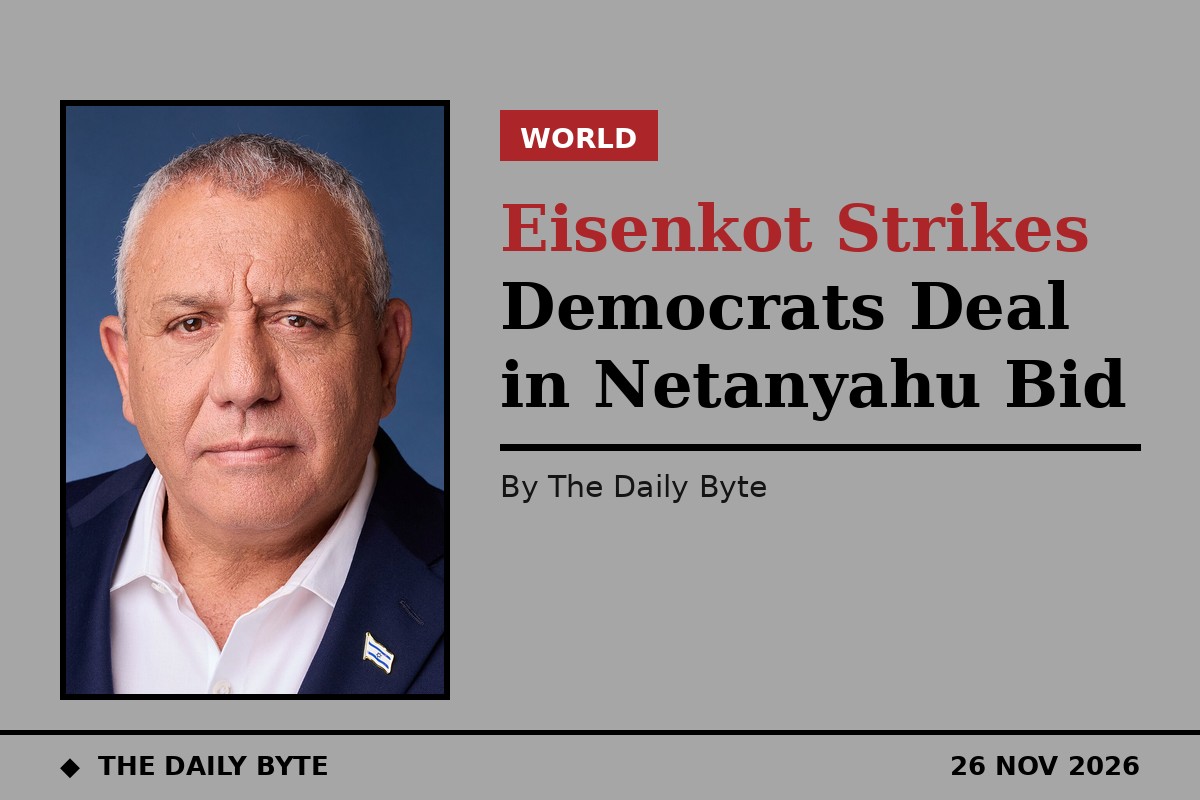
Gadi Eisenkot's Yashar party and the left-wing Democrats have agreed a preliminary coalition deal, clearing the biggest obstacle so far to his bid to replace Benjamin Netanyahu as Israel's prime minister after last month's inconclusive election.
The two sides said in a joint statement on Thursday that, after intense negotiations, they had agreed in principle to join forces in forming a ruling coalition. The agreement came days after the Democrats briefly suspended talks in protest at Eisenkot's parallel negotiations with Netanyahu's Likud party about a possible unity government.
Under the deal, the Democrats, who won eight seats in the 27 October election, will receive four ministries: an expanded public security portfolio, a merged labour and welfare ministry, communications, and culture and sport, which will include a new directorate for democracy. They will also chair the Knesset's powerful Constitution, Law and Justice Committee and take a seat on the committee that selects judges.
The party said the agreement included a commitment to fully repeal the judicial overhaul, the Netanyahu government's controversial plan to curb the power of the courts, which sparked mass protests in 2023.
“We promised the people that we would replace Netanyahu and defend democracy. And that is what we will do,” Democrats leader Yair Golan wrote on X. “I call on all parties to come together as soon as possible to finalise agreements and sign them, form a government, and lead Israel in a new direction.”
The Democrats did not get everything they sought. They had pushed for the justice ministry and, according to earlier Israeli media reports, had expected to receive education. The party said the need to form a “government of change” required it to act swiftly, reach agreements and demonstrate a willingness to compromise. The two sides said they were still working on final details before formally signing the agreement.
It is Eisenkot's second coalition pact since the election. Earlier this week he agreed a deal with Avigdor Lieberman's right-wing Yisrael Beiteinu party. Together the two agreements cover 36 of the Knesset's 120 seats, still well short of the 61 needed for a majority. Eisenkot's wider bloc won 48 seats in the election, while Netanyahu's alliance of Likud, far-right and ultra-Orthodox parties won 53. The Arab-led parties, with 19 seats, oppose Netanyahu, but some of Eisenkot's partners have long refused to rely on their votes.
The talks are now moving fast. The Maariv newspaper reported that the change bloc aims to finalise, sign and submit all coalition agreements to the Knesset by Tuesday 1 December or Wednesday at the latest, with the United Torah Judaism party expected to receive the Housing Ministry and the chairmanship of the Knesset Finance Committee. Lieberman, long one of the fiercest critics of the ultra-Orthodox parties, has softened his position, telling Israel's Kan broadcaster that a government including United Torah Judaism and backed by a “clear Jewish majority” could be presented by the end of next week. That could open the way to a 55-seat minority government, supported from outside by the eight-seat United Arab List. The main obstacle remains the draft law: Eisenkot's allies promised during the campaign to end the exemption that lets ultra-Orthodox seminary students avoid military service, which ultra-Orthodox leaders strongly oppose.
President Isaac Herzog gave Eisenkot the mandate to form a government on 8 November. He has until 6 December, with the possibility of a 14-day extension. If he fails, Netanyahu is likely to be given a chance to form a government, and if no government can be formed, Israel would hold another election next year.
What does the deal change?
It ends the Democrats' boycott of the talks and gives Eisenkot his second signed pact, but he still needs at least 13 more seats — from the ultra-Orthodox parties, the Arab-led parties or Likud — to reach 61.
Why are the talks accelerating?
Eisenkot's allies want agreements signed before the 6 December deadline, and amid concern in the change bloc that Netanyahu, still caretaker prime minister, could order a new strike on Iran before a replacement government is sworn in. Former defence minister Avigdor Lieberman has publicly urged Netanyahu not to launch a new operation before a new government takes office.


