Eisenkot Invites Likud to Marathon Coalition Talks
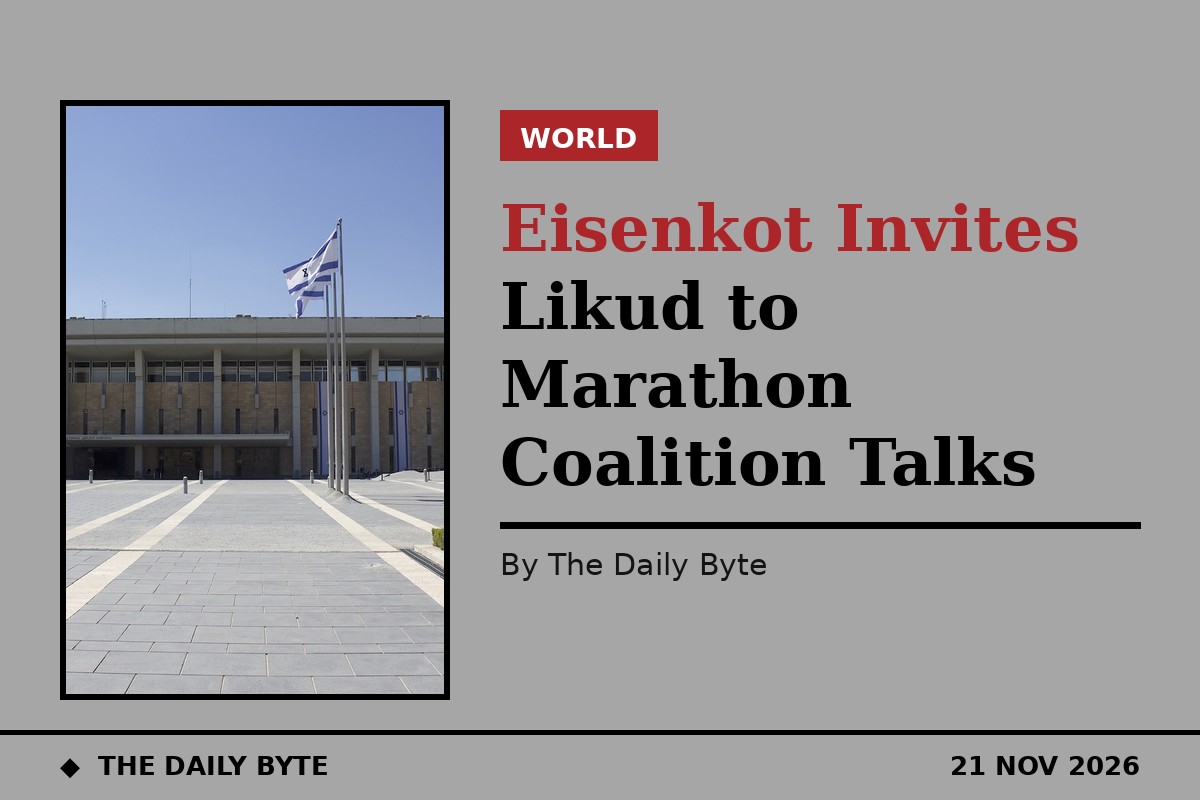
Gadi Eisenkot has invited Benjamin Netanyahu's Likud party back to the negotiating table for intensive coalition talks starting on Sunday, in a fresh attempt to break Israel's political deadlock before his mandate to form a government runs out in early December. The invitation, reported by Israeli media and confirmed in a statement from Eisenkot's Yashar party, follows a first round of talks that ended without agreement on 15 November.
Former prime minister Naftali Bennett confirmed on Saturday that talks with Likud were still going on, and said the bloc led by Eisenkot should leave no stone unturned in order to establish what he called a Zionist government. Bennett said the best alternative was a Zionist unity government led by Eisenkot, and that his initiative would quickly show whether Likud genuinely wanted unity or was merely running down Eisenkot's mandate.
Bennett also drew a firm line on Netanyahu himself. He said he was committed to ensuring that Netanyahu will not be the next prime minister, that under no circumstances will his party join Netanyahu or his bloc, and that his party will form a government with the Eisenkot bloc. "We will steer the country from chaos toward effective governance, and rescue Israel from the head-on collision course upon which we are currently hurtling forward," he said.
Bennett set out three conditions for a new government: a State Commission of Inquiry into the 7 October massacre, a limit of eight years on a prime minister's time in office, and a redirection of economic incentives so that they reach people serving in the army's reserves rather than those avoiding the draft.
The December deadline
Eisenkot confirmed on Friday that he does not intend to let negotiations drag on beyond the time President Isaac Herzog gave him to form a government, saying he will try to reach agreements with the ultra-Orthodox parties and with Likud, but will form a minority government if those efforts fail. "All sides need to understand that I do not intend to drag this out," he wrote in a social media post before Shabbat. "At the right time, I will bring a new and good government under my leadership to the Knesset for approval." He added that this was not a negotiating threat, but a decision taken out of responsibility at a time of emergency, and said he would put a minority government to a vote by 6 December if talks fail.
The arithmetic explains the pressure. Eisenkot's Change Bloc holds 48 seats in the 120-member Knesset, 13 short of the 61 needed for a majority. The two Arab-led parties hold 19 seats between them, which could in theory lift a government headed by Eisenkot to 67 votes, but only with outside support that some of his own allies refuse to accept. Herzog gave Eisenkot the mandate after 67 lawmakers recommended him, against 46 for Netanyahu, with seven declining to recommend either candidate.
The first meeting between Yashar and Likud on 15 November ended without a breakthrough, and both sides have since accused each other of obstructing a unity government. Yashar says it has repeatedly tried to reach agreement, while Likud argues that Eisenkot's allies have undermined cooperation by pursuing parliamentary initiatives with support from Arab parties. Likud is reported to want Eisenkot to abandon the minority-government option before negotiations advance.
Likud's reported conditions
Reports published on Saturday said some of Likud's negotiating demands remain incompatible with Eisenkot's stated conditions. According to Israeli reports, Likud is seeking commitments opposing the establishment of a Palestinian state, continued Israeli military deployment in areas designated as security zones, the maintenance of detention conditions for members of Hamas's Nukhba unit, an end to unilateral parliamentary moves on judicial reform and media legislation, and a commitment not to establish a minority government dependent on Arab parties. Not all of the reported conditions have been independently confirmed as formal negotiating positions.
The Arab-parties question also divides Eisenkot's own bloc. Yair Golan, leader of the Democrats, has argued for exploring cooperation with Arab political representatives to replace Netanyahu, while Avigdor Lieberman, leader of Yisrael Beytenu, opposes a government that includes Arab parties or depends on their parliamentary support. Bennett's own position is unsettled: he met Netanyahu for three hours earlier in the week and has publicly backed a unity government led by Eisenkot while warning against letting talks consume the mandate.
Netanyahu remains caretaker prime minister while the negotiations continue. His political future is complicated by criminal proceedings in which he faces charges of bribery, fraud and breach of trust, which he denies, and by arrest warrants issued by the International Criminal Court in November 2024 for Netanyahu and Yoav Gallant in connection with alleged war crimes and crimes against humanity in Gaza. The warrants concern allegations and are not criminal convictions.


