Eisenkot, Liberman Agree Yashar Knesset Speaker
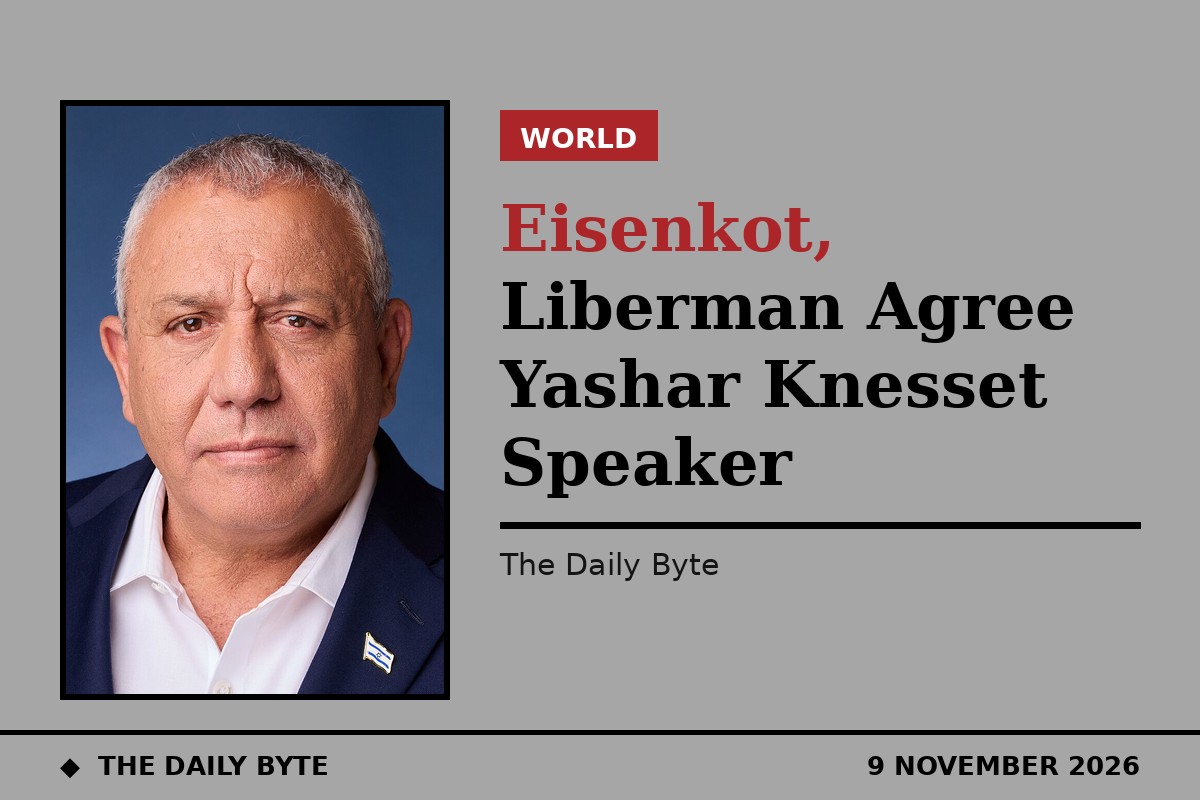
Yashar chairman Gadi Eisenkot and Yisrael Beytenu chairman Avigdor Liberman met on Monday and agreed that the next speaker of the Knesset will be a Yashar member of parliament, according to reports, in the first public agreement to emerge from Israel's coalition talks.
The agreement marks a shift from Liberman's original demand that the post go to Yair Lapid, which had caused friction among the opposition bloc's partners in recent days. Liberman is also willing to drop his call for an immediate vote to replace the speaker. Yashar has not said which of its members will be named for the post.
Liberman drops the Lapid demand
The speakership had become an early test of unity inside the bloc that backed Eisenkot for prime minister. Liberman had insisted the post should go to Lapid, the Yesh Atid leader, while others in the bloc resisted handing the powerful parliamentary role outside Eisenkot's own party.
By conceding the point, Liberman removed one of the obstacles to a working relationship between the two men, who will need each other if Eisenkot is to assemble a government. The two leaders also agreed that Liberman would first have the opportunity to negotiate with the ultra-Orthodox parties, whose support could prove decisive.
A day after the mandate
The meeting came a day after President Isaac Herzog gave Eisenkot the mandate to form a government, after he was recommended by 67 members of the 120-seat Knesset, including the Arab parties. Eisenkot has until 6 December to present a government, with the possibility of a 14-day extension.
In a statement after what it called a substantive and good meeting, Yashar said that "the two expressed their full confidence in the ability to form a stable government for four years." The new Knesset is due to be sworn in on Tuesday, when the real work of forming a government begins.
Replacing Ohana is not simple
Replacing the current speaker, Amir Ohana, may not be simple. Ohana has said the speaker is usually chosen when a government is formed, and that an earlier vote would require a request signed by at least 61 members of the Knesset. United Torah Judaism has also rejected replacing the speaker at this stage, saying any change should come only as part of forming a government.
Yashar has separately pressed the ultra-Orthodox parties to back Ohana's removal as a first test of loyalty, asking United Torah Judaism to join the bloc's demand to replace the speaker during the opening session of the 26th Knesset. The 67 members opposed to Prime Minister Benjamin Netanyahu want Ohana replaced, but they remain divided over who should take his place.
Coalition talks continue
Beyond the speakership, the two leaders still have substantial differences to resolve. Liberman has ruled out supporting a minority government that relies on the Arab parties, but is open to talks with the ultra-Orthodox parties if agreement can be reached on the draft law. He has also told Eisenkot he is prepared to support him as prime minister, while asking for more time to negotiate an agreement with the ultra-Orthodox parties that could make forming a government possible.
Netanyahu, meanwhile, has urged opposition parties to join a unity government under his leadership, even as Eisenkot's bloc presses ahead with its own efforts. With the Knesset convening on Tuesday and 54 new members taking their seats, the coming days will show whether the speaker agreement was the first step towards a stable government or simply the easiest item on a long list of disagreements.


