Eisenkot to Put Minority Government to Knesset Vote
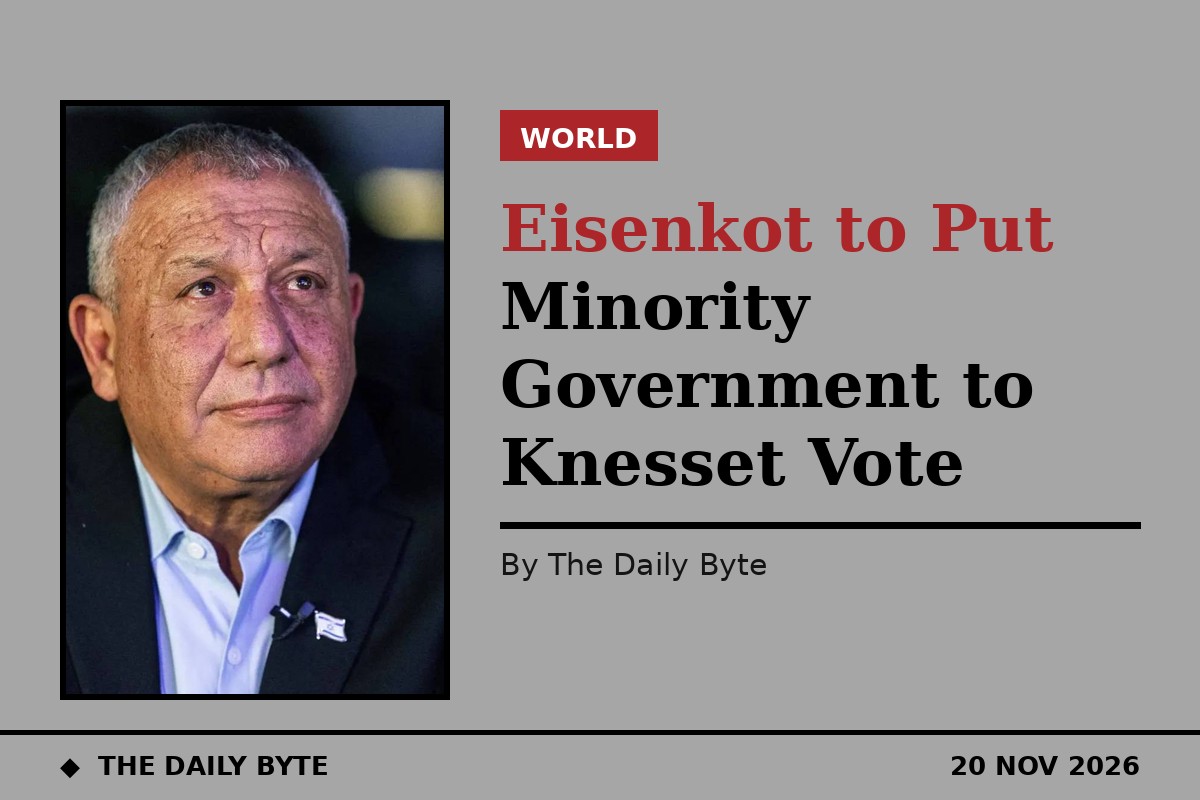
Gadi Eisenkot's Yashar party plans to put a minority government to a confidence vote in the Knesset before his mandate to form a government expires on 6 December, if coalition talks fail. Party officials say they will not let the mandate lapse without a vote.
The plan, reported by the Jerusalem Post on Friday, 20 November, is Yashar's fallback if negotiations with the ultra-Orthodox parties and talks on a unity government with Likud both fail. "We will not wait for the mandate to pass to Netanyahu and then from him to the Knesset," party officials said. "If there is no other government, we will bring the minority government to a vote in any case before the mandate expires, before December 6."
A government without a coalition
The proposed administration would rely on external parliamentary support from Ra'am, the United Arab List, and the Joint List. Unlike the Bennett-Lapid government, in which Ra'am was a formal coalition partner, neither Arab party would receive ministerial posts or representation in the security cabinet under Yashar's plan — an arrangement party officials presented as an answer to concerns about Arab parties' influence over security decisions.
Even so, the government would still need those parties' support on significant legislation and on votes that could decide whether it stays in office. Yashar has also ruled out a rotation deal with Prime Minister Benjamin Netanyahu: the party says it is ready to negotiate a unity government with Likud, but only if Eisenkot serves as prime minister for the entire term.
Yashar officials cited Israel's security situation as the main reason for forcing the issue, arguing the country needs a permanent and stable administration rather than a caretaker government.
The arithmetic is the problem
Eisenkot's four-party alliance won 48 seats in the 27 October general election — Yashar 21, B'Yachad 12, the Democrats 8 and Yisrael Beytenu 7 — against 53 for Netanyahu's right-wing and religious bloc, with Likud on 27. Arab-led parties won a record 19 seats. A government needs 61 of the Knesset's 120 seats, and Eisenkot has ruled out forming a government with the Arab-led parties, which would give him a 67-seat bloc.
That leaves one narrow path: winning over the two ultra-Orthodox parties, United Torah Judaism and Shas, both long-time Netanyahu allies. Even the minority-government plan faces obstacles: opposition from Avigdor Liberman's Yisrael Beytenu, the possibility that some Arab lawmakers abstain, and uncertainty over whether right-wing members of Yashar itself would back a government dependent on Arab votes. Party officials say those members knew external Arab support was possible from the outset — but that will only be tested if the vote actually happens.
The election of Matan Kahana of Yashar as Knesset speaker on Tuesday, by 66 votes to 52 over Likud's Amir Ohana, gives Eisenkot's bloc control of the parliamentary agenda, but it does not supply the votes for a confidence motion. Former prime ministers Naftali Bennett and Liberman would also face a decision: allow the minority government to take office, or vote against it and risk undermining the effort to replace Netanyahu.
How the deadlock built
President Isaac Herzog gave Eisenkot the mandate to form a government on 8 November, after consultations in which 67 lawmakers recommended the former army chief and 46 backed Netanyahu — passing over the sitting prime minister, whose Likud won the most seats of any single party. Under Israeli law Eisenkot has 28 days to assemble a coalition, with a possible 14-day extension, so the deadline falls on 6 December and at the latest on 20 December.
If he fails, the president may give another lawmaker the chance, and if that fails too a parliamentary majority can back a third candidate for a final 14 days before a new election is called within 90 days. Netanyahu stays on as caretaker prime minister throughout. He has publicly urged Eisenkot to join a unity government, setting 6 December as the deadline to accept — the same date the law imposes on Eisenkot. Eisenkot has dismissed the overture as a political ploy.
Frequently asked questions
What is a minority government? A government that does not hold a majority of seats itself but governs with the votes of parties outside the coalition, which support it in confidence votes without taking ministerial posts.
What happens if the confidence vote fails? Eisenkot's mandate would lapse and the president could turn to another candidate; if no government can be formed, Israel faces another election within 90 days.
Sources: Lake County IL Gazette (Jerusalem Post report) | The Curtain


