Eisenkot plans surprise vote to form government
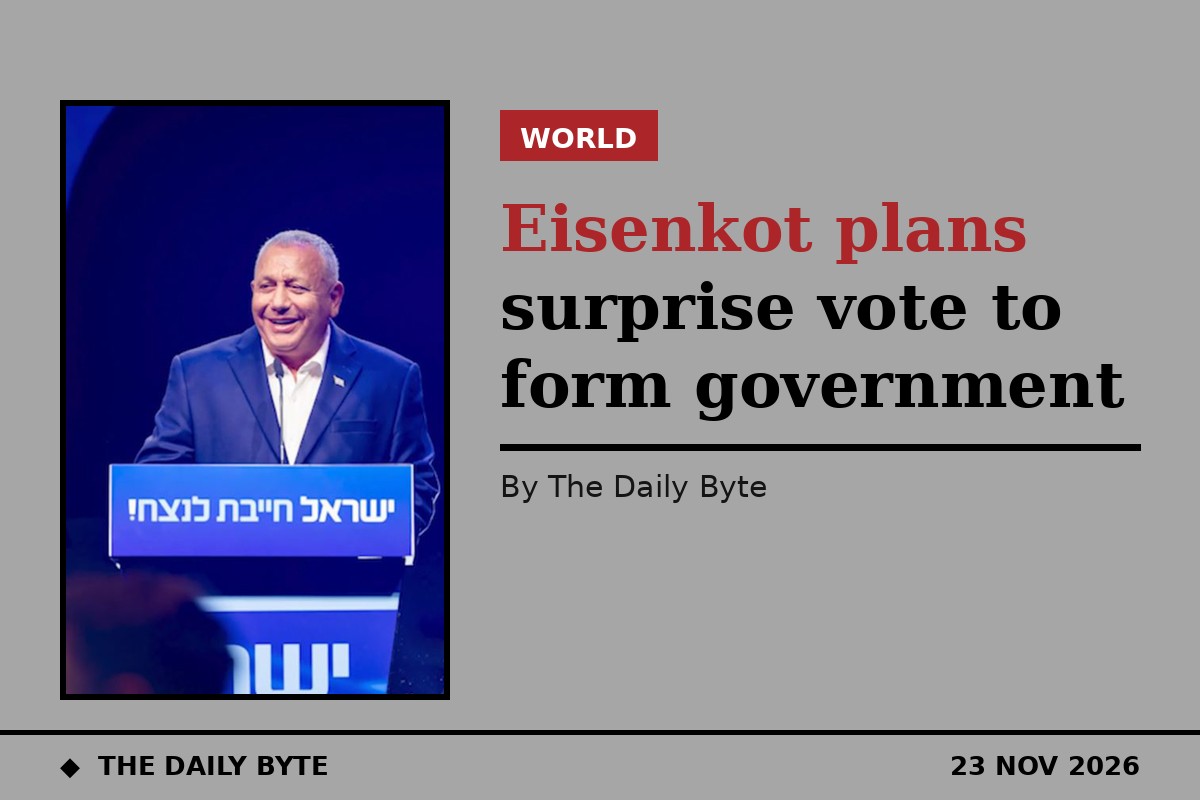
Gadi Eisenkot plans to announce a governing coalition at a moment of his own choosing and push it to a vote in the Knesset within a day or two, in a gamble aimed at ending Israel's political deadlock and replacing Benjamin Netanyahu as prime minister. The plan, reported on Monday, 23 November, comes after four hours of talks between Eisenkot's Yashar party and Netanyahu's Likud ended on Sunday without any agreement.
According to Israel's public broadcaster Kan, cited by The Times of Israel, Eisenkot intends to unveil his coalition without warning and call a plenum vote within one to two days, leaving rivals and waverers little time to organise against him. The calculation is that lawmakers who will not vote for his government might still abstain rather than vote against it, allowing a minority government to take office even without a majority of the 120-seat parliament behind it.
Eisenkot, a former chief of staff of the Israel Defense Forces, was tasked by President Isaac Herzog on 8 November with forming a government after an inconclusive election on 27 October left no bloc with the 61 seats needed to govern. His 28-day mandate, with a possible 14-day extension, expires on 6 December. If he fails, Netanyahu could then be given his own 28 days to try.
Talks with Likud end without a deal
The surprise-vote plan emerged after the latest round of unity talks collapsed. Representatives of Yashar and Likud met for about four hours on Sunday at a hotel in Herzliya, near Tel Aviv, in a second round of talks on a broad-based government. Afterwards the two sides issued a joint statement saying they had discussed core issues and would continue talking, but they announced no agreement and set no date for the next meeting.
The meeting did not even address who would serve as prime minister, or whether the two men would share the job through rotation. Instead the negotiators argued over Likud's proposed judicial overhaul, military service for ultra-Orthodox Jewish men, and a possible commission of inquiry into the Hamas attack of 7 October 2023. They also disagreed over giving Itamar Ben-Gvir's far-right Otzma Yehudit party a place in any future government, which Yashar opposes and Likud will not rule out.
Likud was represented by faction leader Ofir Katz and Michael Rabello, a long-time lawyer for Netanyahu. Yashar's team included lawmaker Chili Tropper and Yoav Horowitz. Naftali Bennett's B'Yachad party, which backs a unity government led by Eisenkot including Likud, did not take part.
Netanyahu pushes unity; Eisenkot rules out rotation
Netanyahu used a post on X on Monday to renew his call for a national unity government, writing that it was the only government capable of meeting the challenges Israel faces, and that it must include all parties that regard Israel as the state of the Jewish people. He added that any government would work with its ultra-Orthodox partners and enshrine in law, by mutual agreement, the status of Torah students.
Eisenkot has ruled out rotation with Netanyahu, insisting he would be the sole prime minister in any unity government involving Likud. Likud, for its part, has called on Eisenkot's bloc to suspend its legislative agenda and end its cooperation with Arab parties.
The arithmetic explains the urgency. In the October election Netanyahu's right-wing and ultra-Orthodox alliance won 53 seats, while Eisenkot's four-party bloc won 48. The two Arab-majority parties, which hold 19 seats between them, backed the winning side in the 66-52 vote for Knesset speaker. But senior figures in his own camp have publicly rejected each possible path: a deal with the ultra-Orthodox, a government relying on Arab support, or unity with Likud.
A minority government built on abstentions
Channel 12 reported some movement elsewhere: representatives of United Torah Judaism's Degel HaTorah faction described talks on ultra-Orthodox military service as showing positive progress, although the sides remain far from exchanging formal proposals. Within his bloc, Avigdor Liberman has called for painful compromises with the ultra-Orthodox, while Democrats leader Yair Golan says an Arab-supported minority government should stay on the table. Golan would not oppose a coalition involving ultra-Orthodox parties, but ruled out joining what he called a fake unity government that would keep Netanyahu in power.
A surprise declaration followed by a vote within a day or two would test whether abstentions can do what negotiations have not. If enough lawmakers sit out the vote, Eisenkot could be sworn in at the head of a minority government, even one that might soon collapse and force another election. If the gamble fails, the deadlock continues, and Netanyahu, still caretaker prime minister, gets his turn to try. ANI reported the surprise-vote plan, and the Daily Jagran reported the collapse of Sunday's talks.


