El Salvador Extends State of Exception for 57th Time
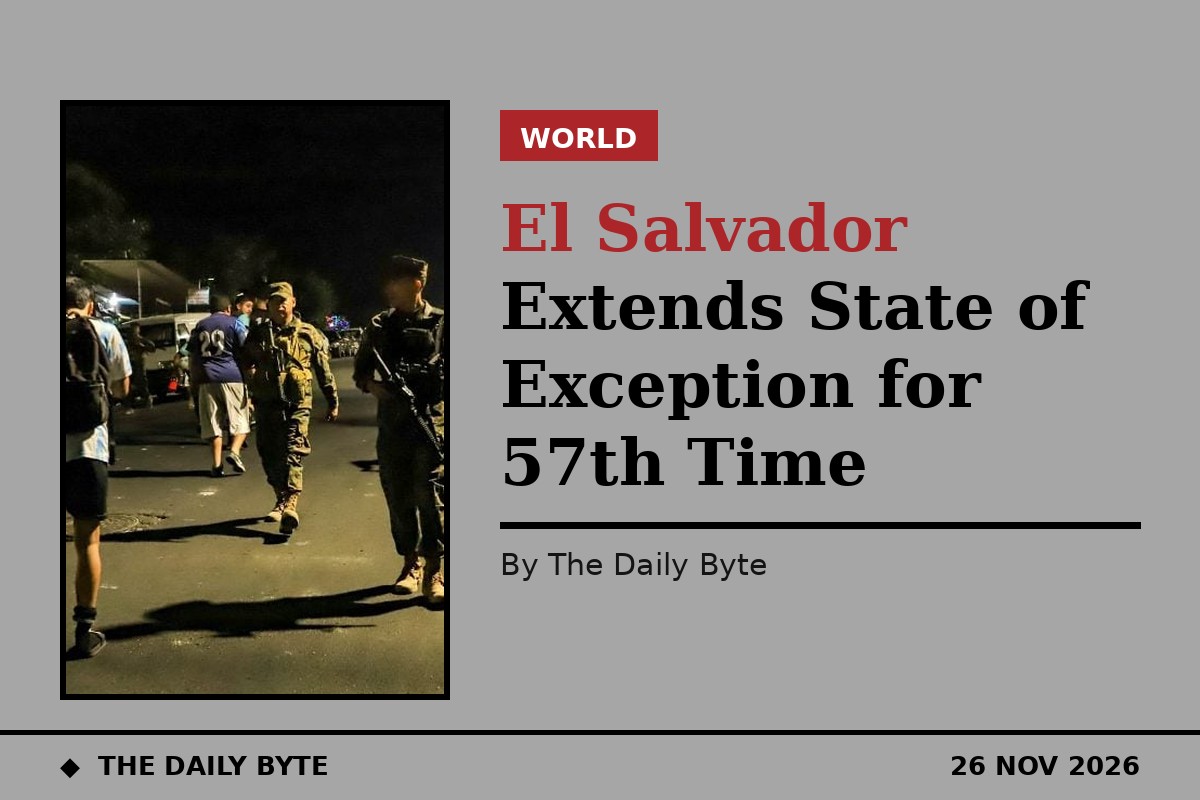
El Salvador's Legislative Assembly has approved a 57th consecutive monthly extension of the state of exception, keeping the emergency security measures that have governed the country since March 2022 in place for another 30 days.
The extension was approved on Tuesday 24 November with 57 votes in favour and one against. Claudia Ortiz, a deputy for the Vamos party, voted against it, while the two deputies from the opposition Arena party were absent from the vote. The new extension runs from 27 November to 26 December 2026.
The measure keeps three constitutional guarantees suspended: the right to a legal defence, the maximum period of administrative detention, and the inviolability of correspondence and telecommunications. That allows the security forces to hold people for longer before they appear before a judge and gives the authorities special powers to intercept communications where a link to criminal structures is suspected.
The state of exception was first decreed on 27 March 2022, after a weekend of gang violence in which 87 people were killed between 25 and 27 March. The government argued then that it faced a grave disturbance of public order and asked deputies to suspend constitutional guarantees to widen the room for police, soldiers and prosecutors to act.
In its request for the latest extension, the Council of Ministers argued that gang-linked structures were still operating through encrypted communications, social media and messaging or delivery services. The government said investigations were under way into new methods used by extortionists and drug dealers, and warned of attempts to recruit minors and to create youth groups that adopt gang symbols, rituals and forms of organisation.
The initiative was added to the agenda of the Assembly's 136th plenary session with a waiver of procedure, at the request of the governing Nuevas Ideas deputy Cristian Guevara, and then won the backing of the majority of the chamber.
93,694 detentions since March 2022
The government attributes a sustained fall in homicides to the measure. The decree approved by deputies records more than 93,694 people detained on suspicion of links to criminal structures since the measure began, with more than 12,500 convictions and 593 cases opened by the Attorney General's Office.
The government also says the country has accumulated more than 1,377 days without a homicide since the current administration took office on 1 June 2019, of which 1,263 days fall under the state of exception. The figures were presented in the debate by the governing party deputy Caleb Navarro, citing data from the Attorney General's Office.
Human rights organisations have denounced arbitrary detentions, torture and deaths inside prisons during the application of the measure, and the policy remains one of the most contested in Latin America. Supporters in the Assembly argue it is the only strategy that has delivered results on security, while critics say the monthly renewals have turned an emergency measure into a permanent feature of government.
The extension comes as President Nayib Bukele seeks a third consecutive term. The Supreme Electoral Tribunal has formally registered his candidacy for the February 2027 elections, after constitutional changes approved by the Assembly in July 2025 opened the way for him to stand again.
The monthly renewal has become a routine of Salvadoran politics. Each month the Assembly votes again on the same measure, and each time the governing majority approves it by a wide margin, with the small opposition either voting against or staying away. With this extension the regime reaches four years and eight months of continuous application since it was first approved in March 2022.
What the government says the figures show
During the debate, the governing party deputy Caleb Navarro presented the government's figures for the crackdown. He said that by 2 November the authorities had detained 93,548 suspected gang members and collaborators, and that the Attorney General's Office had secured 10,561 convictions on the basis of data updated to 16 October.
Navarro also said that in the first nine months of 2026 the authorities had seized 15,829 kilograms of various drugs, valued at $389.2 million. The government presents these figures as evidence that the emergency powers are still needed, arguing that criminal structures continue to adapt, moving their communications onto encrypted applications and using social media and delivery services to extort and to deal drugs.
Critics dispute the official picture. Human rights organisations have documented cases of people detained with no apparent gang link, and families of detainees have reported months without news of relatives held in the country's prisons. The government has not published a full accounting of how many of those detained have been released after being found to have no gang connection, and the Assembly debate did not settle that question.


