Electrolux Heater Phoned Home to Russian Server
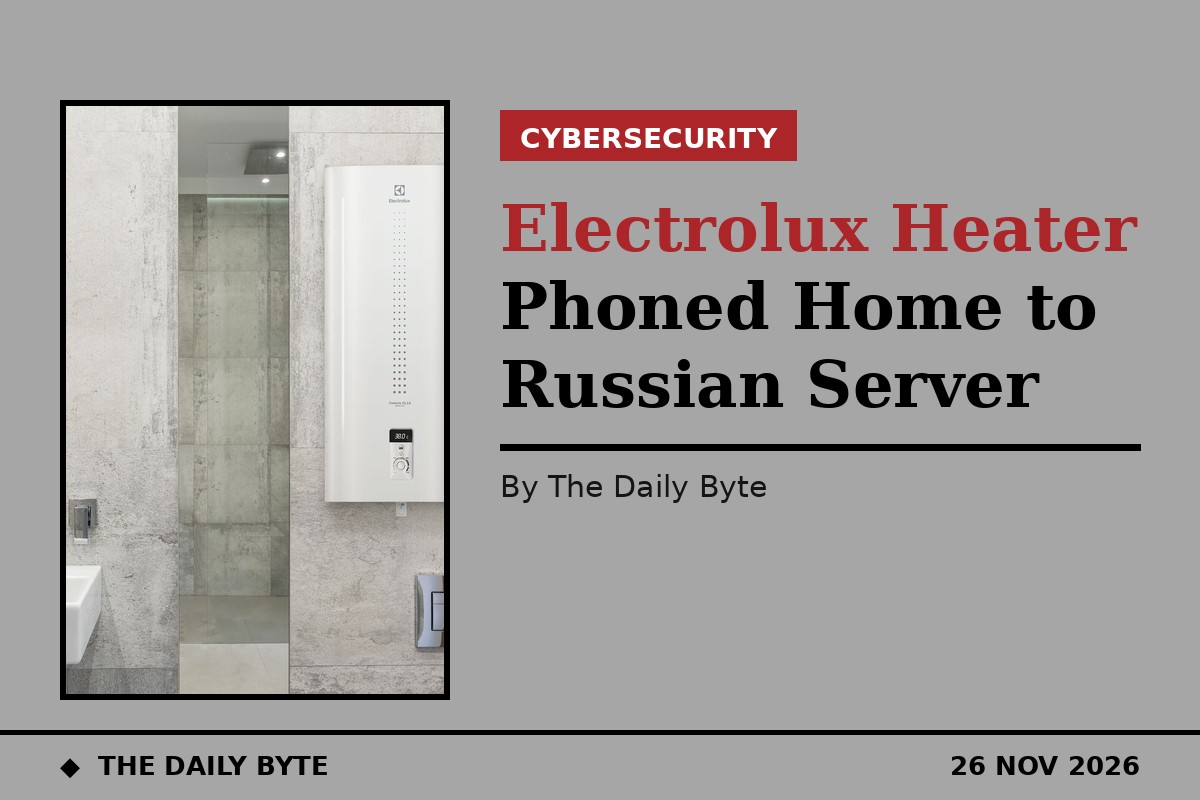
A smart water heater in Kyiv was caught trying to phone home to a server in Moscow. The owner of an Electrolux EWH 80, bought from the Ukrainian retailer Rozetka in 2025, spotted the device looking up mqtt.cloud.rusklimat.ru in his router logs at 18:00 on 23 November, a domain belonging to Rusklimat, a Moscow climate-equipment group, that resolves to an address on Yandex Cloud.
Researchers at Mysterium VPN checked the finding and repeated the lookup on 25 November, getting the same address, 130.193.49.173. RIPE, the registry that assigns internet addresses in Europe and Russia, lists that block under Yandex.Cloud LLC at 16 Lva Tolstogo Street in Moscow. The story was first reported by Cybernews on 25 November, with Mysterium VPN's research covered the same day by Security Affairs.
Two apps, two countries
The owner had set the boiler up with Hommyn, Rusklimat's app. Version 1.20.2 of the Android app lists 118 devices, 19 of them Electrolux, including the "Electrolux SI (SE/BE) EEC" series sold in EU shops. Its privacy policy names R-Klimat LLC of Moscow as the operator and says personal data stays "exclusively within the territory" of Russia, under Russian law. The app is written to send sign-in details, the name and room of each device, and the phone's location to a weather service to Rusklimat servers, and keeps device history on Yandex Cloud. It also carries one fixed username and password for Rusklimat's device server, the same in every copy. Mysterium VPN did not use the credentials and is not publishing them.
Electrolux does not make the heater. The manual for the EWH SI EEC series names CladSwiss AG of Zug, Switzerland, as the manufacturer, says the unit is made in China, and says the Electrolux name is used under licence from AB Electrolux, the Swedish parent. The remote-control app the manual names is ClimatOn, from CladSwiss, not Electrolux and not Hommyn. According to CladSwiss, data collected by ClimatOn should be stored in Frankfurt, Germany, and Mysterium VPN also found a ClimatOn server hosted on Amazon infrastructure in Germany. The same boiler can therefore connect to two different servers, depending on which app the owner uses.
Why it matters
MQTT is the lightweight messaging protocol IoT devices use to talk to their cloud services. The server, or broker, issues remote commands, switching the heater on or changing its temperature, and relays telemetry such as on/off state, water temperature, settings, errors and energy use. A record of when a household heats water shows when people are at home. "The line that carries those reports also carries commands to switch the boiler on or change its temperature. For a boiler tied to mqtt.cloud.rusklimat.ru, that line ends at a Russian company's server in Moscow," Mysterium VPN said. Russia is not among the countries the European Commission recognises as protecting personal data adequately, and Ukraine first ordered its internet providers to block Yandex's services in 2017.
Mysterium VPN does not know why a buyer in Ukraine ended up on the Russian app. Another buyer of a different Electrolux model wrote on Rozetka in June 2026 that the Wi-Fi worked properly only through the Russian app. The range is sold online in Poland, Lithuania and Serbia. Rusklimat sells Electrolux-branded boilers in Russia and advertises them for Hommyn and for Yandex's voice assistant, Alisa. AB Electrolux sold its Russian business in 2022 and said then that it had no production in Russia and would not supply the company it sold.
What owners can do
Mysterium VPN stresses its findings are limited: the researchers reviewed the Hommyn app's code and did not connect to the servers or examine the boiler itself, so they cannot confirm what data the device actually sends. One claim remains untested: developers who studied a Ballu ventilation unit from the same family wrote that every unit shipped with the same cloud login and did not check the server's certificate. Mysterium VPN has not tested whether that applies to the boiler.
Owners can search their router logs for "rusklimat" and block the address; blocking the Russian server stops remote access, though local control over Wi-Fi may still work. The boiler heats water without Wi-Fi, so switching its Wi-Fi off is an option, and smart appliances can be moved to a separate guest network to keep them away from computers and phones. A VPN on a phone or laptop does not change where an appliance sends its data; the fix sits at the router.
Mysterium VPN sent questions to AB Electrolux, CladSwiss and Rozetka on 25 November; none had replied at publication. The owner has blocked the heater from the internet. Replacing it, he said, would be difficult: "There's a six-month waiting list" for a plumber.


