ElevenLabs Scribe v3 Medical Brings AI to Hospitals
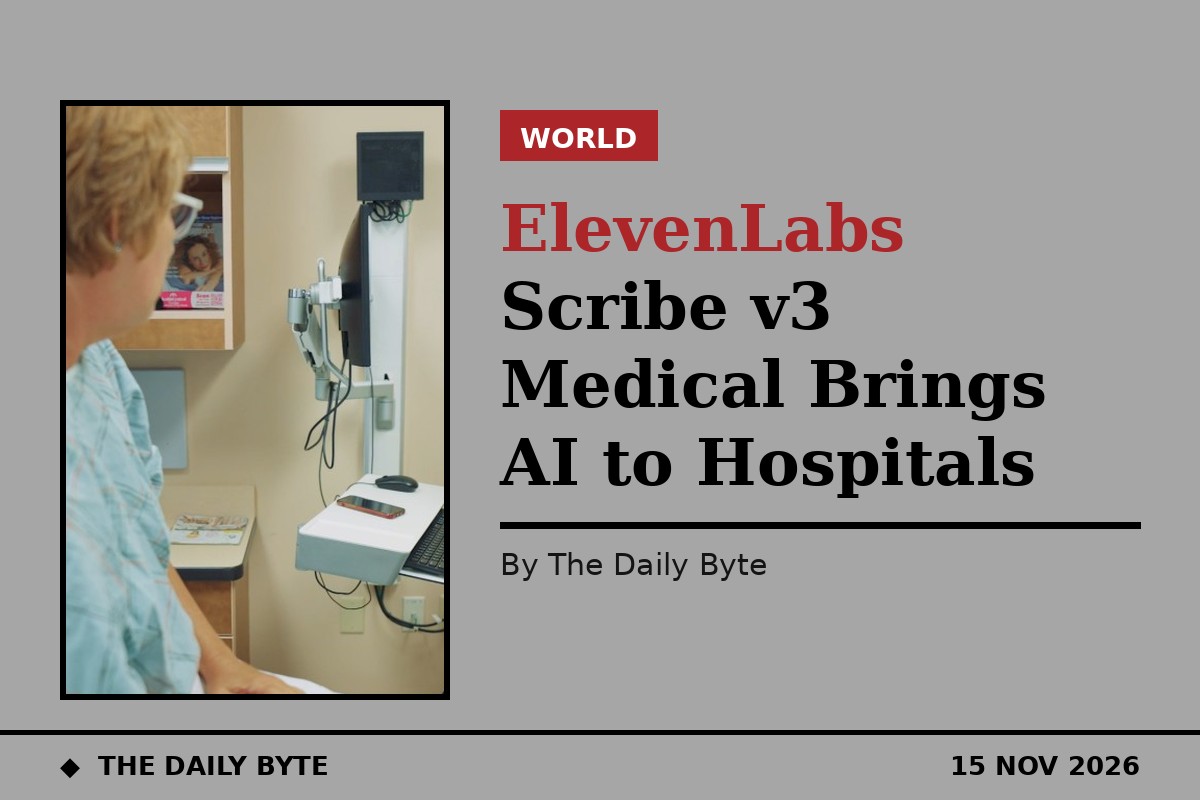
ElevenLabs has launched Scribe v3 Medical, a speech-to-text model tuned specifically for healthcare, as part of a major package of new voice AI products announced this week. The medical model is designed to transcribe clinical conversations accurately, recognising the specialist terms that general transcription tools often get wrong.
The launch was announced on 12 November 2026, following the company's New York Summit the day before, where ElevenLabs unveiled 13 new products and upgrades. Alongside the medical model, the company introduced three new voice models and a new orchestration system for voice agents, plus partnerships with McKinsey and Nvidia.
Built for clinical language
Scribe v3 Medical is a healthcare-optimised version of the company's new Scribe v3 transcription model. It is aimed at hospitals and healthcare teams that need reliable records of doctor-patient conversations, where drug names, procedures and medical terminology leave little room for error.
ElevenLabs says it plans to build further industry-specific versions, with a model for financial services already in development. The approach is to tune the same underlying transcription technology for the vocabulary of each sector, rather than asking one general model to cover everything.
Scribe v3 and Scribe v3 Live
The medical model sits on top of Scribe v3, ElevenLabs' new speech-to-text model for recorded audio, and Scribe v3 Live, its low-latency real-time variant. Both cover 102 languages and are available through the ElevenAPI developer interface and the ElevenAgents platform.
On the company's own evaluations, Scribe v3 makes 27% fewer word errors than its predecessor, Scribe v2, with accuracy improving by 42% in German, 35% in Spanish and 23% in English. Scribe v3 Live makes 43% fewer errors than Scribe v2 Realtime and, for the first time, supports diarization — identifying who said what, and when — in real time.
Independent benchmarks cited in coverage of the launch say Scribe v3 narrowly beats rival models from OpenAI, Google and Microsoft on accuracy, although competitors run faster and cheaper. The accuracy figures are the vendor's own measurements and have not been independently verified.
New voice models and the Interaction Engine
The Summit also brought two more models: Eleven v4, a text-to-speech model that reads scripts with more expressive tone, pacing and context, and Eleven Realtime, a new speech-to-speech model for fast voice agents.
These are tied together by the Interaction Engine, a new orchestration layer for voice agents that manages turn-taking and interruptions, sends routine questions to cheaper models and hands complex moments to stronger ones. The aim is a voice agent that sounds natural without running the most expensive model on every word. Most of the package is still in preview or early access, so the immediate effect is a roadmap rather than a finished catalogue.
McKinsey and Nvidia partnerships
ElevenLabs has also announced an alliance with McKinsey to support organisations developing and scaling AI agents, and an expanded partnership with Nvidia. The Nvidia deal brings the Nemotron 3.5 Super VL model into ElevenAgents and adds plans for 15 megawatts of Vera Rubin computing capacity.
Together, the announcements mark a shift for ElevenLabs from a voice-tools company towards a platform for building voice agents across customer support, sales, recruitment and healthcare. The medical model is the clearest sign of that direction: a product aimed at a specific industry, where accurate transcription has a direct effect on patient care.
Sources: MartechAI — ElevenLabs Launches Medical AI Transcription Tool; The 9th Estate — ElevenLabs Builds Out the Interaction Layer for AI.


