Elisa and Drei launch first 5G standalone roaming in Europe
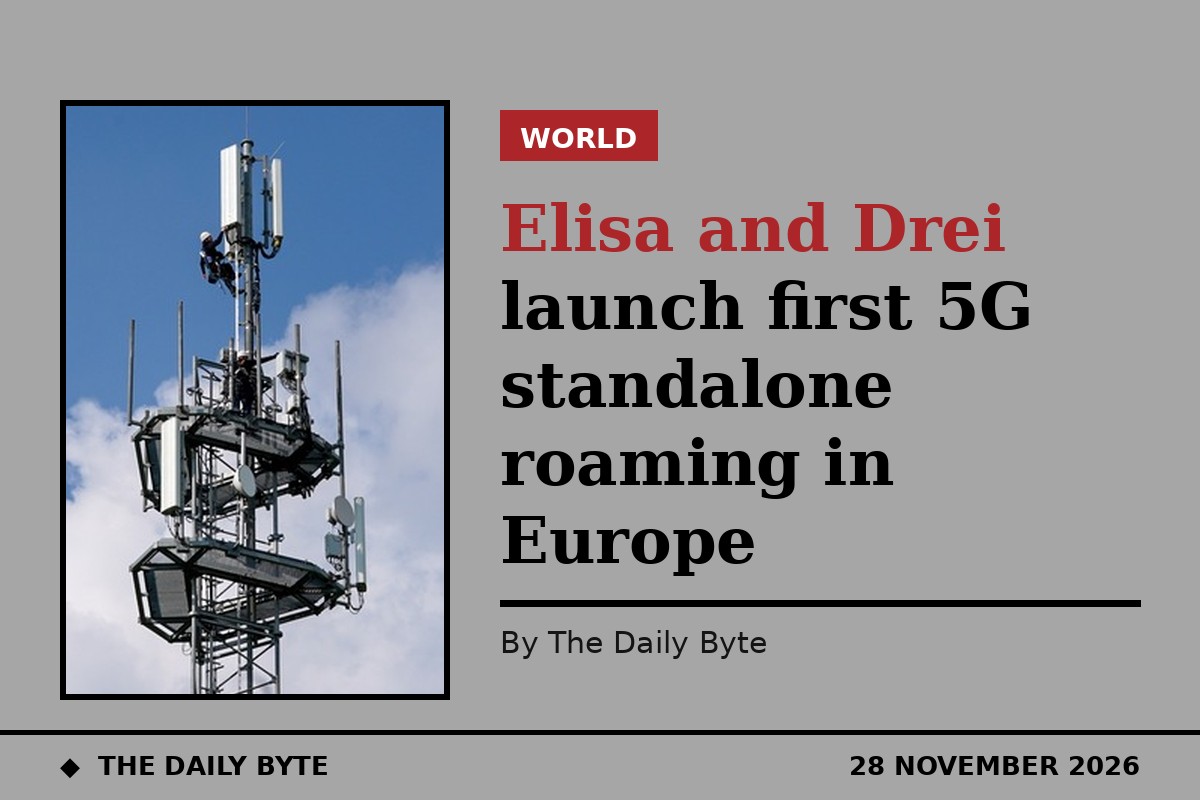
Finland's Elisa and Austria's Hutchison Drei have switched on Europe's first commercial standalone 5G roaming connection, letting customers use a pure 5G network when they travel between the two countries.
The link went live on Friday 27 November for consumer and business customers. It is the first time standalone 5G roaming has moved from technical trials to commercial service in Europe, the operators said, with interconnection handled through a hub run by BICS, part of Proximus Global.
Most 5G service today is non-standalone, pairing a 5G radio connection with a 4G core. Standalone 5G uses its own 5G core, which can cut response times and supports features such as lower latency, better security and network slicing, where part of a network is reserved for a particular use.
A long build-up
Drei has run a nationwide standalone network since autumn 2022, the only Austrian operator to do so. Elisa began selling domestic standalone service to consumers and businesses in Finland in 2024. BICS added both operators to its group of roaming-ready networks in April 2025, and commercial service between them followed 596 days later.
The BICS 5G Service Hub carries the encrypted control messages the carriers use to manage roaming connections. It can also help a home operator steer customers towards a preferred partner network.
Simone Keglovics, Senior Head of Wholesale and Regulatory at Drei Austria, said customers expect first-class connections wherever they travel, and described the launch as a European first that brings the full performance of 5G to customers on the move.
Niklas Granholm, Elisa's vice president for network and services, said the operators had completed a standalone roaming call. 'International roaming is an essential part of mobile service,' he said, calling the link an important milestone.
Second commercial link worldwide
The European launch follows a commercial link between the United States and India. T-Mobile and Jio announced theirs on 21 September, 67 days before Friday's launch, with Syniverse handling interconnection for that route. The two launches used different hubs to connect networks that already offered standalone service at home.
For travellers, the launch changes which kind of network a compatible phone can connect to when roaming in the other country. Access still depends on coverage, and the operators named no other roaming partners. The announcement gives no date for extending the connection to a third country.
What is still unknown
Friday's disclosures provide no measured speeds or latency for travellers, and the announcement gives no count of subscribers using the link. The carriers have yet to say whether ordinary roaming voice calls can stay on 5G in both directions, and actual standalone access depends on the combination of plan, handset and coverage.
Prepaid access also remains unresolved. Elisa sells a standalone-capable prepaid package with 66 GB of EU data for 44.99 euros over 30 days, but the launch materials do not say whether that plan can use Drei's standalone network in Austria.
EU rules generally let customers use their domestic allowance while travelling in the bloc, although data fair-use limits can still apply on unlimited or inexpensive plans. The EU roaming regulation also sets the maximum average wholesale rate for regulated data, which falls to 1.00 euro per gigabyte on 1 January 2027, from 1.10 euros in 2026.


