Embargo vs sanctions: what is the difference?
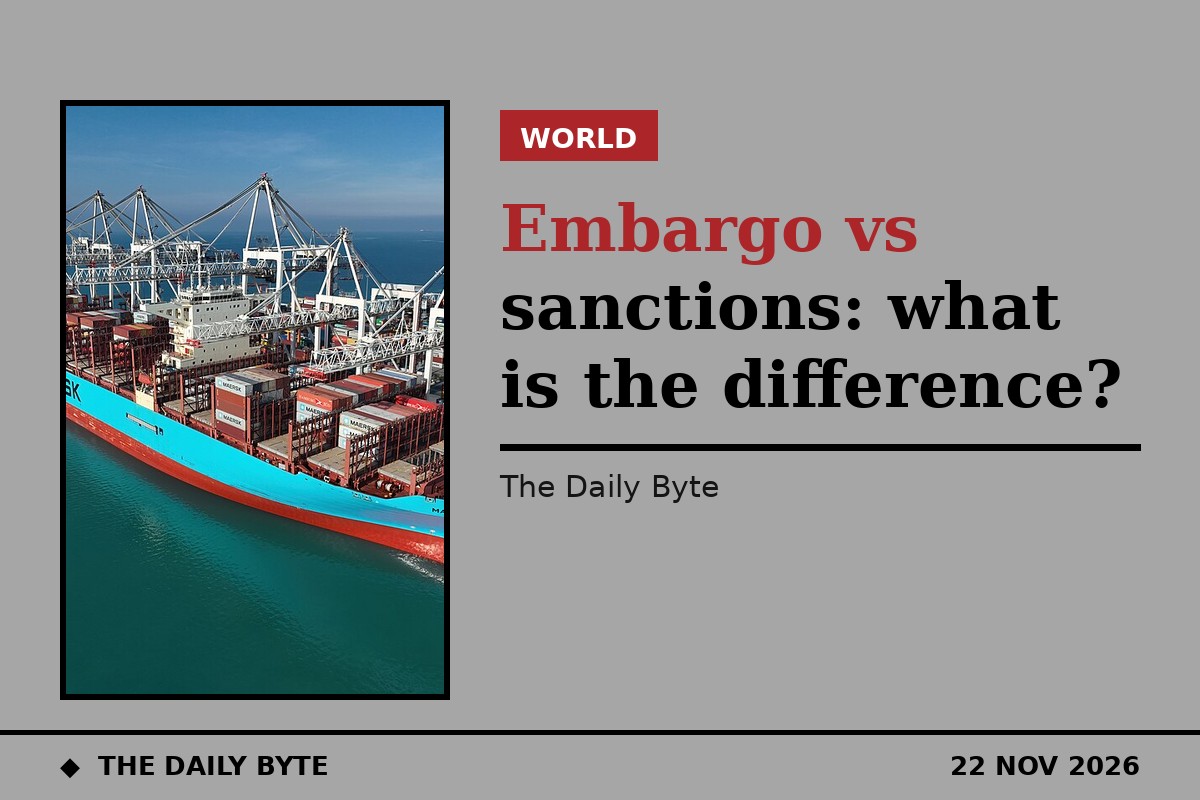
An embargo is a ban on trade or other economic dealings with a country, or on specific goods, services or activities. Sanctions are the broader family of measures that an embargo belongs to: they include asset freezes, travel bans and financial restrictions, often aimed at named people, companies or sectors. Put simply, every embargo is a kind of sanction, but not every sanction is an embargo.
The two words are used interchangeably in much news coverage, which is understandable but confusing. With the United States maintaining broad sanctions on Iran, the European Union adopting new sanctions packages on Russia, and the UN Security Council running arms embargoes in several conflicts, the distinction matters for businesses, travellers and anyone trying to follow the news. This guide explains what each term means, who can impose these measures, and how they work in practice.
What sanctions are
Sanctions are restrictive measures imposed by a state, a group of states or an international organisation to put pressure on a country, organisation or individual without using military force. They are a tool of foreign policy, used to enforce international law, respond to aggression, punish human rights abuses, or try to stop a country developing nuclear weapons.
Sanctions can be targeted or comprehensive. Targeted sanctions, sometimes called "smart sanctions", are aimed at named people, companies or sectors: freezing the bank accounts of a list of officials, banning named individuals from travelling, or blocking a country's access to specific technology. Comprehensive sanctions apply to a whole country or economy. Modern practice has moved towards targeted measures, because comprehensive sanctions often hurt ordinary people far more than the leaders they are meant to pressure.
The best-known targeted sanctions lists are the US Treasury's Specially Designated Nationals (SDN) List, run by the Office of Foreign Assets Control (OFAC), and the UK Sanctions List. Banks and businesses around the world screen their customers and transactions against these lists, because dealing with a listed person can lead to heavy fines and criminal penalties.
What an embargo is
An embargo is a specific type of sanction: an official prohibition on trade or other economic dealings with a specified country, or on specific goods, services or activities. Where sanctions can be narrow and targeted, embargoes are usually broad. They often comprehensively prohibit trade with a target country, or imports from or exports to that country.
Embargoes come in several types. A trade embargo bans imports, exports or both with a specified country. A military or arms embargo prevents the exchange of military goods, including weapons and ammunition, and sometimes dual-use items that could have a military purpose. A fuel or oil embargo targets only trades of oil or other fuels, aiming to cut off a country's energy supplies or its export earnings.
The legal basis for UN action is Article 41 of the UN Charter, which allows the Security Council to decide on the "complete or partial interruption of economic relations". The European Union uses Article 215 of the Treaty on the Functioning of the European Union for its own restrictive measures. Individual countries impose embargoes under their own laws.
Embargo vs sanctions: the key differences
The difference is mainly one of scope and target. An embargo is aimed at a place or a class of goods and binds every deal within its reach that touches them. Targeted sanctions follow a listed person wherever that person trades.
Scope: sanctions can be narrow, hitting one person, one company or one sector. An embargo is usually broad, covering most or all trade with a country, or a whole category of goods. Target: sanctions are often aimed at named individuals, firms and vessels. An embargo is aimed at a country, a region or a category of goods. Purpose: both aim to change behaviour without military force, but an embargo is the heavier instrument, used when targeted pressure has failed or when the situation is grave enough to justify cutting off trade entirely. Duration: embargoes tend to last longer and are harder to lift, because they are usually tied to a major political dispute. The US embargo on Cuba, for example, has lasted for more than six decades.
Enforcement also differs. Targeted sanctions are enforced mainly through name screening: banks check their customers against sanctions lists. Embargoes are enforced through trade controls: customs authorities, shipping companies and insurers check where goods are going, where they came from, and what they are.
Who can impose sanctions and embargoes
Three kinds of authority can impose these measures. The UN Security Council can impose binding sanctions and embargoes under Chapter VII of the UN Charter, which all member states are obliged to implement. Decisions on sanctions require an affirmative vote of at least nine of the fifteen council members, including the concurring votes of all five permanent members: China, France, Russia, the United Kingdom and the United States. That veto power is why the Security Council often cannot agree on sanctions, even in major crises.
Regional organisations can also act. The European Union imposes sanctions and embargoes through decisions of its member states, and its measures bind within the EU. The EU has adopted successive sanctions packages against Russia since 2022, including restrictions on oil, banking and technology.
Individual countries impose their own measures under national law. The United States is the most active: OFAC's FAQ 10 lists Cuba, Iran and North Korea as countries under broad US sanctions, together with the Crimea, Donetsk and Luhansk regions of Ukraine. The UK, after leaving the EU, runs its own sanctions regime under the Sanctions and Money Laundering Act 2018.
Real examples
The UN Security Council uses arms embargoes more than any other sanctions tool. Of the 28 mandatory UN arms embargoes recorded to date, 26 were passed in 1990 or later. Current examples include the arms embargo on Libya and the extensive sanctions on North Korea: since 2006, the Security Council has adopted nine major sanctions resolutions on North Korea in response to its nuclear and missile activities, including embargoes on the import and export of weapons, including small arms.
The US embargo on Cuba is the longest-running example of a comprehensive trade embargo. It bans most trade between the United States and Cuba, and its reach extends far beyond American companies, because the rules also affect foreign firms that deal with Cuba. Iran is under broad US sanctions that cover oil exports, banking and shipping, and the US has also pressed allies to stop buying Iranian oil. Russia has faced successive rounds of Western sanctions since 2022, including EU sanctions packages, asset freezes on named individuals and restrictions on oil exports and technology.
These examples show how the tools are combined in practice. A single country can be under a UN arms embargo, EU targeted sanctions on named officials, and US comprehensive sanctions all at the same time, each with its own lists, exemptions and enforcement.
Do sanctions and embargoes work?
The honest answer is that it depends, and experts disagree. Sanctions and embargoes are designed to change behaviour by raising the cost of continuing it: cutting off revenue, denying access to weapons or technology, and isolating leaders from the international financial system. Sometimes that pressure contributes to a change of policy. Often it does not, and the target government adapts, finds alternative trading partners, or simply absorbs the cost while ordinary people bear the burden.
The UN itself recommends the use of embargoes and sanctions only as part of a wider strategy, and there are suggestions that their impact is not always as intended. The unintended consequences are well documented: shortages of food and medicine, inflation battering the daily lives of people in poverty, and the growth of black markets and sanctions evasion. That is why modern sanctions are often designed with humanitarian exemptions, allowing food, medicine and other essential goods to continue, and why targeted sanctions have largely replaced comprehensive embargoes as the tool of first resort.
Enforcement is also a constant challenge. Sanctions evasion is a major industry: ships switching off their tracking systems, shell companies hiding the real owners of cargo, and goods routed through third countries. The EU has created a sanctions office and a crypto task force to deal with evasion through digital assets, and the UN Security Council's sanctions committees rely on panels of experts to investigate breaches.
Sanctions, embargoes and blockades are not the same thing
A blockade is different again. A blockade is a military operation that physically prevents ships or aircraft from reaching a country or a port, usually enforced by naval forces. An embargo is a legal ban on trade: it does not require warships, and it is enforced through law, customs and finance rather than force. The distinction matters in the news: a country can be under a trade embargo without any blockade, and a blockade is an act of war in a way that an embargo is not.
Tariffs are different too. A tariff is a tax on imported goods, used to protect domestic industries or raise revenue. An embargo bans the trade entirely. Both restrict trade, but only an embargo stops it.
Frequently asked questions
Is an embargo a type of sanction? Yes. An embargo is a specific kind of sanction: a ban on trade or economic dealings with a country or on specific goods. Sanctions are the broader category, including asset freezes, travel bans and financial restrictions.
What is the difference between an embargo and a sanction? Scope and target. An embargo usually bans most or all trade with a place or a class of goods. Targeted sanctions aim at named people, companies or sectors, and can be much narrower.
Who decides UN sanctions? The UN Security Council. A sanctions resolution needs at least nine of the fifteen members to vote in favour, and none of the five permanent members may veto it.
Can sanctions be lifted? Yes. Sanctions are usually lifted when the target changes its behaviour, when a political settlement is reached, or when the authority that imposed them decides to ease them. US sanctions can be eased by executive action; UN sanctions require Security Council agreement.
Do embargoes hurt ordinary people? They can. Broad embargoes raise prices, create shortages and damage the wider economy, which is why modern measures usually include humanitarian exemptions for food and medicine and why targeted sanctions are now preferred.
Sanctions and embargoes are the middle ground of international pressure: stronger than diplomacy, weaker than war. Knowing which is which, and who imposed it, is the key to understanding what the news is actually reporting. Sources: ComplyAdvantage on sanctions and embargoes and Complead on embargoes, Article 41 of the UN Charter and OFAC guidance.


