Emerging Markets Enter Bear Market on AI Rout
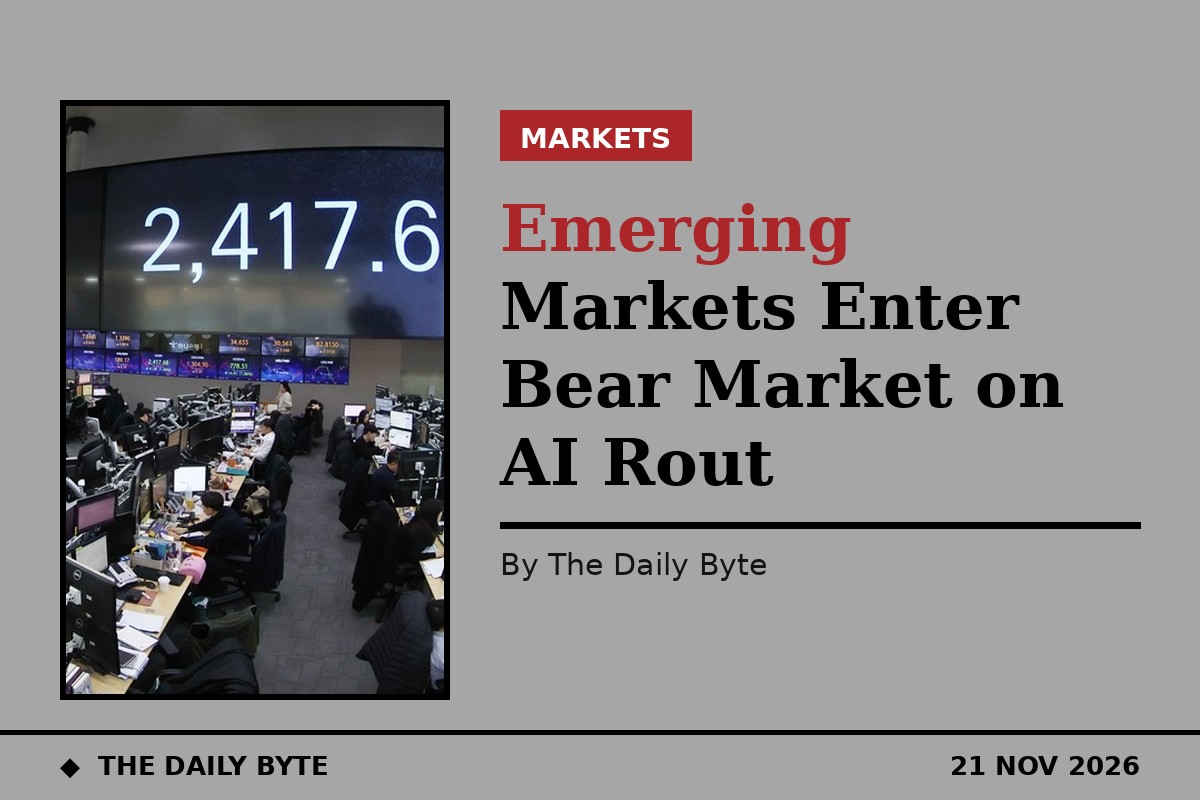
Emerging-market stocks have entered a bear market. The MSCI emerging-markets index suffered its seventh consecutive loss on Friday and has now fallen just over 20 percent from its 2026 high, set in June, crossing the threshold that defines a technical bear market.
The MSCI All-Country World Index also fell for a seventh consecutive trading session, its longest losing streak since September 2023, as confidence in the artificial intelligence trade crumbled around the world. Asia-Pacific markets, the most concentrated zone for AI trading, bore the brunt of Friday's selling.
The problem for the emerging-markets benchmark is its make-up. Korea, Taiwan and China together account for two-thirds of the index, and those markets are bellwethers for the global AI trade, which has been faltering in momentum since the summer. When chip stocks fall, the index falls with them, and this week chip stocks fell hard. Taiwan's benchmark plunged 6.2 percent in a single day on Friday, South Korea's Kospi fell 5.2 percent, and Japan's Nikkei 225 dropped 5.1 percent.
Brazil added to the damage
The weakness was not confined to Asia. Brazil, the fifth-largest market in the emerging-markets index, also dragged it lower. The Bovespa index has fallen by a fifth in the last month alone after an October election outcome that disappointed investors. The decline in Brazil shows the sell-off reaching beyond the AI trade into markets with their own domestic troubles.
The speed of the reversal is striking. Emerging markets outran the United States for much of 2026, peaking on 22 June, and have since lost a fifth of their value. According to Yardeni Research, the index now trades on a price-to-earnings multiple of less than eight times for the next twelve months, a level that reflects how far expectations have fallen.
Anthropic's debut failed to stop the slide
The week's most watched market event did nothing to halt the decline. Anthropic completed the largest initial public offering in history, but the listing failed to reverse market pessimism. Investors are seriously questioning whether the massive capital and debt consumed by the AI boom can translate into commercial returns to match its lofty valuations, and the debut's failure to lift sentiment only deepened the doubt.
The selling was broad rather than confined to equities. As risk assets sold off, safe-haven money moved quickly. United States Treasuries continued to strengthen, with the 10-year Treasury yield falling to 5.01 percent. In foreign exchange, both the Japanese yen and the Swiss franc appreciated against the dollar, while the dollar index posted its fourth consecutive weekly gain as Anthropic's listing drew global capital into dollar conversions.
What a bear market label does and does not mean
A fall of 20 percent from a peak is the conventional definition of a bear market, but it is a label rather than a verdict. It says nothing about how much further an index might fall, or when it might recover. What it does record is the scale of the change in sentiment: an asset class that led global markets for most of the year is now, on the standard measure, in a bear market, driven by the same AI trade that once powered it higher. Precious metals suffered alongside equities, with gold down about 9 percent for the week and silver down about 14 percent on a spot basis, both recording their largest weekly declines since March. This article reports market movements only and is not investment advice.