Energy Secretary: Cutting Bills Is My Overriding Aim
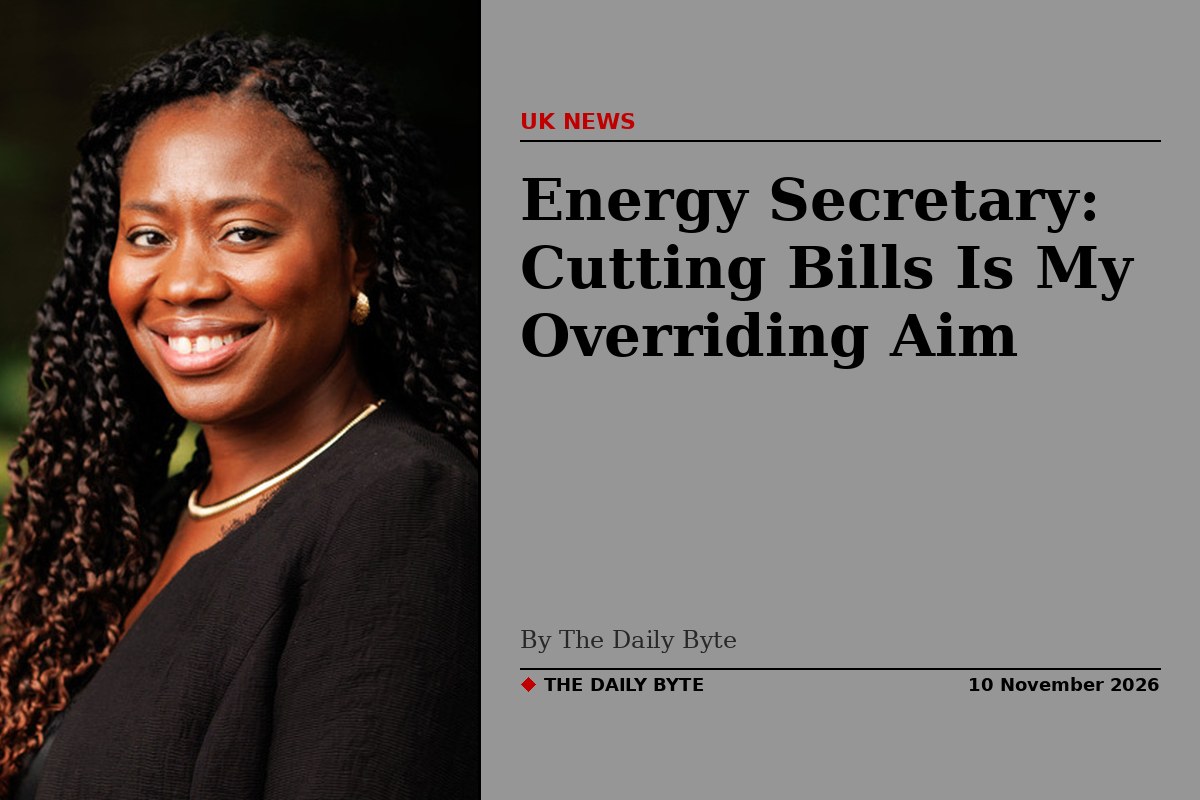
Energy Secretary Miatta Fahnbulleh has said cutting household energy bills is her overriding objective, as the Government faces pressure over rising costs and the future of its clean power plans.
Speaking to BBC Panorama in an interview broadcast on Monday 9 November, Ms Fahnbulleh said affordability must guide every decision her department takes. “With the cost of living biting, affordability is my overriding objective, without a doubt,” she said.
She argued that building more homegrown clean power was the best route to lower bills over time, rather than relying on imported fossil fuels. “The drive to clean power is about decoupling our dependence on global fossil fuel markets,” she said. “Ultimately if we have homegrown renewables, nuclear, that’s the way in which we will drive bills in the long term.”
January price cap forecast to rise sharply
The interview comes as households face the prospect of another steep rise in energy bills. Forecasts from the big suppliers British Gas, EDF and E.ON suggest the energy price cap could rise by around 27% in January 2027, adding roughly £460 a year to a typical dual-fuel bill, taking it from £1,723 to around £2,190.
Ofgem, the regulator, has not yet set the January cap and is due to confirm the figure by 25 November. The forecasts are driven by higher wholesale gas prices, pushed up by the conflict in the Middle East and the effective closure of the Strait of Hormuz to shipping earlier this year.
UK households already pay some of the highest electricity prices in Europe. Bills have been pushed up both by the high price of gas on international markets and by the cost of subsidies supporting renewable generation.
Drilling will not cut bills, she says
Ms Fahnbulleh was asked whether producing more British oil and gas would bring bills down. She was clear that it would not. “No, it doesn’t,” she said. “In the end, the oil and gas is sold on global markets.”
That position matters because the Government approved drilling at the Jackdaw gas field in the North Sea in October, while a decision on the much larger Rosebank oil field, west of Shetland, is still to come. Ms Fahnbulleh has said Jackdaw “will not have an impact on affordability and bills”.
She also acknowledged that Britain was swapping one form of dependence for another, saying the country was becoming reliant on China for clean energy equipment even as it moved away from petrostates. “Well, look, we are,” she said, adding that the UK bought from a diversified global market and that she wanted more of the kit made in Britain.
What the Energy Independence Bill promises
Last week the Government introduced the Energy Independence Bill to Parliament, describing it as a major overhaul of the energy system with affordability at its heart. The Bill was introduced on Wednesday 4 November.
Under the Bill, the Government will bring forward amendments to scrap standing charges on household gas bills, ending the daily charge paid even when no gas is used. Around 23 million households would be affected, with around 60% of gas account holders expected to save an average of £45 a year.
The Bill would also put on a lasting legal footing the decision to move 75% of domestic Renewables Obligation costs from energy bills to public spending, protecting savings the Government says are already worth around £90 a year for the average household. It would end new licences to explore for new oil and gas fields in the North Sea, while supporting continued production from existing licensed areas.
The measures build on the Budget on 28 October, which announced a one-off £100 payment for up to 20 million households in England this winter and a £50 cut to the annual price cap.
Net zero under political pressure
Labour has faced growing political pressure over its climate plans since coming to power, as Reform UK has risen in the polls and the Conservatives under Kemi Badenoch have dropped their previous commitment to reaching net zero by 2050. Both parties have attacked the public subsidy schemes for renewable electricity, arguing they have driven up costs for consumers.
Ms Fahnbulleh rejected that argument, saying people wanted to blame net zero for high bills but that she did not believe that was the case. She said cutting bills was essential to keeping public support for climate action, with world leaders gathering in Antalya, Turkey, this week for the COP31 climate summit.
The Bill still has to pass through Parliament and can be amended, so none of its measures is law yet. The gas standing charge change is not expected to take effect before 2027.