Eskom Green RFQ Locks Out Local SA Developers
South Africa's own renewable energy developers have spent 15 years building the country's independent power industry. Now they find themselves unable to lead a bid in Eskom's most important renewable energy procurement to date, according to analysis published on Monday by energy expert Chris Yelland.
On 2 October 2026, Eskom issued a request for qualification, RFQ E3612GXR, to select strategic partners for Eskom Green, its new renewable energy subsidiary. The aim is a five-year panel of partners to co-develop, finance and build up to 6 GW of solar PV, wind and battery storage, with Eskom contributing at least 2 GW of solar PV and 1 GW / 4 GWh of battery storage from its own land and sites. Responses close on 12 January 2027.
Four pass-or-fail tests
There is no explicit requirement for the size of a responding company. Size is imposed through four pass-or-fail mandatory criteria, and failing any one means disqualification. The lead member of a bidding consortium must have at least one operational solar or wind project of 240 MW or more, or a standalone battery of at least 600 MWh, plus a portfolio of at least three operational projects of 100 MW or more totalling at least 800 MW. Consortium members may combine their experience to show executed power purchase agreements totalling 1,000 MW as sellers, and must show an audited net asset value of at least R5 billion. Only projects in commercial operation count: plants at financial close or under construction do not, smaller projects or phases at one site cannot be combined to reach 240 MW, and the company must have been the developer, co-developer or sponsor rather than a passive shareholder.
One plant in the country clears the bar
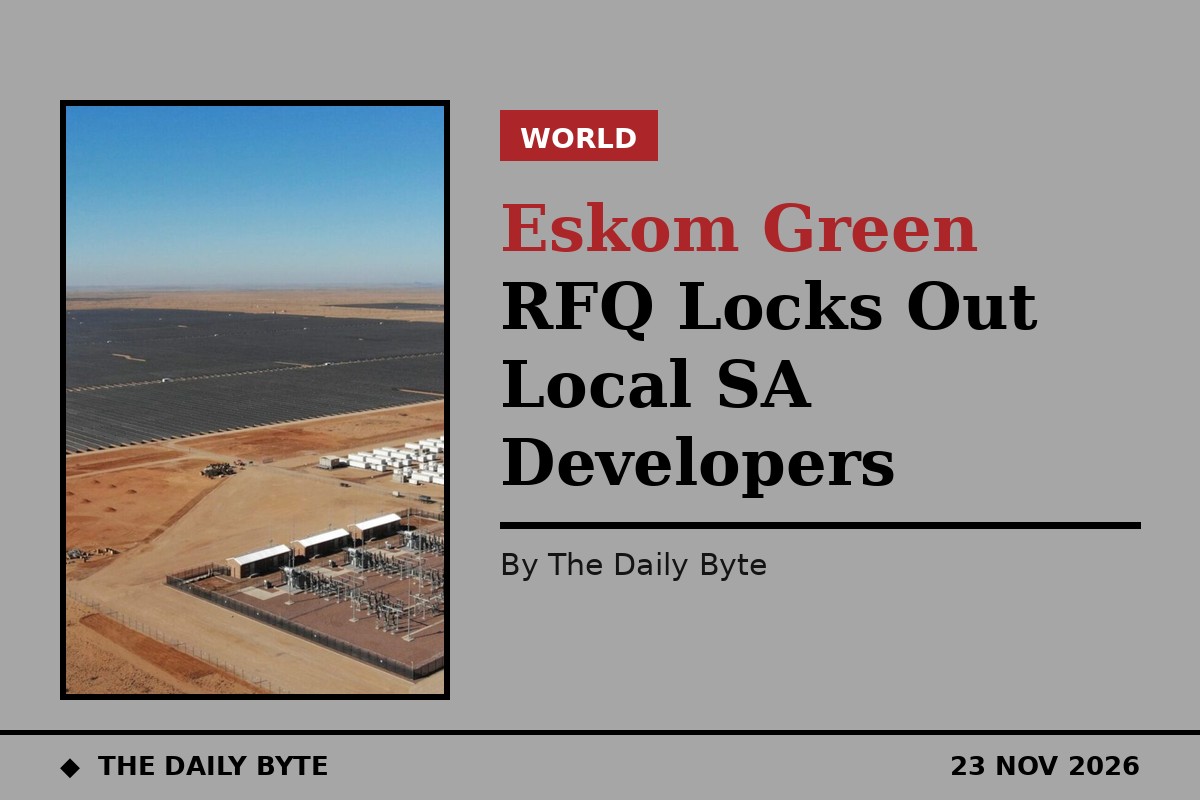
The 240 MW requirement is the hardest test. In its own published clarification responses, Eskom records a respondent's point that only one operational solar or wind project of that size exists in South Africa: the 240 MW Mooi Plaats solar plant near Noupoort, which reached commercial operation in March 2026. It belongs to Envusa Energy, the joint venture of Anglo American and France's EDF, with black-owned Pele Green Energy holding 20 per cent. Even Envusa falls short on its South African assets alone: its Koruson 2 cluster of Mooi Plaats and two 140 MW wind farms totals 520 MW, well short of the 800 MW portfolio test.
The other leading local developers fare worse. SOLA Group has about 600 MW in operation, but its largest plant, Springbok, is 195 MW, and its 300 MW Naos-1 hybrid project is due only in 2028. Red Rocket has 530 MW in operation, and its 242 MW Overberg wind farm is due in early 2027, after the closing date. NOA Group's 157 MW Khauta West and 349 MW Khauta South solar plants reach commercial operation in late 2026 and early 2027, while Seriti Green's Ummbila Emoyeni wind farm entered operation only in 2026 and Mulilo Energy's 250 MW Beaufort West solar project reached financial close in April 2026.
A gap made by past procurement rules
The irony, Yelland argues, is that local developers fail not for lack of capability but because of how the state procured renewable energy in the past. For most of its history, the Renewable Energy Independent Power Producer Procurement Programme capped individual projects, typically at 75 MW for solar PV and 140 MW for wind, and Bid Window 5, awarded in 2021, still procured exactly those sizes. Local developers responded rationally and built many projects of the size the government asked for. The larger projects came only recently, through private wheeling and later bid windows, and many have reached financial close or are under construction but have not yet reached commercial operation.
Eskom declines to change the rules
When asked directly whether the first criterion was intended to exclude South African independent power producers from leading a response, Eskom said no. But it refused every remedy proposed, including recognising projects at financial close, combining phases at one site or aligning the threshold with South African project sizes, and it declined to create a separate category for local developers. Clarification questions close on 30 November 2026. With experience anywhere in the world counting and no South African experience needed to pass the first stage, the likely leaders are international players with renewable plants measured in gigawatts, including EDF, Copenhagen Infrastructure Partners, Scatec, Engie, ACWA Power, Masdar and TotalEnergies.
Copenhagen Infrastructure Partners shows how this works. The Danish fund manager has owned a majority of Mulilo since 2023. Mulilo will not qualify in its own right, but the fund may respond with Mulilo as part of its consortium. SOLA, Red Rocket, NOA and Pele have no foreign parent to lean on, and must find a multinational willing to take them along.
The same pattern on transmission
It is the second time in just over a year that local industry has been bypassed in this way. In July 2025, the Department of Electricity and Energy issued a request for qualification for the first phase of the Independent Transmission Projects programme, about 1,064 km of new lines worth roughly R17 billion, requiring experience of at least three independent transmission projects built in the past 15 years. No South African company could meet that test, because Eskom and later the National Transmission Company South Africa had built all of the country's transmission infrastructure. On 15 December 2025, the minister named seven pre-qualified bidders from 17 respondents, all led by international companies, including China's State Grid International Development Company, Spain's Grupo Cobra and Celeo Redes, and India's Adani. Local firms were left to bid for engineering, procurement and construction subcontracts.
Local developers are not shut out entirely. They can join a consortium as members, contribute to the offtake and financial tests, or bring their South African project pipelines to foreign bidders. But none of these routes gives a local company a seat at the table in its own name. As Manufacturing Circle executive director Philippa Rodseth put it: "SA Inc should have a primary seat at the table at this critical juncture to leverage our capabilities at every level – including local developers, local contractors and local manufacturers." The full analysis is published by Green Building Africa.


