Espressif ESP ZeroCode AI writes ESP32 firmware
Espressif has launched ESP ZeroCode AI, a browser-based development studio that turns a plain-language description of a device into a complete, tested firmware project for its ESP32 chips. The company announced the tool on 27 November 2026, and it is live now at esp-zerocode.ai, with nothing to install on the user's computer.
The idea is simple to describe and hard to get right in practice. AI tools can already turn a prompt into embedded code, but code that compiles is not the same as a device that works. Pins, peripherals, memory limits, connectivity stacks and physical behaviour all matter, and firmware that builds cleanly may still fail on the real board. Espressif says ESP ZeroCode AI was built to close that gap: it works out what the device should do, writes the firmware for the chosen board, has it reviewed and tested, and then helps the user check it on real hardware, all in the browser.
Three AI experts share the work
The workflow starts with a sentence rather than a datasheet. The user describes the device in plain words, saying what it senses, what it does and what it works with. A Product Expert agent asks a few clarifying questions, then writes the product specification, including the intended behaviour, the hardware and the wiring. Espressif says early users have found this conversation one of the most useful parts of the experience, because it raises decisions about the product they had not yet considered.
The Product Expert captures the intended behaviour, hardware and wiring. The Firmware Expert writes the ESP-IDF source code, compiles it for the target board and has the code reviewed. The Testing Expert checks the behaviour on an emulator and guides testing on real hardware, and when a test uncovers a problem, the findings go back to the Firmware Expert to fix.
Before any hardware is involved, the firmware can be run on a virtual device in the browser, wired like the diagram the Product Expert produced. It boots the same image that would be flashed to the board, and the user can press its buttons and touch its screen. The final test loop runs on the real board, because an emulator cannot tell the user that a relay clicks or that a 180-millisecond double-press is too quick for a thumb. The board plugs in over USB and is flashed from the browser in one click. The Testing Expert then gives a checklist, watches the device log for the events that matter and flags crashes, while the user confirms what they see and hear.
Grounded in real boards, not generic pins
The tool is grounded in the ESP32 ecosystem rather than generic pin assumptions. At launch, its catalogue spans eight Espressif system-on-chips, more than 130 development boards and more than 400 parts, with boards from Espressif, M5Stack, Seeed Studio and Adafruit. The Product Expert uses the selected board's pin map when it writes the specification and wiring. Depending on the chip and hardware, firmware can combine Wi-Fi, Bluetooth LE, Matter over Wi-Fi or Thread, Zigbee, BLE Mesh, ESP-NOW, ESP RainMaker, MQTT and AWS IoT, along with touchscreen displays, speakers, a control page served by the device itself and Bluetooth media remotes. AI features include voice commands, trained models that classify sensor data on the device, plain-language commands understood offline, camera motion detection and cloud AI agents.
Try it in the browser first
The output is a complete, editable ESP-IDF project with source code, configuration and a flashable binary. Makers can continue working in the browser, while experienced developers can download the project into their usual ESP-IDF tools, add custom components and carry out the additional validation needed for a commercial product. Projects stay private unless the user chooses to publish them to the Community, where others can try them in the browser, flash them to their own board or fork them. Published code and binaries are shared under the Apache-2.0 licence, and photos and descriptions under CC BY 4.0.
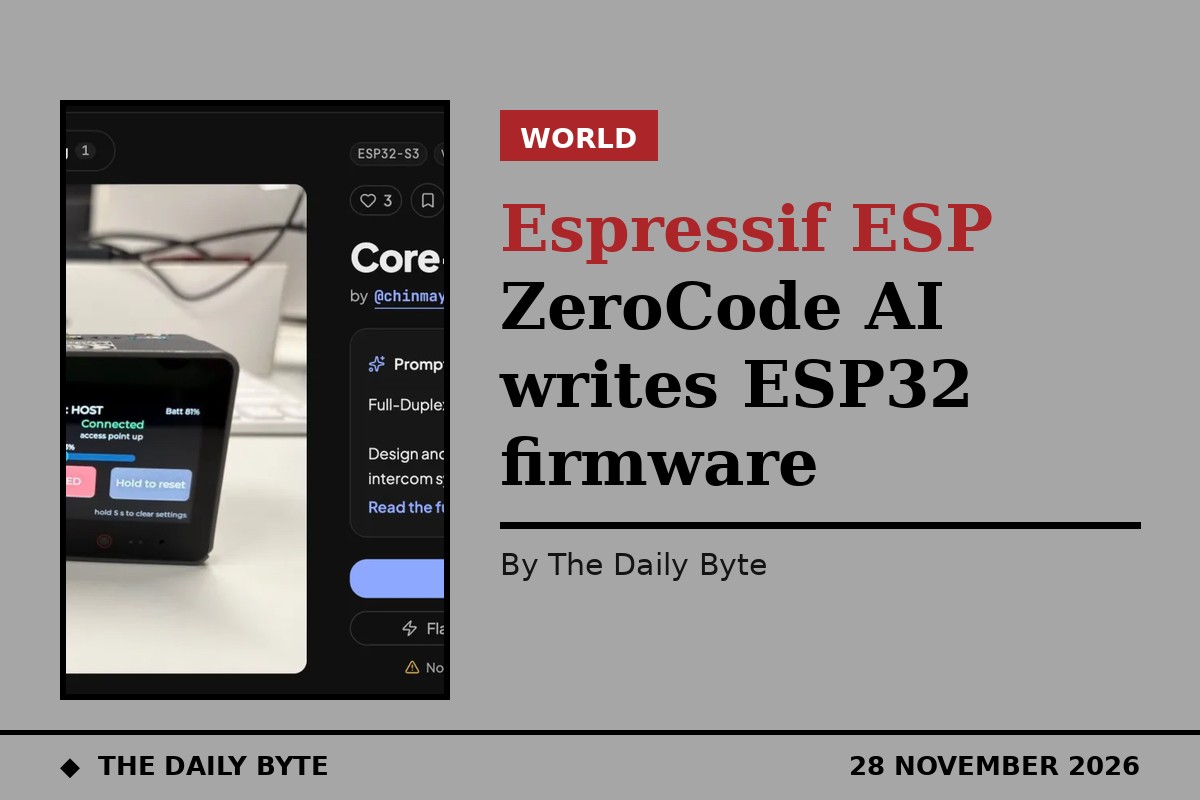
The Community has already built a Minecraft-style game, a T-Rex runner game, a music synthesiser, a USB security key and a robot that plays the Atari game with a real joystick, all on ESP32 hardware. One featured project is a Core-S3 Walkie-Talkie, a full-duplex, low-latency Wi-Fi intercom built from two M5Stack CoreS3 units. Espressif invites makers to describe a device, watch it get built and tested, run it in the browser, and then plug in a board when they are ready.


