Ethereum Glamsterdam Upgrade Set for 15 December Test
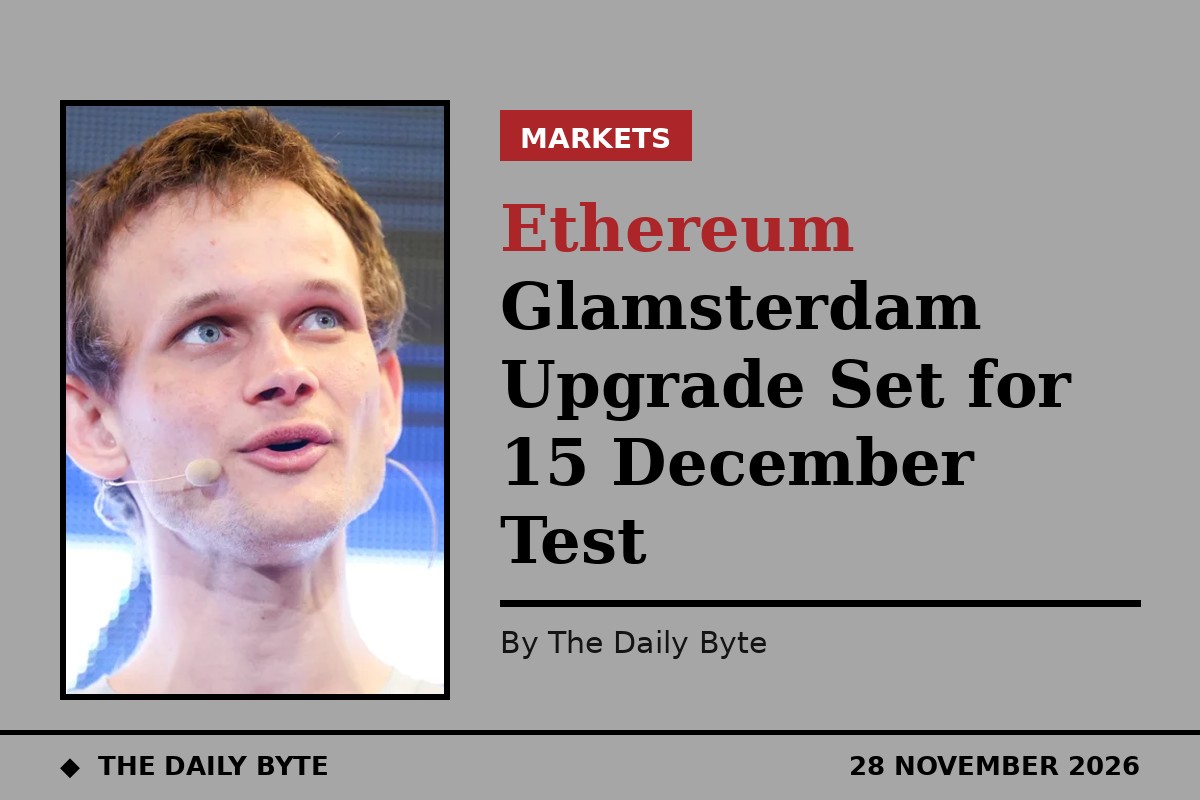
Ethereum's core developers have set 15 December 2026 as the date for the final public test of Glamsterdam, the network's next major upgrade, after agreeing to press ahead with a contested change to storage fees that could leave thousands of existing smart contracts unable to finish their transactions.
The decision was taken at the developers' all-core-devs consensus meeting on Thursday 26 November. The upgrade will activate on the Hoodi test network at 19:12 UTC on 15 December, at epoch 143,616, The Block reported. Hoodi is the last rehearsal network developers use before changes reach Ethereum itself, and no date has yet been set for the main network.
Glamsterdam is Ethereum's next major upgrade after Fusaka, which went live on the main network in December 2025. Its name combines the consensus-layer part, Gloas, with the execution-layer part, Amsterdam. Its two headline features are enshrined proposer-builder separation, known as ePBS, which moves the split between block proposers and builders into the protocol itself, and block-level access lists, which record the state each block touches so clients can process transactions in parallel.
The storage fee at the centre of the row
At the heart of the dispute is a rule known as EIP-8037, which sharply raises the cost of creating new permanent data on Ethereum and charges for it separately from normal transaction fees. It is designed to stop Ethereum's database from growing without limit as Glamsterdam packs more activity into every block.
Under the new rule, creating a new smart contract would cost 183,600 units of gas, Ethereum's meter for computing work, in storage charges alone, before regular fees and a charge for each byte of code. The base cost today is a flat 32,000 units, CoinDesk reported.
Contracts written around the old prices can run out of the gas they need halfway through a transaction and fail. Ethereum Foundation developer Marius van der Wijden estimated that up to 15,000 of the network's roughly 90 million contracts are exposed. Security firm ChainSecurity told CoinDesk it had found 200 problems in programs across the industry, in bridges that move money between blockchains, wallets, exchanges, staking services and oracles that feed outside data such as prices into blockchain programs.
Most of the problems can be fixed by changing a setting, CoinDesk reported. The other 24 require upgrading the programs or moving users and their money to new ones, and the teams behind them have less than three weeks to do it. The final public test on 15 December is also the deadline for fixing the most serious problems, with the rest due by 10 January.
A test called off in October
The Hoodi test was originally scheduled for 26 October but was called off after ChainSecurity warned that the changes could alter how programs already running on the network behave. The 15 December date is seven weeks later than originally planned.
At the meeting, developers agreed to ship the rule as it stands, with no changes to its specification, despite the concerns. A last-minute proposal to simplify how the new charges are tracked was turned down.
Developers said at a meeting last week that the upgrade would reach Ethereum's main network no earlier than mid-January, and more likely in late January or early February, once testing is complete.
What comes next
The same meeting opened a debate over Hegota, the upgrade scheduled after Glamsterdam. Its main feature is a mechanism called FOCIL, designed to stop any single block builder from quietly leaving some transactions out.
Caspar Schwarz-Schilling, a researcher at Ethlabs, a non-profit Ethereum research lab, said FOCIL should be dropped so developers could spend the time on defences against future quantum computers instead. The lab wants Ethereum ready for quantum computers by 2027, a year or two earlier than the schedule researchers at the Ethereum Foundation had discussed. No final decision was made, and the full list of features for Hegota is expected to be settled around 10 December.
The upgrade news came as ether, the network's currency, traded near 1,657 dollars on Saturday 28 November, down 4.39 percent over 24 hours and below the 1,700 dollar level, according to CoinGecko data reported by MarketAlleys at 08:01 UTC.


