Etsy to Revise AI Policy After Seller Backlash
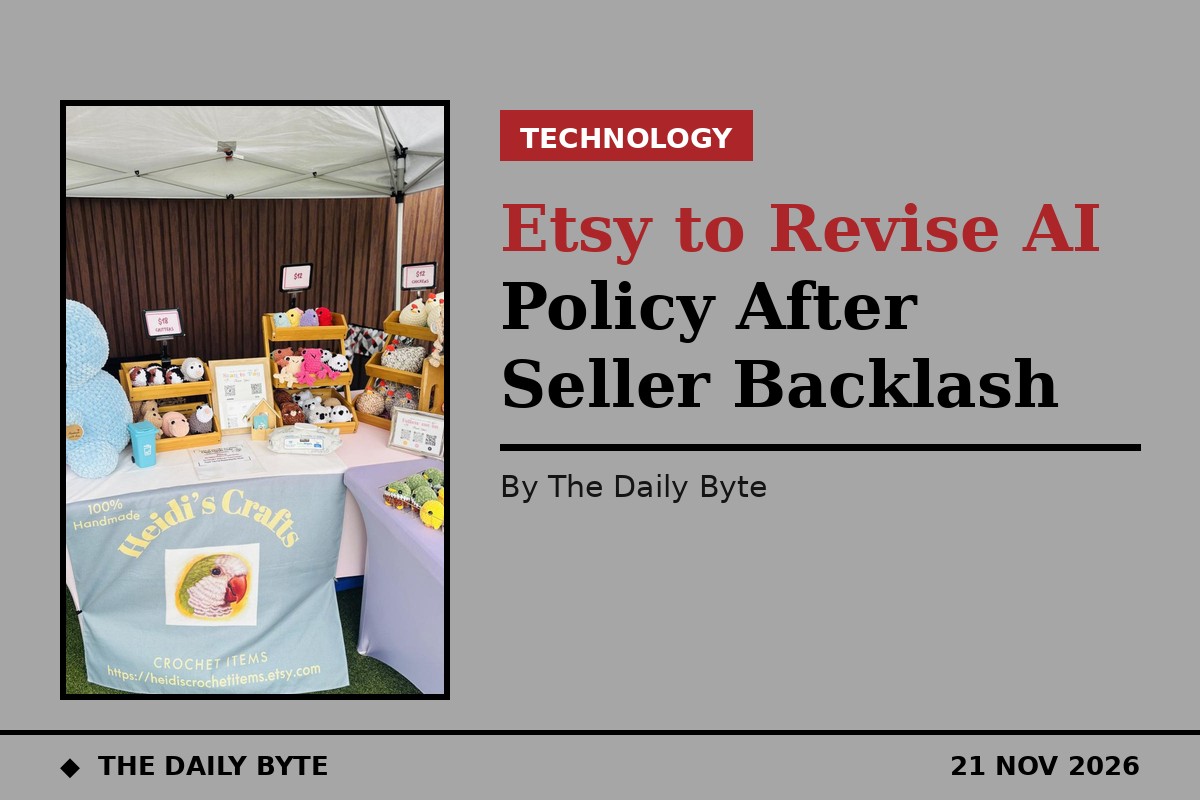
Etsy says it will revise its new AI policy after a backlash from sellers, some of whom have closed their shops in protest at terms that would let the marketplace use their work to train artificial intelligence systems.
James Ossman, Etsy’s vice-president of customer operations, told the New York Times that the company plans to “share the revised terms directly with sellers soon”, according to The Verge’s report of the newspaper’s story. The promise came after days of anger from the handmade sellers who built Etsy’s reputation, and it leaves the key question — what exactly will change — unanswered for now.
The dispute centres on Etsy’s updated Terms of Use, published on 26 October and due to take effect on 16 December. Section 5C of the terms gives Etsy and its third-party partners and vendors the right to use sellers’ content “to develop, train, test and improve artificial intelligence and machine learning technologies”. That content covers listing photographs and descriptions, videos, reviews and other material sellers upload to the site.
Sellers say the wording is far broader than Etsy’s reassurances suggest. The terms do not name the partners involved, and there is no general opt-out. Sellers who want their work excluded from AI training cannot switch it off in their account settings; they must email Etsy’s data protection officer and ask. Some sellers who contacted the company say they were advised to close their accounts if they disagreed with the terms.
Sellers are already leaving
The reaction has moved beyond argument. War and Peas, a shop selling prints, books and apparel run by webcomic creators Jonathan Kunz and Elizabeth Pich, announced it had closed its Etsy shop, writing on social media: “You might have heard of Etsy’s new terms and artists fleeing the platform. We’re out, too.” Other sellers have reported closing their shops this week, although the total number is not known.
The timing has made the anger worse. Only weeks earlier, Etsy won praise from many of the same sellers for cracking down on misleading uses of AI. On 22 October it announced that listings must include at least one unaltered photograph of the actual item, that bot-generated listings with no human involvement are banned, and that AI-generated patterns, recipes and other functional guides are banned outright. Sellers must also disclose when AI was used to create an item.
To many sellers, the two moves now look contradictory: Etsy is restricting how sellers may use AI while claiming broad rights to feed sellers’ own human-made work into AI systems. “Can’t train AI on AI, they know what they are doing,” one seller wrote online, capturing a widely shared suspicion that handmade listings are being sought as fresh training data precisely because AI-generated content is of little use for training.
What Etsy says in its defence
Ossman addressed sellers’ concerns in a post on Etsy’s community site on 16 November. He said sellers keep ownership of their creative work and that Etsy does “not use your content to train AI models designed to copy your original work or replace your creativity”. He said the company uses AI to spot fraudulent accounts and listings, to power search and recommendations, and to build tools such as listing optimisation and shop statistics summaries.
He also said the terms prohibit scraping Etsy and unauthorised use of its content to train AI models. Critics note that the ban covers unauthorised third parties, not Etsy itself or the partners it licenses, and that Ossman’s reassurance does not appear in the binding terms. The legal language, as published, still says Etsy and its partners may use content to develop and train AI systems.
For sellers, the practical choice is stark. The current terms are still due to take effect on 16 December, and Etsy has not said whether the promised revision will arrive before then, or what it will change. Until sellers see the revised wording, those who object to their work being used for AI training face the same options as before: email the data protection officer, or close their shops.


