EU Adds 145 Russia Sanctions Listings
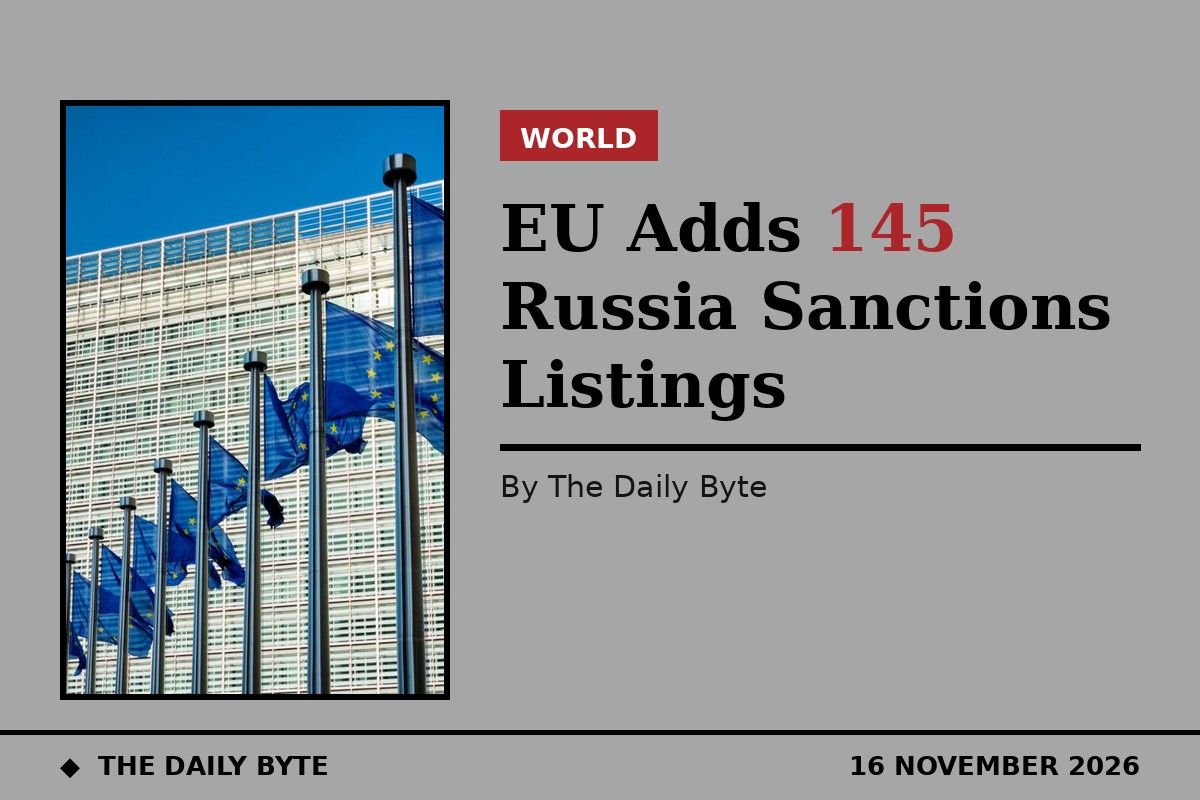
The European Union has added 145 people and entities to its Russia sanctions lists, including nearly 50 Russian banks, the owner of online retailer Wildberries and the pro-Russian hacker group NoName057(16). The Council of the European Union confirmed the listings on Monday, 16 November, after foreign ministers adopted them at their monthly meeting in Brussels.
The listings fall into two groups. The first covers 12 individuals and 101 entities whose activities help finance Russia's war in Ukraine or support its shadow fleet of oil tankers. The second covers 30 individuals and two entities listed for foreign information manipulation and interference and for malicious cyber activity. Together, the two decisions add up to 145 new listings.
Banks, e-commerce and the shadow fleet
The Council said nearly 50 Russian banks and financial institutions were listed, as part of a continuing effort to cut off the financial channels that process state revenues and fund the war. The measures also reach into Russian e-commerce: those listed include the sole shareholder of Wildberries, Russia's largest online retailer, and an individual holding the majority stake in another major online retailer, Ozon. Reuters identified the Wildberries shareholder as its chief executive and founder, Tatyana Kim.
Energy companies were also listed, including firms that manage Russian refineries and the St Petersburg oil terminal and are active in oil exploration and production. The Council further targeted the shadow fleet, listing companies from the United Arab Emirates, China, Seychelles and Oman that buy Russian-origin crude oil products, as well as businesspeople who own or manage vessels under EU sanctions and move Russian oil while engaging in high-risk shipping.
Those listed face an asset freeze, and EU citizens and companies are banned from making funds available to them. A travel ban to the EU applies to the individuals named. The Council said the relevant legal acts have been published in the Official Journal of the European Union.
Disinformation network and hacker group listed
The second decision targets Russia's foreign information manipulation and interference, known as FIMI, and malicious cyber activity. It lists the Moscow-based Social Design Agency, which the Council describes as a public relations and political technology company carrying out large-scale information manipulation projects funded, directed and supervised by the Russian Presidential Administration. The agency has run disinformation campaigns targeting EU countries and institutions and European public support for Ukraine, including around the 2024 European Parliament elections and in operations against Germany and France. Twenty-four people working for the agency were also listed.
Also listed were television figures Vitaly Eliseev and Petr Marchenko, Ukrainian-born blogger and military commentator Yurii Podoliaka, and Chay Bowes of RT international, whom the Council accuses of spreading narratives that legitimise Russia's war against Ukraine.
On cyber activity, the Council listed NoName057(16), a pro-Russian hacker group that emerged in March 2022 and claims responsibility for denial-of-service attacks on government bodies, critical infrastructure and private companies in Ukraine, the United States and EU member states. In the EU, the group has targeted websites in the energy, financial and transport sectors, water supply facilities, and political parties and candidates during elections.
No security talks before a ceasefire, ministers say
At the same meeting, several EU foreign ministers cautioned against discussing Europe's future security architecture with Moscow before a ceasefire is reached in Ukraine, warning against falling into what they described as a Russian trap. EU foreign policy chief Kaja Kallas said a ceasefire was needed before talks about anything else could start, and that Russia was escalating rather than moving towards one. Lithuanian Foreign Minister Kestutis Budrys told reporters that the rules were working, but that Russia was breaking them.
Irish Foreign Minister Helen McEntee, whose country holds the EU presidency, said a further package of sanctions was being finalised and would be discussed later in the week. French Foreign Minister Jean-Noel Barrot said Paris would host a conference on 4 December with Britain on Russia's shadow fleet. The listings adopted on Monday are separate from the EU's 22nd sanctions package, which remains in preparation.
The Council's decisions follow conclusions adopted by EU leaders on 15 and 16 October, in which the European Council reaffirmed its support for Ukraine's independence, sovereignty and territorial integrity and its determination to increase pressure on Russia so that it ends its war and engages in meaningful negotiations towards peace.
Sources: Council of the European Union; Council of the European Union; Reuters. Published 16 November 2026.


