EU plans seven AI gigafactories in €500bn tech push
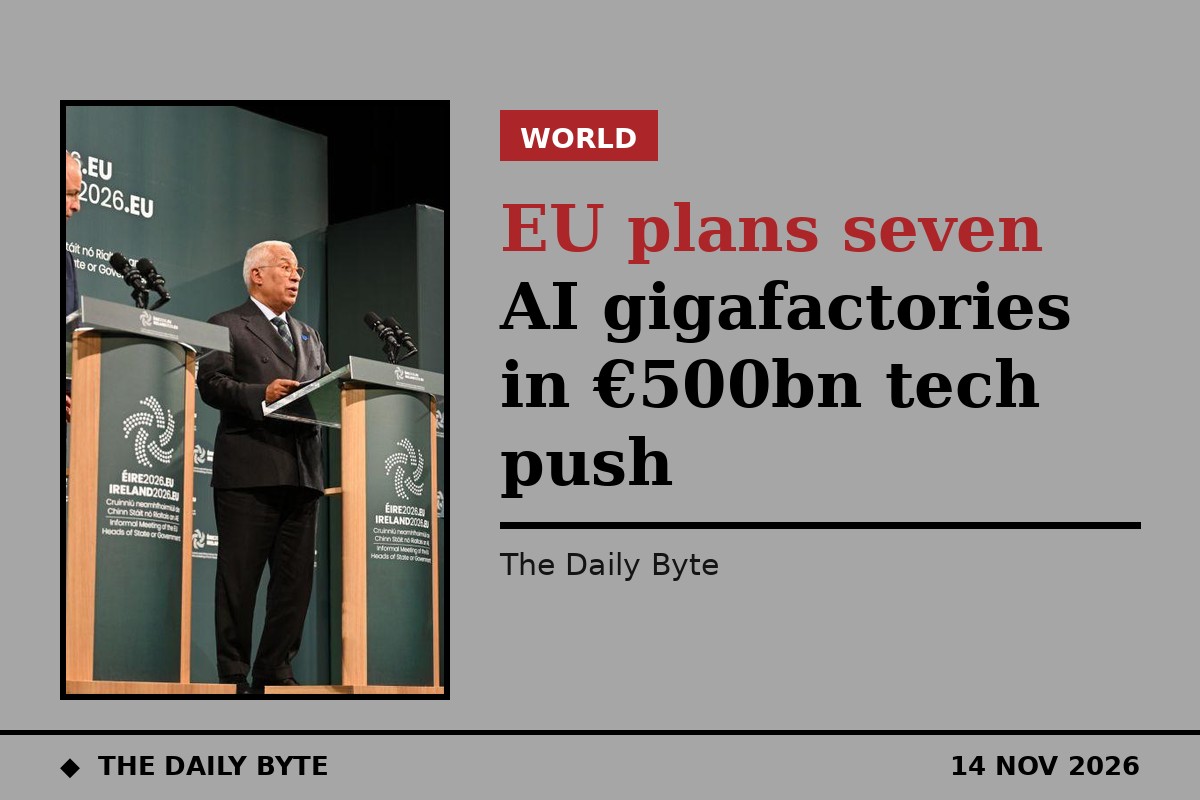
European Union leaders have agreed to press ahead with seven giant artificial intelligence factories and a technology investment drive worth at least €500 billion, after their first summit devoted entirely to AI ended in Dublin on Friday, 13 November 2026.
The informal European Council, hosted by Irish Prime Minister Micheál Martin and chaired by European Council President António Costa, was held at the Convention Centre Dublin as part of Ireland's presidency of the Council of the European Union. Because the meeting was informal, no formal decisions were taken, but leaders used it to set the direction for a formal summit on 26 and 27 November.
Seven gigafactories and €30 billion for computing power
European Commission President Ursula von der Leyen told reporters that the EU was advancing plans to build seven AI gigafactories, with around €30 billion expected to be mobilised for the computing infrastructure needed to train advanced AI models. She said Europe would need to mobilise at least €500 billion in total investment to achieve its ambition of mastering the technology and securing what she called technological sovereignty.
Von der Leyen said strengthening Europe's AI capability would require public and private funding to work together, reliable supplies of clean energy at reasonable prices, and reduced dependence on external technology supply chains. She promised to table a detailed financing proposal at the leaders' next meeting.
Costa said the EU needed to accelerate the adoption of AI across member states, cut critical dependencies on suppliers outside Europe, and unlock greater public and private capital. The discussion was the first time EU heads of government had held a dedicated leaders' level debate on AI, and it followed the ninth European Political Community summit, also held in Dublin on Thursday, 12 November.
Paris gathering of technology leaders in December
French President Emmanuel Macron announced that he and Dutch Prime Minister Rob Jetten would co-host a gathering of European technology leaders in Paris on 2 December, under the banner "Tech Creators", to deepen cooperation and bolster the continent's technological independence.
Artificial intelligence specialists were also part of the Dublin discussions. Mistral AI chief executive Arthur Mensch and Nobel laureate Geoffrey Hinton were invited to brief leaders on the pace of development in the field and the safeguards it may require.
Ukraine peace team agreed in Dublin
Ukraine also featured prominently on the Dublin agenda. Costa announced that EU institutions and five European countries from the Coalition of the Willing — Britain, France, Germany, Italy and Poland, collectively known as the E5 — would form a single European negotiating team for any peace talks aimed at ending the war in Ukraine.
"Today the Leaders agreed that the European Team for negotiations on peace in Ukraine is the EU institutions and the E5 of the Coalition of the Willing," Costa said, adding that the team would act in full unity and that Europe must speak with one clear and united voice.
Von der Leyen welcomed the agreement and said a strong European presence was important to securing a just and lasting peace. She added that the Commission would soon propose its 22nd sanctions package against Russia, along with a proposal to close Ukraine's financing gap for 2027. Leaders will discuss Ukraine's financing needs for next year and beyond at the European Council meeting on 26 and 27 November.
The Dublin summit followed renewed diplomatic activity involving the United States, Ukraine and Russia. Ukrainian President Volodymyr Zelenskyy held talks in Ireland with US President Donald Trump's special envoy Steve Witkoff and Jared Kushner, after the two envoys had met Russian President Vladimir Putin in Moscow. Zelenskyy said the discussions had produced progress on humanitarian issues, including preparations for what could become the largest prisoner exchange since the war began.


