EU approves €1bn new military aid for Ukraine
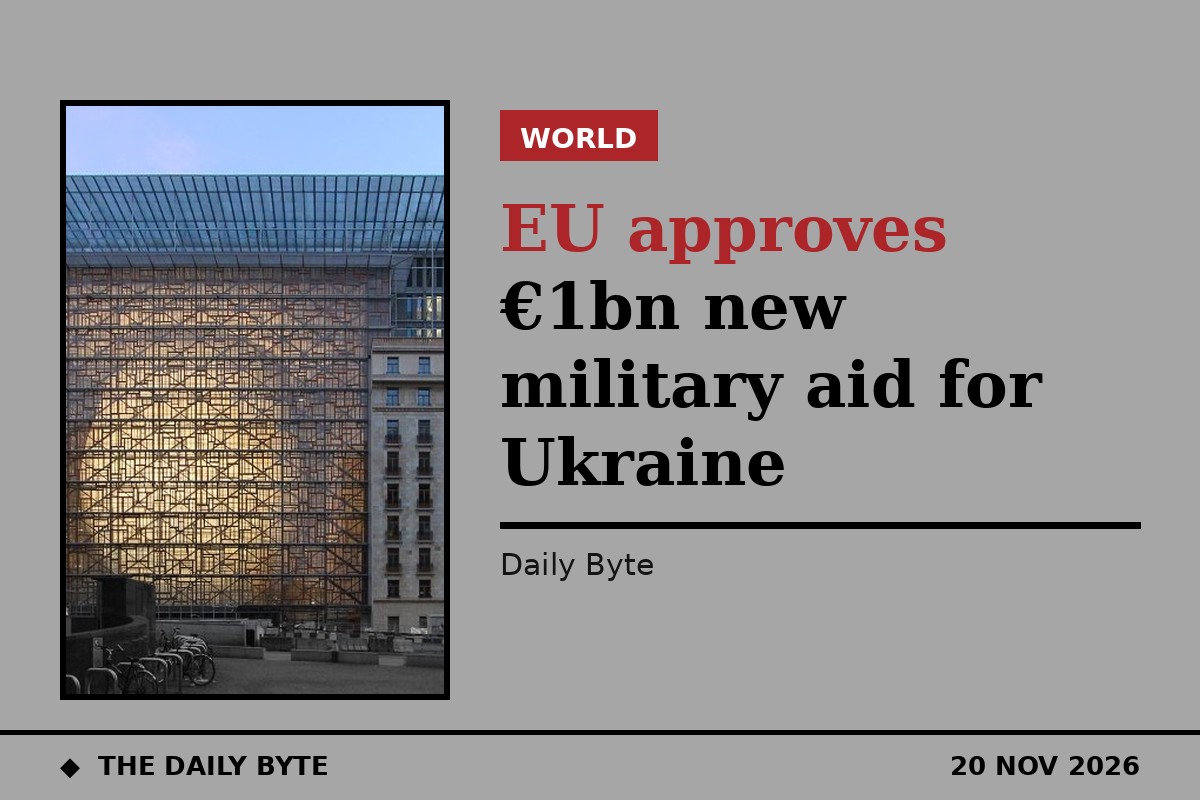
The Council of the European Union has approved a further €1 billion in military aid for Ukraine, to be spent on jointly procured weapons and equipment for the country’s armed forces.
The Council said on Friday 20 November that it had adopted two decisions under the European Peace Facility, the EU’s off-budget military assistance fund, covering the joint procurement of lethal and non-lethal equipment. The package covers drones, air defence equipment, ammunition, electronic warfare equipment, radar systems and explosives, to be provided by the end of 2027.
The announcement came hours after a large Russian missile and drone attack on Ukraine overnight, during which Polish airspace was also violated. The EU’s foreign policy chief, Kaja Kallas, pointed to that attack as she announced the decision, saying: “In 24 hours, Russia killed Ukrainian civilians, damaged several embassies in Kyiv, and violated Polish airspace. There are zero signs Russia wants peace, Moscow’s actions speak for themselves.”
What the €1 billion will buy
Unlike much of the EU’s earlier military support, which reimbursed member states for weapons they had already donated from national stocks, this tranche is for new equipment bought jointly. Joint procurement means EU governments pool their orders, which the Council says should deliver more equipment, faster, than separate national purchases.
The Council has not published a detailed shopping list beyond the categories named in its announcement, and it has not said which member states will take part in each purchase or which suppliers will be used. The European Peace Facility was established in March 2021 to finance security and defence assistance to partner countries, and it sits outside the EU’s regular budget, funded by member states largely according to their gross national income.
Kallas said the money would fund “drones, air defence, ammunition and other capabilities Ukraine urgently needs”, adding: “Ukraine can count on Europe to strengthen its hand on the battlefield and at the negotiating table.”
Part of a wider €6.6 billion package
The decision is the latest step in carrying out a political agreement EU governments reached on 25 September 2026 to mobilise a total of €6.6 billion for Ukraine through the facility. On 26 October, the Council adopted eight decisions mobilising about €4.9 billion of that total: €4.7 billion to partly reimburse member states for military aid already delivered, and €230 million for the EU’s military training mission for Ukrainian soldiers, EUMAM Ukraine.
The €1 billion for new joint procurement was the remaining planned part of that package, and it had not been authorised by the October decisions. With Friday’s decisions, the Council puts the EU’s total support for Ukraine through the facility at €11.8 billion since 2021, including €9.9 billion for reimbursing member states’ bilateral military aid and €950 million for military training.
The Council also said it has channelled €3.5 billion in extraordinary revenues generated by immobilised Russian sovereign assets — so-called windfall profits — through the facility to meet Ukrainian priorities such as ammunition, air defence and drones. More than €1.5 billion of that procurement has gone directly to Ukraine’s own defence industry.
Why the timing matters
The new money arrives as Ukraine heads into winter with its energy infrastructure under repeated attack, and as the EU tries to convert financial commitments into equipment that can be delivered quickly. The facility is only one of the EU’s funding routes: EU leaders have also backed a separate €90 billion Ukraine support loan covering 2026 and 2027, which funds wider budget and defence needs.
For Kyiv, the test now is speed. The Council has set the end of 2027 as the deadline for providing the equipment, but it has not published a delivery timetable for individual items. In its statement, the Council reiterated the EU’s commitment to Ukraine’s independence, sovereignty and territorial integrity within its internationally recognised borders.


