EU lifts growth outlook but inflation stays above 3% into 2027
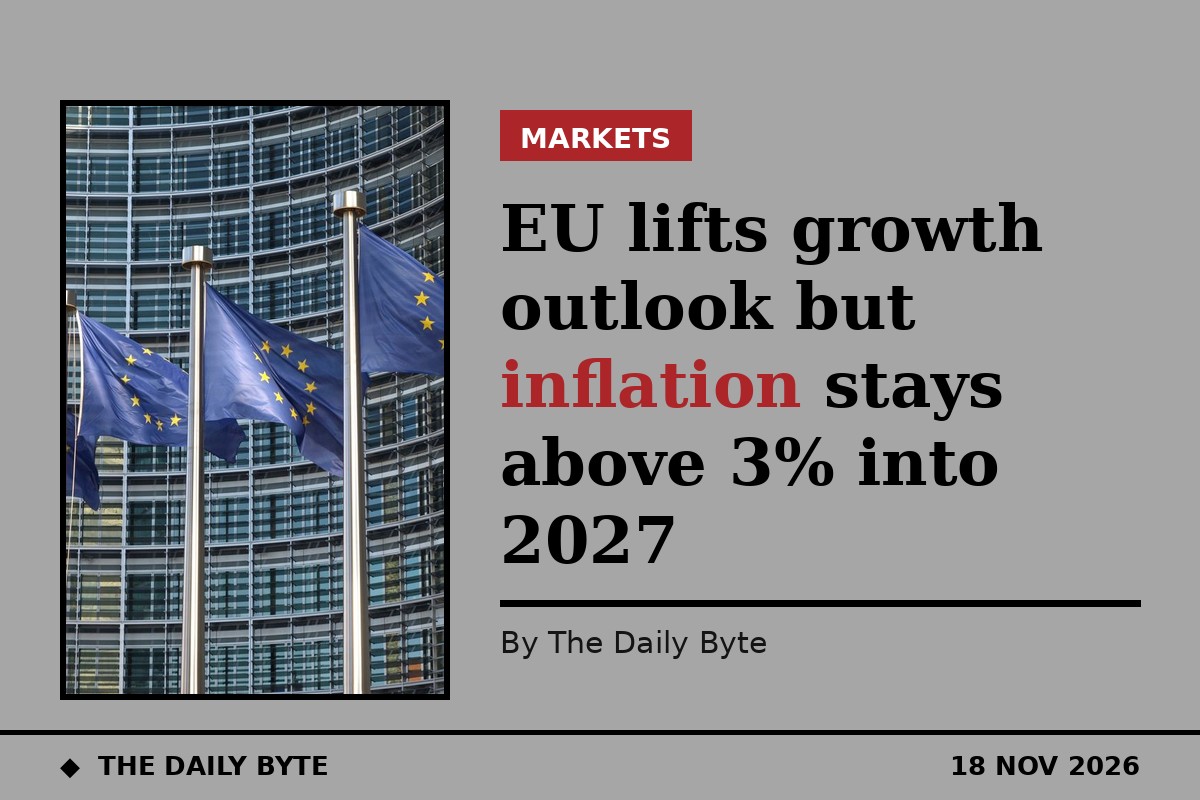
The European Commission has raised its growth outlook for the European Union while warning that inflation will stay above 3% through 2027, driven by an energy shock linked to the conflict in the Middle East. The Autumn 2026 Economic Forecast, published on Tuesday 17 November, expects the EU economy to grow by 1.4% in both 2026 and 2027, rising to 1.5% in 2028.
The euro area is expected to follow a similar path, with real GDP growth of 1.2% in both 2026 and 2027 and 1.3% in 2028. The Commission said growth in the first three quarters of 2026 reached 1.3% across the EU, beating its spring expectations, driven by steady consumption and a sharp rebound in goods exports, while investment came in slightly below expectations.
Inflation to stay high until 2028
Inflation in the euro area reached 4% in October, its highest level in three years, and the Commission expects it to peak above 4% between late 2026 and early 2027 before gradually easing. Annual inflation in the euro area is forecast to average 3.2% in 2026 and 3.1% in 2027, easing to 2.1% only in 2028. Across the wider EU, inflation is forecast at 3.3% in 2026 and 3.2% in 2027, before falling to 2.3% in 2028.
That is markedly higher than the Commission projected in the spring, and it leaves inflation well above the European Central Bank's 2% target for another year. Economy Commissioner Valdis Dombrovskis told reporters that higher energy prices mean higher costs for households and businesses, Euronews reported.
Energy inflation is projected to moderate next year, but food inflation is set to accelerate, driven by higher energy and fertiliser costs and crop disruption caused by extreme summer weather. The forecast is based on technical assumptions on exchange rates, interest rates and commodity prices with a cut-off date of 29 October 2026, when Brent crude was priced at more than $100 a barrel.
Jobs growth slows but unemployment stays low
Employment growth is projected to slow, although the Commission still expects 800,000 additional jobs in the EU in 2026. The unemployment rate is set to remain close to 6%, its record low, while the labour force expands only marginally. Wages are projected to grow slightly more than previously expected and to slightly outpace inflation, implying moderate positive real wage growth.
The Commission said faster progress on reforms to address bottlenecks in competitiveness and growth could support stronger activity than currently projected, while developments in energy markets could lower the inflation outlook. Progress in the energy transition to reduce Europe's dependence on imported fossil fuels would further boost economic resilience, it added.
The full assessment of member states' budgets under the autumn package of the European Semester will be presented next week.
Frequently asked questions
When will euro area inflation return to 2%? The Commission expects euro area inflation to average 3.1% in 2027 and to ease to 2.1% only in 2028, so a return close to the European Central Bank's 2% target is not forecast until 2028.
What is driving the higher inflation forecast? Energy prices are the main driver, with energy inflation at 20.8% in October, linked to the conflict in the Middle East. Food inflation is also set to accelerate on higher energy and fertiliser costs and crop disruption from extreme summer weather.
How fast is the EU economy expected to grow? The Commission forecasts EU real GDP growth of 1.4% in 2026 and 2027, rising to 1.5% in 2028, with the euro area growing 1.2% in 2026 and 2027 and 1.3% in 2028.
Sources: European Commission; Business News / Euronews.